

Anduril is not just a flashy name for a drone army; in 2026, Anduril and US policy collide in a way that makes foreign policy feel like a budget video game. Palmer Luckey frames the mission so that Anduril mirrors US policy, not inventing its own path, even if that means navigating tricky questions about North Korea only when Washington asks for it. The billionaire founder says he won’t pivot to independence just to chase a quick sale, because apparently the real boss is the policy brief. That stance has stirred debate among policy analysts and industry observers alike.
Anduril and US policy: a 2026 backstage pass
Luckey’s stance is straightforward in principle: an arms company should act as an extension of national strategy. That alignment, however, blurs the line between civilian tech and military program in ways that prompt questions about accountability and independence. Critics worry that private firms could steer policy if they control key parts of the supply chain, while supporters argue the approach strengthens alliance deterrence. In this view, Anduril exists to operationalize policy, not to rewrite it, with US policy as a guiding framework rather than a blank check.
US policy and Anduril’s Asia expansion in 2026
The company has quietly expanded its footprint in Asia, courting governments and defense ministries in Japan, South Korea, and Taiwan in line with US policy goals. This expansion has drawn Beijing’s sanctions against Anduril and Luckey personally, underscoring how tech diplomacy can escalate quickly. In policy terms, the expansion is presented as strengthening alliances and deterrence, but critics worry about private tech firms shaping the supply chain and the pace of military modernization. Anduril’s approach—where products become extensions of a foreign policy posture—places the firm at the heart of debates about alliance politics in Asia, the rise of Chinese military hardware, and the broader question of tech billionaires steering matters of war and peace.
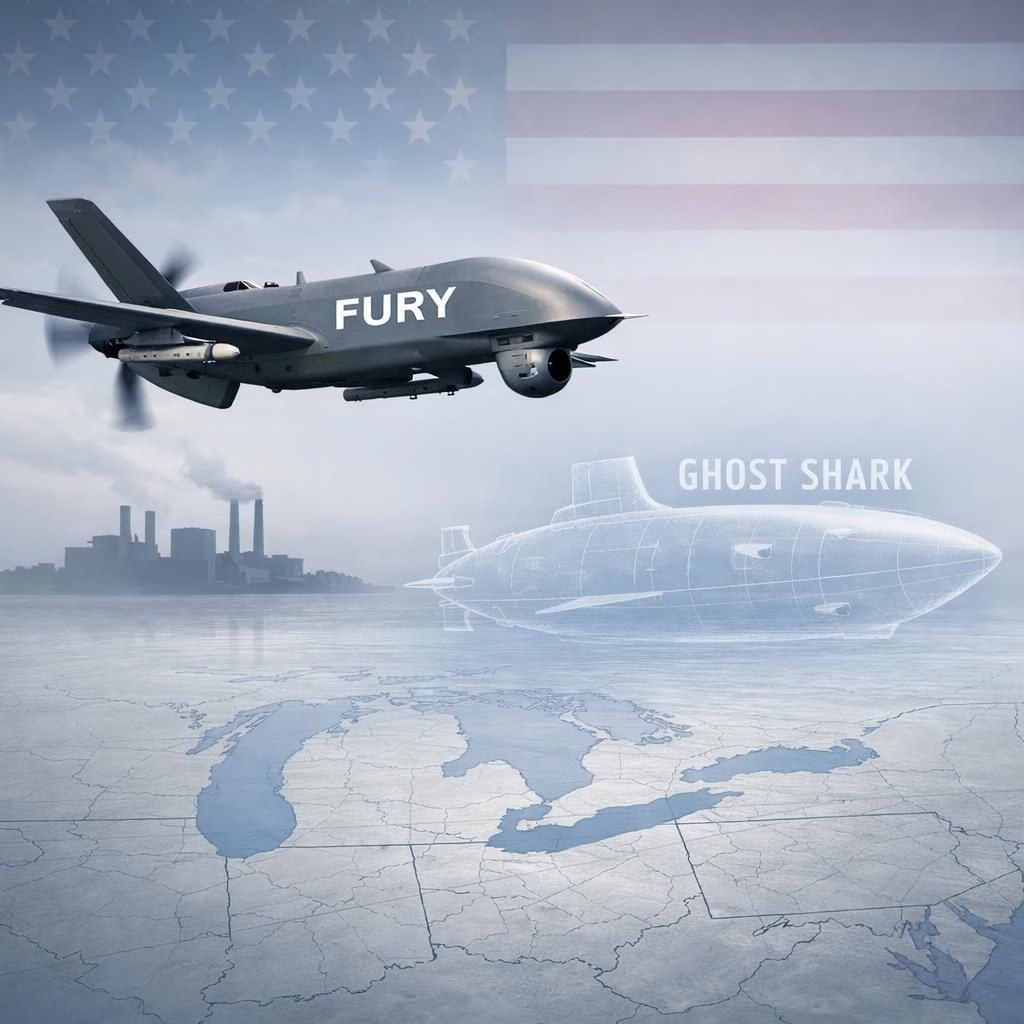
Among its product lineup, Fury is designed to fly alongside fighter jets, while Ghost Shark—the submarine project—has already earned a high-profile contract with Australia for about $1.1 billion. The company is riding a global defense spending boom, with revenues projected at $4.3 billion this year and a potential valuation around $60 billion as new rounds of funding flow in. The tech-forward ethos behind these weapons is unmistakable: software-driven, modular, and meant to scale to mass production as swiftly as a startup pitch can travel from slide to sale.
To scale production, Luckey unveiled plans for a 5-million-square-foot Arsenal-1 factory in Ohio, targeted for mass production of drones and weapons by 2026. The factory symbolically anchors Anduril’s promise to deliver rapid, repeatable military-grade hardware. Critics worry about the consequences of mass-producing advanced systems in a private sector that answers to investors and not to the broad public. Proponents argue that mass manufacturing can reduce costs, shorten timelines, and keep allies better equipped in a volatile security environment.
US policy and the Silicon Valley defense shift
Luckey’s remarks reflect a broader shift in Silicon Valley, where defense work has become a more common—and sometimes controversial—line of business. He has publicly criticized rivals who resist Pentagon engagement, arguing that the industry’s shift is a return to practical manufacturing sensibilities. The defense conversation, in his view, should focus on capability and accountability, not on corporate virtue signaling. Still, the rhetoric lands in a culture where private firms are increasingly seen as de facto strategic partners, not mere suppliers. His stance pleases some investors and unsettles others who worry about private influence in public security matters.
In a broader sense, Luckey’s comments illuminate a tension in tech capital: the push to innovate quickly meets the duty to consider the consequences of those innovations in war and peace. He argues that the United States should maintain a leadership position in defense manufacturing and that relying on a narrow set of suppliers risks falling behind. He contrasts China’s mass-producible, repair-friendly models with an American preference for exquisite, complex systems that are harder to scale. Arsenal-1 is pitched as a bridge—designed to combine advanced design with scalable production, strengthening a defense industrial base that can respond to threats with speed and reliability.
As the story broadens, Luckey’s engagement with fellow tech leaders highlights the governance angle. He criticizes rivals like Anthropic for resisting Pentagon access to AI, arguing that a constitutional republic remains capable of governing without outsourcing core powers to a handful of billionaires or corporations. That sentiment sits at the center of a wider debate about accountability, public-interest stewardship, and the proper role of private tech in national security. The defense tech boom, in this view, tests how much influence private firms should wield when weapons and AI intersect with policy.
For readers tracing the original reporting, Fortune’s coverage provided a foundation for these reflections. Original reporting and quotes are credited to Fortune: Fortune.
Practical implications for buyers, partners, and policymakers
- Scale vs. sustainability. Arsenal-1 aims to reduce unit costs through high-volume production, but long-term sustainment and supply chain resilience remain critical concerns.
- Export controls and governance. Private defense firms must navigate export rules, geopolitical risk, and accountability to voters and taxpayers.
- Alliance deterrence. When private technology underpins national policy, allies benefit from faster deployment, yet the public may demand clearer oversight.
FAQ
-
What is the core claim about Anduril and US policy?
The company positions itself as an extension of national strategy, aligning product development with US policy rather than pursuing independent goals. -
Why is Asia expansion controversial?
Expanding ties with Japan, South Korea, and Taiwan raises questions about private firms shaping regional deterrence and the pace of modernization, and it invites sanctions pressure from China. -
What about mass production?
Proponents argue it lowers costs and speeds readiness; critics warn about risks of private control over critical military technology. -
What role does governance play in these decisions?
Luckey frames governance as essential, urging accountability and a constitutional framework to guard against outsized private influence over national security. -
Where can I read the original reporting?
Fortune’s reporting is cited in the article’s references; links to Fortune provide the source material for Luckey’s quotes and the storyline.
Conclusion
Anduril’s trajectory in 2026 reflects a broader shift in defense technology: faster development cycles, modular designs, and a governance debate about who steers the lever of national security. By aligning with US policy while planning ambitious mass production, the company tests how private capital and public responsibilities can co-exist in a high-stakes field. The outcome depends on how policymakers, partners, and the public balance innovation with accountability.