

Anduril, the defense-tech startup founded by Palmer Luckey in 2017, has emerged as a headline grabber as talks circle a funding round that could value the company at about $60 billion. The firm designs autonomous systems like the Fury drone and the Ghose Shark submarine, riding a global surge in defense spending alongside a Silicon Valley pivot toward military partnerships. Luckey has described Anduril as an extension of US foreign policy, even suggesting he would sell weapons to North Korea if Washington asked, arguing that corporate chiefs should not set foreign policy. In short, this is defense-tech with policy teeth and swagger on a large scale.
Anduril defense-tech expansion in the Asia-Pacific arena
Across Asia-Pacific, Anduril has inked major deals with Australia, Japan, South Korea, and Taiwan as it expands its footprint. Anduril has already seen Australia spend roughly $1.1 billion on the Ghost Shark submarine program, and Taiwan’s procurement adds to Beijing’s regional pressure. China has sanctioned Anduril and Luckey as part of a broader pushback, underscoring how tech-enabled security partnerships are becoming a flash point. Luckey frames this expansion as a race to scale industrial capability, not a vanity project.
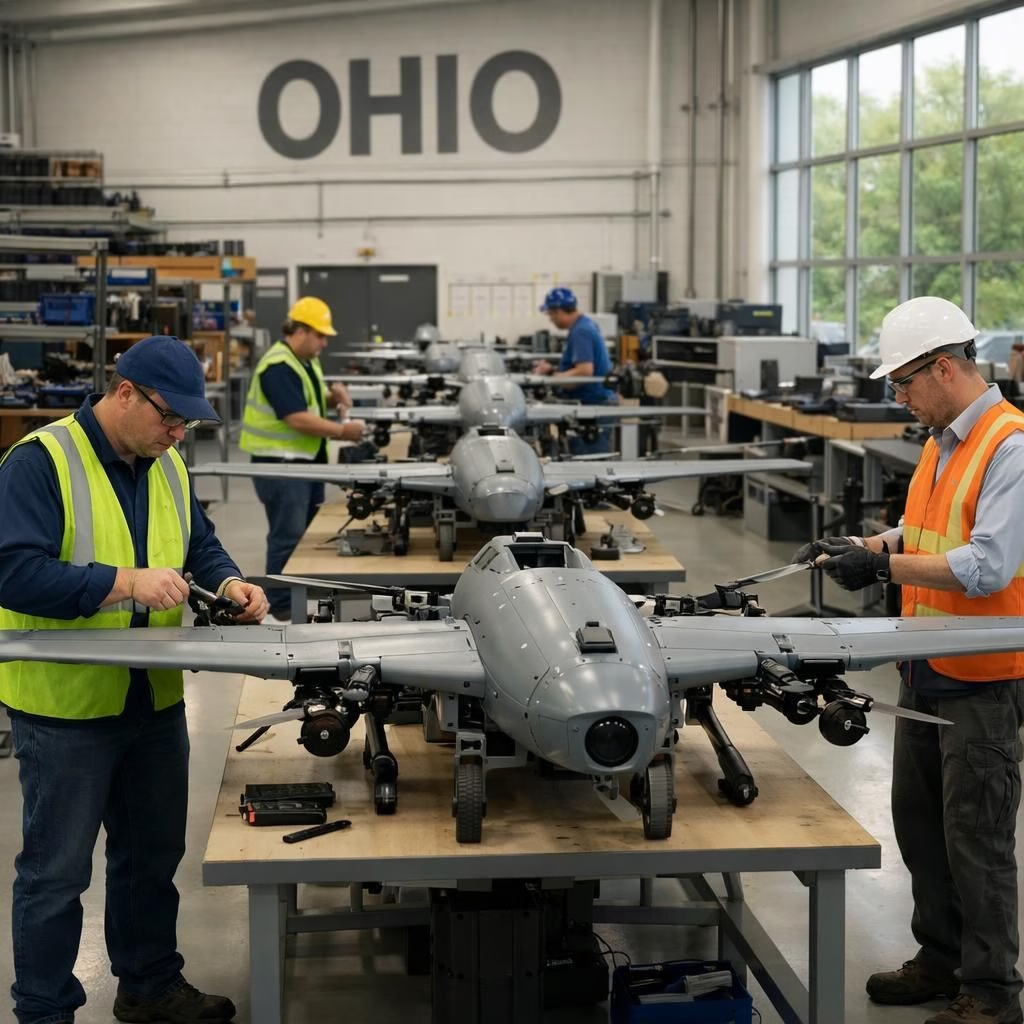
Anduril defense-tech Arsenal-1 fuels production in Ohio
The company is building a 5-million-square-foot Arsenal-1 factory in Ohio that aims to mass-produce drones and weapons systems by mid-2026. Luckey compares the operation to World War II-era U.S. manufacturing, focusing on speed and repairability over complexity. The plan emphasizes quick iteration, modular subsystems, and fast repairs to keep machines on the line rather than in the shop. The defense-tech stack, while touted as disruptive, faces skepticism from some critics.
The bigger picture: defense spending, and a provocative persona
Global defense spending reached about $2.7 trillion in 2024, and SIPRI highlights the scale of the shift toward faster, software-enabled procurement. Anduril projects around $4.3 billion in revenue this year and remains unprofitable for now, as it reinvests in scale and supply chains. Luckey’s public persona — including provocative remarks about manufacturing efficiency and stealth jets — adds spice to the debate about tech entrepreneurs in national security. The broader picture shows scale and policy influence marching alongside clever software and hardware design.
Some observers worry the push may blur lines between private tech and military doctrine. Supporters argue that rapid iteration and scalable production are essential as threats evolve. The story sits at the intersection of private risk-taking and public responsibility.
Why this matters in 2026
For readers who enjoy the nuance, Anduril’s strategy mirrors a broader shift in Silicon Valley toward dual-use tech, balancing profitability with policy impact. The Lattice OS, Ghost Shark submarine, and Fury drone form a modern toolkit in which software, sensors, and logistics work together faster than before. This defense-tech toolkit raises questions about governance, escalation, and risk as governments rely on private infrastructure. Fortune coverage and budget trends suggest the story will continue to unfold as investors weigh returns against public safety.
Fortune: Fortune tracks Luckey’s stance and the strategic implications for Anduril’s growth.
FAQ
-
What is driving Anduril’s high valuation?
The convergence of rising defense budgets, demand for autonomous systems, and policy alignment around security partnerships has pushed investor interest in Anduril. The company also benefits from ambitious production plans and a scalable supply chain.
-
What is Arsenal-1 and why does it matter?
Arsenal-1 is Anduril’s proposed 5‑million‑square‑foot factory in Ohio intended to accelerate mass production of drones and weapons. It signals a push to shorten lead times and reduce costs through modular design and rapid iteration.
-
Has Anduril faced reliability concerns?
Yes. Ukrainian operators reportedly stopped using Anduril drones in 2024 due to reliability issues, and some US testers have questioned aspects of the Lattice OS. The firm argues that its highly iterative development model yields faster updates and fixes.
-
What role does Luckey’s stance play in policy debates?
Luckey’s public comments spotlight the tension between private tech leadership and foreign policy. Critics worry about ambition outpacing safeguards, while supporters say scalable, modular technologies are essential to modern defense.
References
References for further reading: Fortune, SIPRI, DoD.