

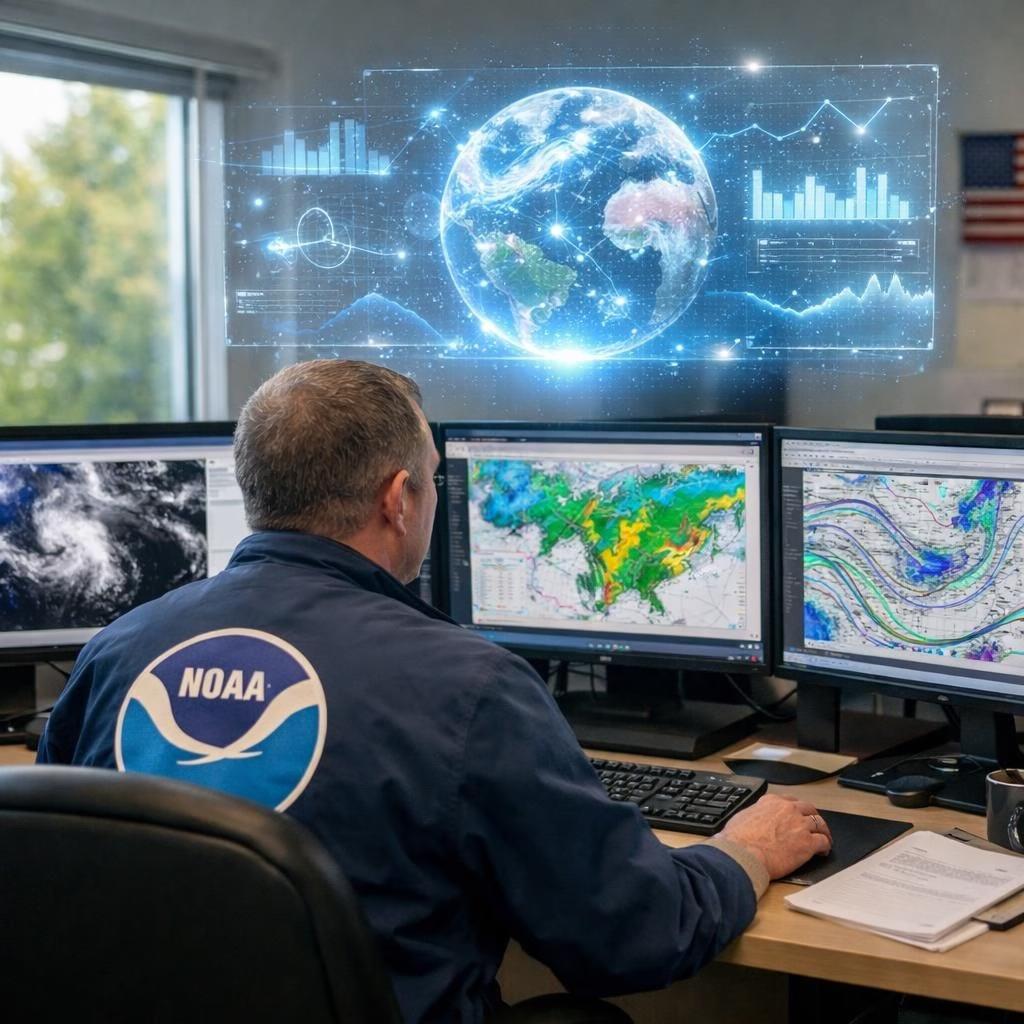
In 2026, as the Atlantic season approaches, the National Hurricane Center charts a new course in AIWeather and Forecasting—combining data crunch with seasoned judgment. The goal is to bring smarter tools into the toolbox while keeping what forecasters do best front and center.
AIWeather: A Pragmatic Reboot of Tropical Forecasting
The 2025 season marked a turning point for AIWeather. Forecasters and partners ran careful experiments, verifying and testing before any AI weather prediction (AIWP) tool could influence operational decisions. As experience grew, NHC began weaving AIWeather into the forecast process, alongside long-standing models, satellite analysis, and the seasoned insights of veteran forecasters.
AI products evaluated ranged from Google’s DeepMind to a system built by the European Centre for Medium-Range Weather Forecasts (ECMWF). The emphasis was on steady integration, not a drastic takeover. The goal was to let machines handle rapid synthesis while humans interpret results and communicate risk in plain language. This is the kind of collaboration that helps communities prepare without losing sight of the human story behind the numbers.
Melissa, the cyclone from 2025, provided a telling example. Melissa strengthened into a blistering Category 5, with sustained winds near 185 mph and a minimum central pressure around 892 millibars. It made landfall in Jamaica, becoming one of the island’s worst storms on record. Yet AIWP tools flagged plausible tracks and intensity earlier than some traditional guidance. Forecasters cautioned against overreading any single event’s outcome and kept a broad view of the season’s overall risk.
As Wallace Hogsett, a science operations officer at NOAA, put it, no AI system will replace forecasters. “None of the models are perfect, and they never will be,” he said. “We need trusted experts in the loop to observe, synthesize, and make sense of the vast amounts of information.” AI can accelerate synthesis and highlight concerns, but it cannot substitute the human ability to communicate a clear, risk-based message.
Looking ahead, the 2026 season is on the calendar from June 1 to November 30. Names for this year include Arthur, Bertha, Cristobal, and Dolly. In the Atlantic, the first named storm tends to form around June 20, with the first hurricane typically around August 11. Those timelines help planners, but AIWeather and other Forecasting tools will continue to refine timing and intensity estimates as the season unfolds.
Forecasting Gets a Fresh Spin: Humans Still in the Loop
AI models are trained on decades of global weather observations. When used operationally, they learn from historical events to generate possible futures. This is not a crystal ball; it is a fast screen for Forecasting possibilities. Forecasters still rely on core tools: long-established forecast models, satellite analysis, and the experience of weather veterans who know how local quirks matter most.
The goal is practical usefulness. AIWeather and Forecasting can speed up data gathering, reduce noise, and help teams compare scenarios quickly. But the final call rests with forecasters who understand local weather patterns, confidence levels, and the likely impacts on people and infrastructure. The idea is to blend the best of both worlds: sharper insight with a steady human touch.
Community resilience benefits from clearer risk communication and more efficient briefings. Emergency managers and planners gain from faster access to credible, action-ready information. The dream is not robotic certainty but trustworthy guidance that respects uncertainty and communicates it calmly. That is how AIWeather and Forecasting become genuinely helpful to the public.
As the hurricane year advances, ongoing evaluations and careful rollouts will continue. AI tools will be tested against real events, and upgrades will be tuned to maximize safety and minimize confusion. The emphasis remains on keeping humans at the center of decision-making, while technology acts as a reliable assistant rather than a replacement.
Looking toward the year ahead, AIWeather and Forecasting will evolve in tandem with the people who interpret the data, and the results will reflect not only numbers but the lived experiences of communities facing storms. Please share your thoughts in the comments.
Original article: Thank you to NOAA for the source material.
Practical steps for AIWeather in communities
- Establish rigorous verification and testing before AIWP is used for operational decisions.
- Maintain a human-in-the-loop workflow so forecasters review AI outputs within a transparent process.
- Develop plain-language risk messages early in the season to avoid confusion during storms.
- Run regular drills that simulate AI-generated scenarios alongside traditional guidance.
How Forecasting teams can use AI responsibly
- Define clear thresholds for alerts and communication that align with risk to life and property.
- Document confidence levels and provide transparent caveats with every forecast update.
- Coordinate with partner agencies to ensure consistent messaging across platforms.
- Continually review tool performance across multiple seasons to improve reliability.
FAQ
Q: What is AIWeather? A: AIWeather refers to AI-assisted tools that augment traditional weather forecasting by rapidly synthesizing data from many sources while keeping human interpretation front and center.
Q: Will AI Weather replace forecasters? A: No. Forecasters remain essential for interpreting local context, communicating risk clearly, and guiding decisions with lived experience.
Q: How should communities prepare this season? A: Embrace AIWeather as a decision-support tool, ensure training and drills with partners, and maintain public risk messaging that emphasizes uncertainty and resilience.