

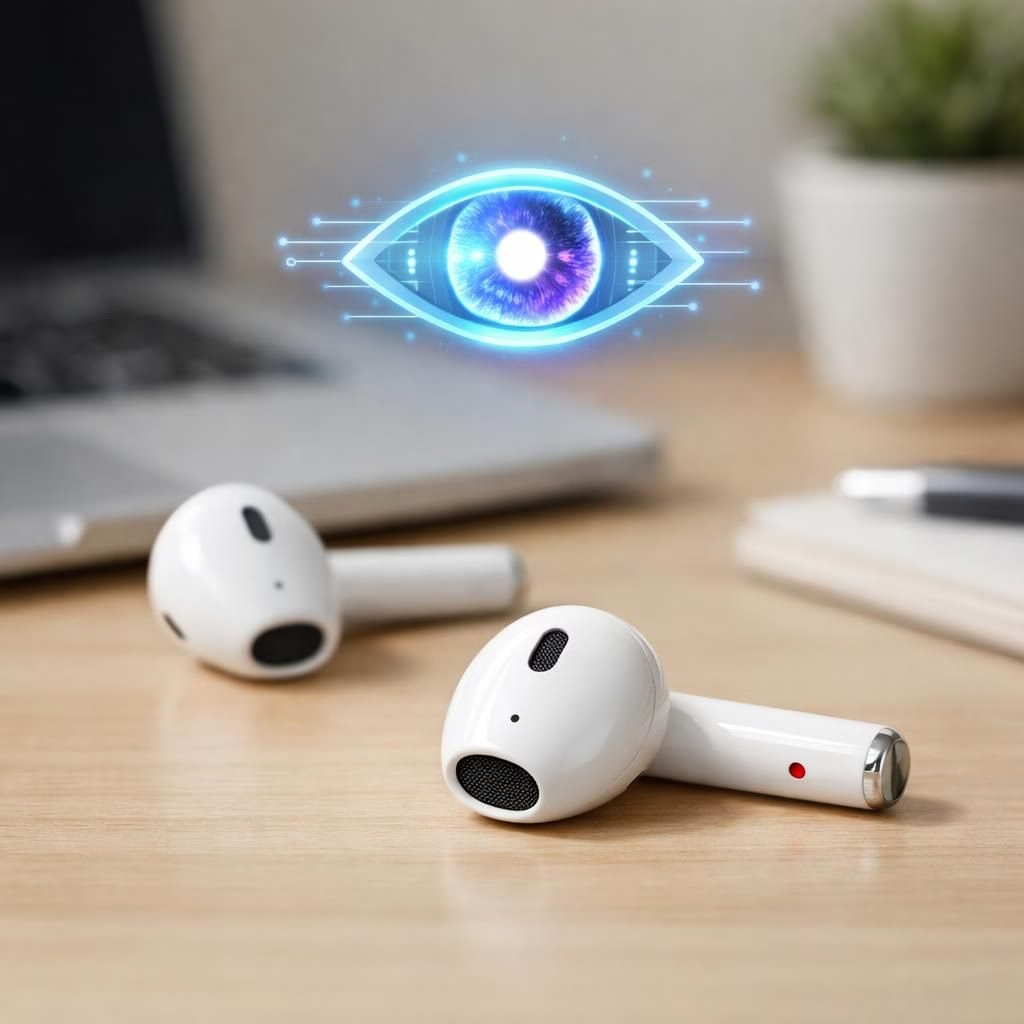
AirPods are getting a glow-up, and Apple insists the cameras are ‘eyes’ for AI, not paparazzi. In 2026, the tech world watches as Apple threads cameras into AirPods for spatial computing, turning listening devices into listening-and-seeing companions. The idea is simple on the surface: tiny cameras help AI understand where you are, what you’re looking at, and when you might want to adjust your environment. But the implications run deeper than a snappy press release, touching on privacy, convenience, and a future where your ear buds know you as well as your playlist does. This is not sci-fi; it’s the slow bake of wearable AI, where AirPods become an extra sense.
AirPods and Apple Tech: A Look at AI Eyes
Apple analysts at Bloomberg’s Mark Gurman report that low-resolution cameras may be added to AirPods to aid AI rather than capture photos. The cameras would help spatial audio and the broader Vision Pro ecosystem by feeding contextual data to Siri and the Apple Intelligence stack. Apple wants the AirPods to act as an extension of the environment, not just a pair of wireless earbuds. The cameras are intentionally low-res to protect privacy and battery life, while still offering enough signal for AI to reason about your surroundings. In practice, you might not notice the tiny cameras until the AI starts to surprise you with helpful suggestions, such as pointing out a doorway you keep walking past or suggesting a turn when you miss an audio cue.
As the AirPods evolve, Apple pitches the move as part of a larger push into AI wearables. The plan includes smart glasses that could rival the Meta Ray-Bans in function, offering a contextual AI layer without a built-in display on the lens. Instead, the experience centers on voice and gesture control, with cameras feeding information to Siri, which in turn stages a quiet, non-interruptive assistant. The glasses would feature high-resolution cameras for video capture and a lower-resolution stream to provide visuals for on-the-fly decisions by the AI. The design aims to be practical, not a Hollywood prop; Apple wants something people will wear daily, not something they stash in a drawer after a week.
AirPods and Apple: The Wearable Tech Pin Privacy Puzzle
Another intriguing piece of the puzzle is an AI pin—think a wearable badge with an always-on camera and a built-in microphone connected to Siri. This pin could sit at the collar or lapel, offering a lightweight alternative to bulkier gear. Apple emphasizes that the devices are designed with privacy in mind, but the idea of a camera that watches your surroundings at all times raises questions about control, data retention, and who gets to see what the AI sees. The team hints at robust on-device processing to minimize cloud data transfer, with facial recognition or sensitive data kept on the device rather than streamed across networks. Still, the broader trend is clear: Apple is putting more perceptual intelligence into wearables, expanding beyond audio into perceptual AI that can interpret context in real time.
From a user experience perspective, the shift toward AI-enabled wearables looks practical. The goal is to enrich spatial computing without overwhelming the user with notifications. AirPods with AI eyes could help you locate a misplaced device, interpret ambient audio cues, or adjust audio profiles automatically as you move from quiet rooms to noisy streets. The wearable AI pin could serve as a discreet companion for quick captures or situational notes. The takeaway for AirPods fans and tech enthusiasts is that the company is quietly building an ecosystem where information flows more naturally between you, your devices, and the world around you. This is the sort of integration that makes tech feel less like a collection of gadgets and more like a living, responsive assistant in your everyday life.
Of course, the development raises questions about privacy, consent, and control. The idea that a camera sits on your Air Pods or on a pin, always mindful of your surroundings, implies a new social contract. Users must trust that Apple will protect sensitive data and that the AI will respect boundaries. Apple has historically walked this line carefully, pairing strong on-device processing with transparent user controls. In practice, that means you’ll likely get clear indicators when cameras are active and straightforward options to disable or limit data sharing when you need to. For many users, this balance will determine whether the wearable AI feels empowering or intrusive.
From a business perspective, the AirPods-as-eyes concept aligns with Apple’s broader strategy to weave AI across devices, strengthening the Vision Pro ecosystem and the iPhone family. It creates a network effect: more sensors on AirPods feed more context to AI services, which then deliver more useful insights through the iPhone, Apple Watch, and Vision Pro. The result is not a single gadget doing everything; it is an integrated set of wearables that share perceptual intelligence. For consumers, that translates into fewer manual tweaks and more smart automation in daily routines. For developers, it signals new opportunities to build apps that respond to real-world context in ways we have only imagined in science fiction a few years ago.
What to Expect Next: A Balanced View on 2026 and Beyond
Apple’s approach remains pragmatic. The cameras are low-res by design, reducing risk while maintaining usefulness for AI. The glasses and pin are intended to augment daily life, not to catalog every moment. In that sense, AirPods, Apple, and Tech join a common thread: wearables becoming more capable while staying respectful of user autonomy. If you love gadgets and you value privacy, you may welcome a future where your devices understand you better without invading your personal space. If you’re wary of cameras in every corner of your life, you’ll want strict controls and clear signals about when data is collected and how it’s used. Either way, the trend is clear: AI-powered wearables are moving from novelty to norm.
As we move through 2026, the conversation should remain grounded in user benefit, privacy safeguards, and practical designs. Apple’s mission here seems less about chasing buzz and more about enabling seamless interactions with the digital world. AirPods become not just a soundtrack to your day but a perceptual extension of your senses. Tech fans get a glimpse of the next phase in wearable computing, where AI sits on your person and helps you navigate the world with less friction and more insight.
Thank you to Claire Reid and Kate Bain for the original reporting that sparked these conversations. You can read the original article here: Original article.
Share your thoughts below: what do you think about AirPods with AI eyes, Apple’s foray into wearables, and the future of Tech-enabled context awareness? Do you trust a pin, a pair of glasses, or AirPods to help you while protecting privacy? We’d love to hear your take in the comments.
AirPods in Daily Life: Practical Scenarios
- Locate a misplaced AirPod or charging case with AI-assisted guidance.
- Interpret ambient sounds to optimize your audio profile automatically as you move between quiet rooms and busy streets.
- Receive contextual reminders or directions without interrupting your workflow or conversation.
- Capture quick notes or images with a discreet tap, when appropriate, and with privacy controls in place.
Apple Wearables: Glasses, Pins, and Privacy
In addition to AirPods, the plan includes glasses and a wearable pin that lean into context-aware AI. These devices would rely on a mix of high- and low-resolution cameras to balance usefulness with privacy. The focus remains on voice and gesture interfaces, with on-device processing to minimize data sent to the cloud. As with any wearable, you’ll want clear indicators when sensing is active and simple controls to limit or stop data collection.
FAQ: AirPods AI Eyes and Wearables
- Will the cameras always be on? The approach emphasizes low-power, low-resolution sensing with explicit user controls and visible indicators when sensing is active.
- How is privacy protected? Much of the processing is on-device, with sensitive data kept locally whenever possible and data-sharing options exposed in the settings.
- When could these features launch? Rumors suggest early-stage tests could surface inside next-year product lines, with broader availability potentially in 2027, depending on regulatory and user-feedback milestones.
- Do I need to buy new devices to use this? The ecosystem is designed to work across AirPods, glasses, and pins, but precise compatibility will depend on the final hardware and software requirements.
Conclusion: A Practical Path Toward Contextual AI
The direction toward AI-assisted wearables blends convenience with new privacy considerations. AirPods with AI eyes, a light wearable pin, and smart glasses could make daily life smoother by adding perceptual intelligence without flooding you with noise. If you value privacy safeguards and thoughtful design, this shift could feel empowering rather than intrusive. If you’re uncomfortable with cameras in everyday life, you’ll want strong controls and clear signals about data usage. Either way, the trend is clear: wearable AI is moving from novelty to practical, everyday assistance.
For readers curious about the ongoing evolution, stay tuned to updates on how Apple is weaving AI across its devices and refining the balance between insight and privacy.