

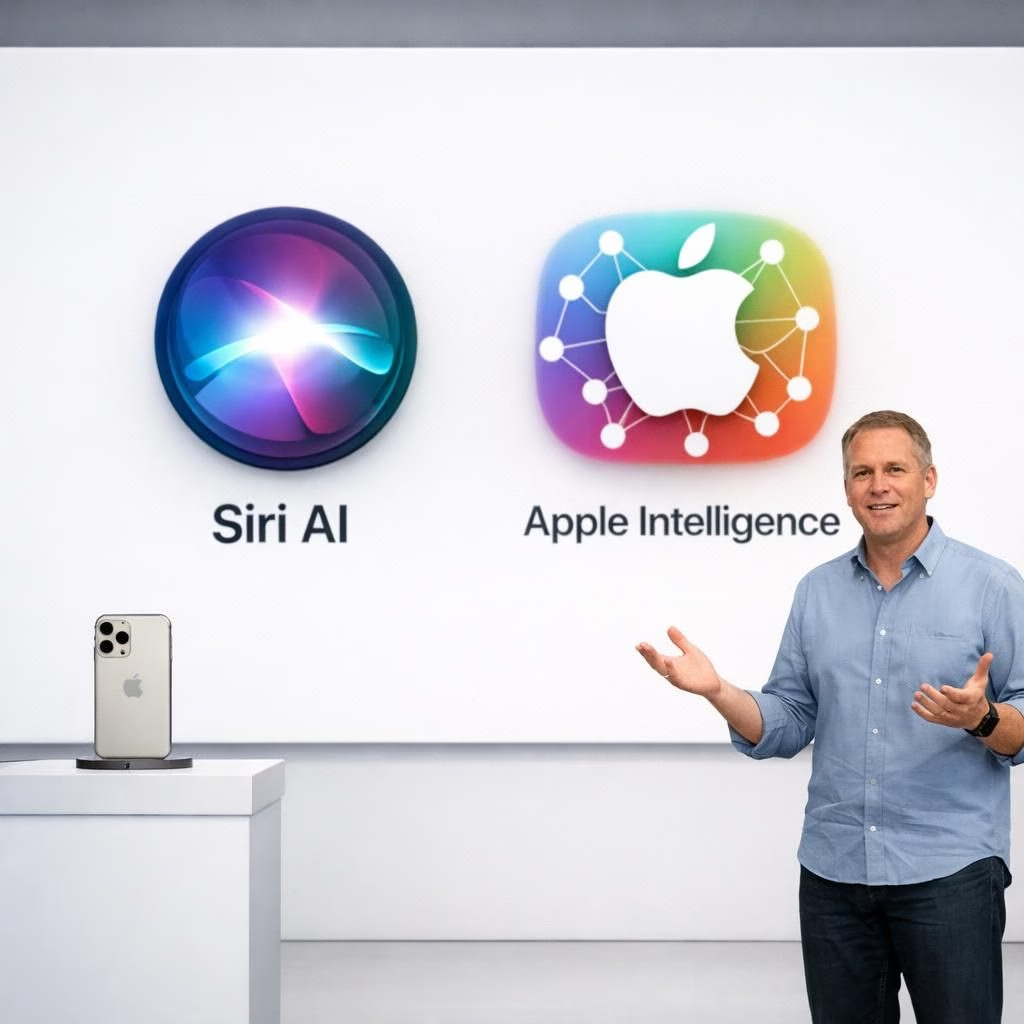
WWDC 2026 opened with a wink for Siri AI and a nod to Apple Intelligence. After years of hype cycles, Apple finally delivered a confident, useful version of its signature assistant. The engine is Gemini-based and co-built with Google, a partnership Apple quietly nudged into existence since early 2026.
On-device reasoning handles fast tasks, while the cloud supports heavier thinking. Some queries still travel to Google’s servers, a concession that sounds practical rather than glamorous.
The rest of the show was bright and broad: OS updates across the slate, AI features tucked into Safari, Photos, and the Camera app, plus a serious overhaul of parental controls and speed gains that bring the iPhone 11 back into the conversation.
Tim Cook closed the keynote; John Ternus will take over on September 1. No hardware was announced, which means the real show is what happens inside our phones and on our desks this fall.
Siri AI: Gentle comeback
The Gemini-based core handles everyday reasoning, while a private cloud layer helps with more demanding tasks. Apple emphasizes privacy: queries are scrubbed of personal identifiers before they reach the inference layer, and data is not retained after a request.
Some operations travel to cloud servers, but the company argues it’s essential for speed and capability. The company also underlined governance and auditability, inviting independent review while keeping user data out of reach.
Apple Intelligence powers privacy-first creativity
In photos and visuals, the feature set leans into practical creativity. Visual Intelligence can recognize scenes and offer practical suggestions, while new tools in Photos improve cleanup, extend image boundaries, and generate photorealistic iterations with a watermark to distinguish synthetic work.
Not every test hits the mark, but the public beta will reveal how well it lands in real life. The Narration and "Describe an Extension" features in Safari push the browser toward precise user requests—no more juggling code for a basic task.
Safari’s AI touch is deliberate and useful: tabs cluster by topic, a Notify Me option surfaces changes, and the Passwords tool cross-references compromised credentials for quick updates. Shortcuts becomes friendlier; describe a desired automation, and the system will sketch it, connecting maps, messages, and app actions with fewer clicks than before.
In photography, Spatial Reframe shifts perspective without losing your subjects, while the revamped Clean Up and Extend tools let you push images beyond their original frame. SynthID watermarks mark every result, rendering bold claims about originality more credible in a world of AI-generated outputs.
Meanwhile, the rest of the OS stack leans into efficiency. The iPhone 11 remains supported with a swifter scheduler, while newer devices benefit from faster app launches, quicker photo rendering, and more efficient background tasks. macOS gains a Spotlight-integrated Siri, a more uniform interface, and a refreshed design language that acknowledges the chasm between Intel-era machines and modern silicon.
Shortcuts, timers, and automations finally feel accessible to a broader audience, powered by Siri AI. The OS is moving toward adaptive layouts and smarter defaults, laying groundwork for a potential foldable form factor inspired by real-world usage rather than speculation.
Parental controls mature into a more nuanced, family-friendly set of tools, with safer browsing defaults and clearer controls for time use and content categories.
The timing, of course, fits the moment. The Kids Online Safety Act is moving through US Congress, and the UK and Australia are pushing age verification harder. Apple’s pitch is that this can be done inside the OS, without making kids upload ID to a third-party verifier.
That approach, in Apple’s view, is a better answer than most.
Cook closed the keynote solo, with a line about the best being still ahead and "so many more still to come." He’s right to plant the flag there. iOS 27's beta code hints at app resizability and adaptive layouts, plumbing that could support a foldable iPhone, even if Apple didn’t confirm a device.
There was no hardware at WWDC this year. The plan is to push software in 2026 while saving the big unveil for a later stage. Tim Cook’s last keynote as CEO lands with a promise that the best is yet to come; John Ternus will preside over a leadership transition starting September 1.
Developer betas are out today. Public betas arrive next month. The new OS updates ship as free fall updates this year. Siri AI follows in beta later this year for English-speaking users on supported devices: iPhone 16 and later, iPhone 15 Pro and Pro Max, M1 Macs and newer, and Apple Watch Series 9 and newer paired with a compatible iPhone.
EU users miss Siri AI at launch, with Apple pointing at the Digital Markets Act. China is on hold for regulatory clearance. India, for once, sits on neither list. iPhone users here should get the new Siri when the beta lands, and the full feature set when iOS 27 ships this fall.
In short, it’s a software-focused moment with a friendlier face for AI, a clearer privacy stance, and a roadmap that treats devices as evolving partners rather than static gadgets. If you’re curious about how these pieces fit into your daily routine, start exploring the beta and weigh in with your experiences.
Original article: Original source article.
Share your thoughts in the comments below.
Siri AI remains central to these updates, guiding how apps and automations interact across devices.
External sources