

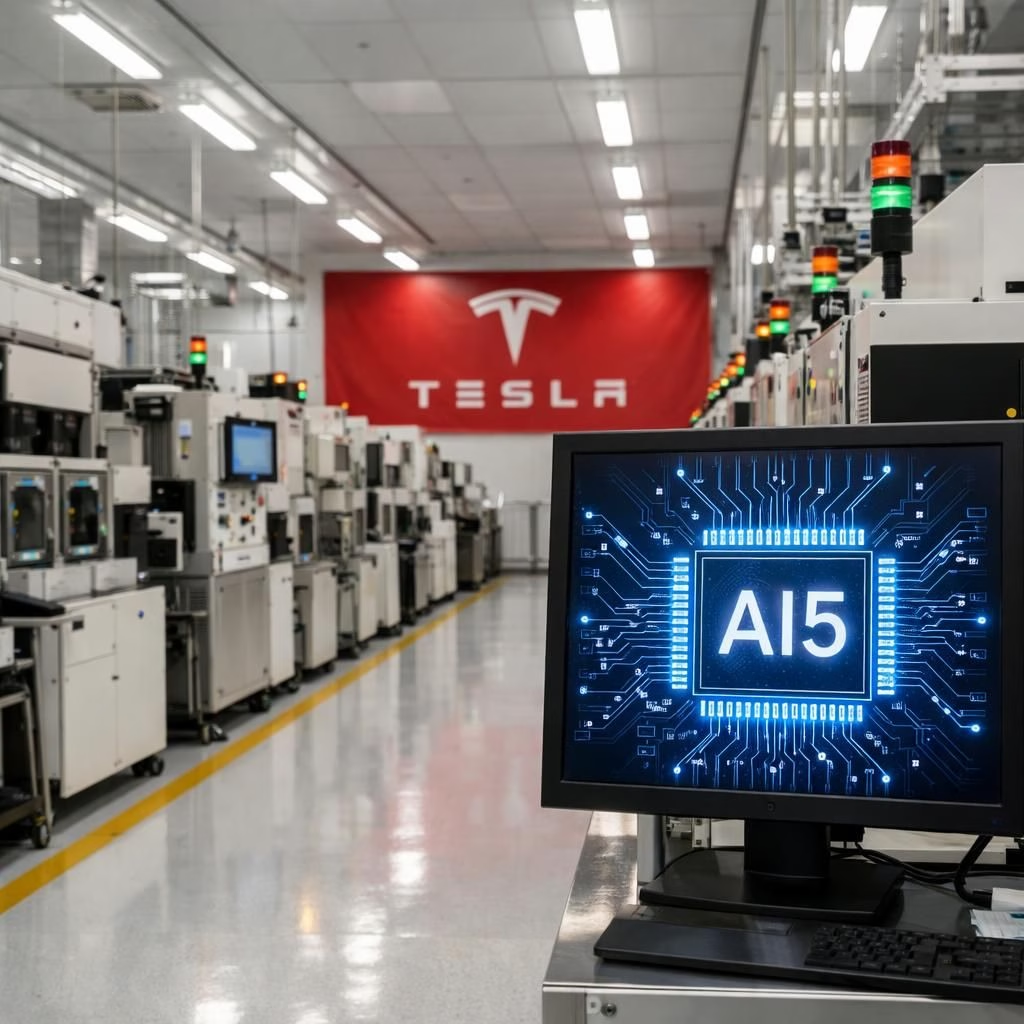
AIchips and Gigafab orbit around a bold plan as Tesla’s Terafab countdown ticks toward launch in seven days. The focus is the AI5 chip for autonomous driving and robotics. Tesla aims to produce AI chips at scale in-house and shrink reliance on external foundries.
AIchips strategy behind Terafab
The Terafab is a mega facility, a notch bigger than the usual. The Gigafab is designed to house the AI5 chip powering the next generation of Full Self-Driving software and robotics. Elon Musk has warned that even best-case supplier throughput will fall short of demand. By bringing design, tooling, and volume production under one roof, AIchips can become the heart of a self-sufficient compute stack.
Gigafab scale and AIchips strategy around AI5
Tesla has secured partnerships with two semiconductor giants to realize this vision. The Gigafab concept helps diversify risk and avoid overreliance on a single supplier. Tesla has named TSMC for advanced process nodes and high-volume production, Samsung for memory, and has floated Intel as a potential collaborator.
The AI5 chip remains focused on Autopilot, FSD updates, and robotics workloads, balancing compute with memory. This hardware-software co-design aims to align silicon design with software goals, reducing handoffs and speeding iteration cycles for AIchips and vehicle software.
The Gigafab approach is also about timing and cost, aiming to dampen supply crunches while preserving quality. With AI workloads growing, the Terafab seeks efficiency gains, price control, and better chip timing with vehicle programs. The broader market breathes easier when a large-scale, in-house fabrication plan supports predictable delivery and faster updates.
The global demand for AI chips has surged. Firms like Nvidia, Google, Microsoft, and Amazon seek capacity at the same foundries. Tesla argues that in-house production could dampen this crunch by enabling more predictable delivery, better quality control, and faster iteration cycles. The Terafab would sit alongside existing supplier lines, not replace them, with the aim to absorb peak demand and then scale back to keep the balance. The plan signals a shift toward hardware-software co-design where engineers shape chips for software goals, not the other way around.
The path to 2026 remains bold, and the team has shown it can mix humor with serious silicon manufacturing plans. The vision remains compelling: a future where a single factory helps Tesla drive its own silicon destiny, with AIchips powering the journey and Gigafab backing the scale.
What do you think about Terafab and the AI5 strategy? Share your thoughts in the comments below.
Practical takeaways
- In-house AI chips could shorten lead times and improve update cycles for autonomous driving software.
- Hardware-software co-design may align chip features with real-world vehicle needs.
- Rising demand for AI chips may influence partnerships and pricing in the broader tech sector.
Related coverage: YouTube launches dedicated app for Apple Vision Pro and YouTube’s native app for Apple Vision Pro.
FAQ
- What is Terafab? A large-scale, in-house chip fabrication initiative focused on AI chips for Tesla’s AI stack.
- Who are the partners? Tesla has cited TSMC and Samsung, with Intel as a potential collaborator.
- When is mass production expected? The public timeline mentions seven days for launch, with ramp planning continuing afterward.
External sources
- CNBC coverage of Tesla’s Terafab ambitions
- Bloomberg coverage of Tesla AI chips and hardware strategy
- The Verge: Tesla and AI chips