

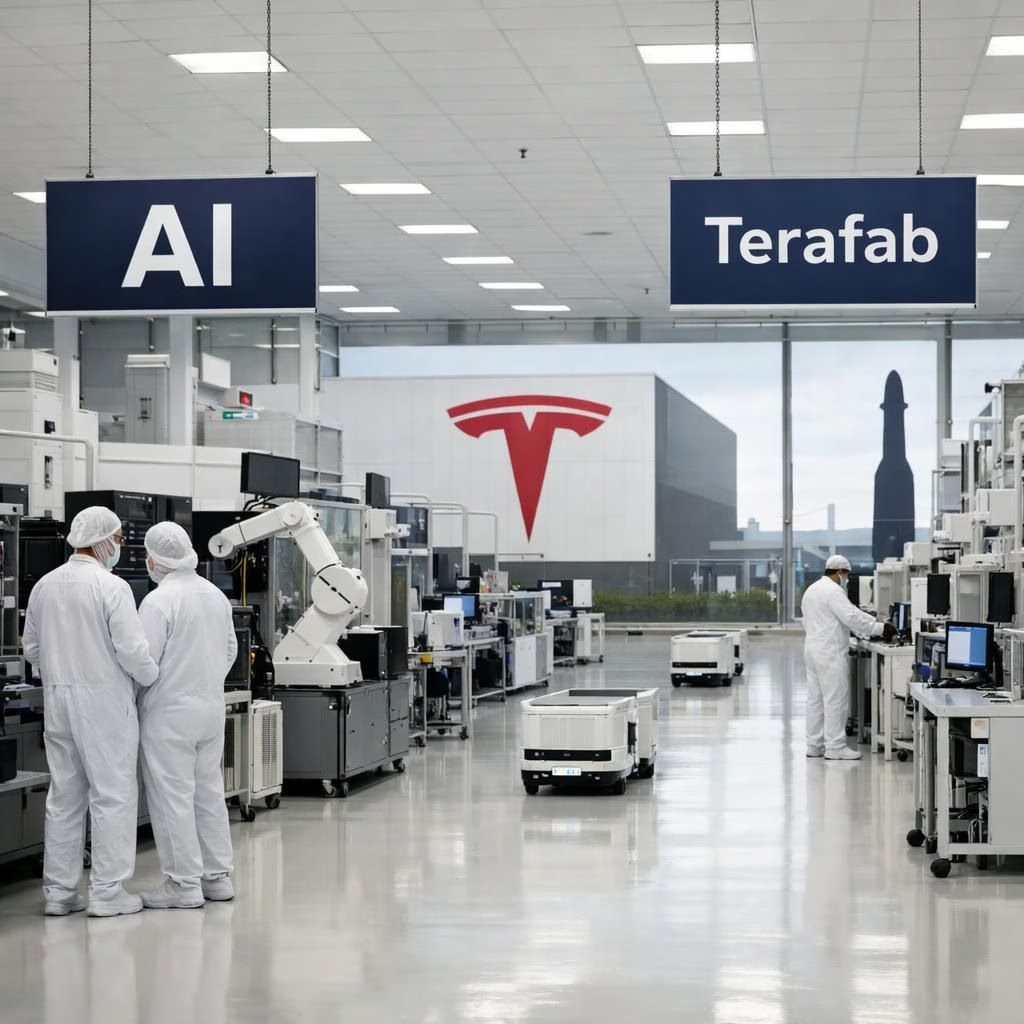
Today we unpack Elon Musk’s latest blueprint for chips and computing. It centers on an Terafab footprint near Tesla’s Texas HQ and gigafactory in Austin, with AI ambitions woven through Tesla, SpaceX, and xAI. The plan envisions in-house semiconductors to power AI, robotics, autonomy, and SpaceX’s orbital data centers. The Terafab concept promises equipment and processes flexible enough to handle diverse chip types. Executives say this is a practical step, not a dream on a whiteboard, though timelines remain vague.
AI-ready chips and Terafab scale in Texas
At the core, the plan targets 2-nanometer chips and ambitious scaling. The target capacity is 100 to 200 gigawatts per year on Earth and a terawatt in space. The two chip families address different jobs: edge and inference chips for robotaxi and Optimus-like robots, and high-power chips for orbital data centers run by SpaceX and xAI, enabling AI workloads. The Terafab would also handle on-site testing, reducing delays and supplier drama.
Orbital AI data centers and Terafab ambitions in space
Beyond Earth, Musk envisions orbital data centers delivering AI compute in orbit. A future “mini AI data center satellite” could deliver around 100 kilowatts of computing power, forming the first link in a network intended to scale to megawatt capacity. The plan envisions running SpaceX and xAI workloads in space, powered by Terafab-grade chips that meet speed and reliability needs. Some talk of launching satellites from the Moon’s surface as part of a broader abundance vision.
In January, Musk sought FCC permission for a million satellites, a move attracting skepticism but illustrating the scale of the ambition.
As a reminder of the capital intensity, Musk’s plan mentions TSMC, Micron, and a Samsung agreement for production near Austin, with billions of dollars in play. Some observers warn timelines may slip, while others call the ambition plausible given industry cycles. The Terafab concept aims to shorten the design-to-production loop by centralizing equipment and testing under one roof.
What the Terafab plan could mean for AI hardware
- Faster iteration cycles from design to silicon for AI workloads.
- Potential changes to supply chains through in-house capabilities.
- Impact on robotics and autonomous systems via edge/inference chips.
- Risks include high capital costs and regulatory hurdles.
FAQ about AI and Terafab ambitions
- What is Terafab? A proposed mega-fab near Austin intended to produce and test in-house chips for AI, robotics, autonomy, and orbital computing.
- When could it start delivering chips? Officials have not provided a firm timeline; the plan is still in early stages and depends on funding and partnerships.
- How could this affect the AI hardware market? If successful, it could shorten supply chains, speed up iteration, and shift some wafer supply dynamics toward in-house production.
- What are orbital data centers? Data centers placed in space to run workloads closer to deep-space missions and satellite networks, enabled by high-performance chips.
Original article: Bloomberg coverage of Musk’s Terafab plans. Thank you for the source material. We invite you to share your thoughts in the comments about AI, Terafab, and the future of chip fabrication.
References
Original source: Indian Express article
External context
For broader context on chip fabrication challenges, see IEEE Spectrum and the broader coverage from Bloomberg.