

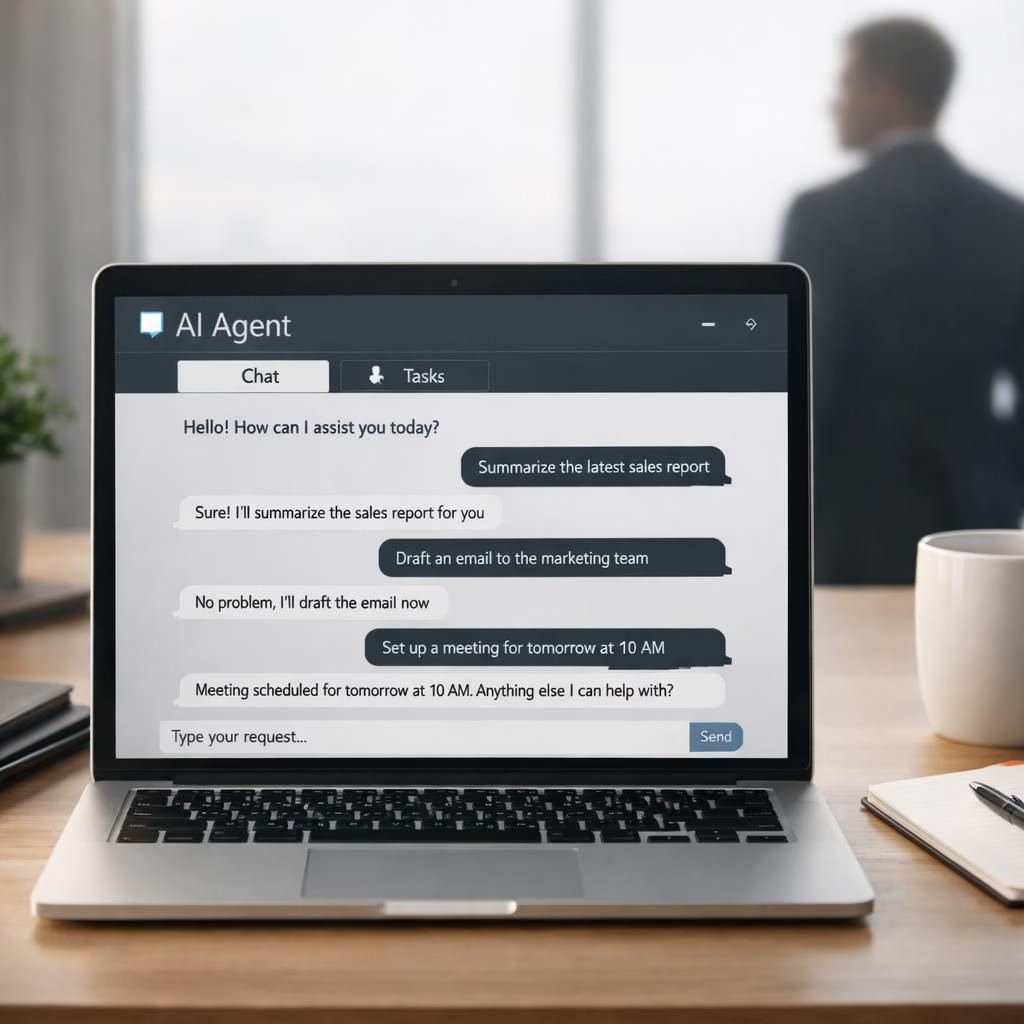
In 2026, Meta doubles down on AI Leadership and Tech Management, turning theory into practice with a CEO agent that speeds up information retrieval and trims bureaucracy. Zuckerberg’s project is small but strategic, a signal that the company wants to flatten its 78,000-person organization and test how AI can support, rather than supplant, human leadership.
AI Leadership at Meta: The CEO Agent Experiment
The CEO agent is designed to fetch facts, compile notes, and surface context without pinging several staffers. It is intentional, not autonomous, with humans still in the decision loop. This keeps accountability front and center while chasing efficiency gains. For AI Leadership, the emphasis is on speed, not surprise, as the AI helps leadership avoid needless detours.
Tech Management Transformation: Flattening the Org
Meta’s push to flatten the organization mirrors a broader trend across big tech. Tech Management becomes a more dynamic capability, with My Claw and Second Brain forming part of a toolkit that employees can customize. These personal agents act like a tiny chief of staff, pinging colleagues when needed and logging decisions for later review. The aim is to reduce friction and keep teams aligned across dozens of product groups.
Industry reaction is mixed but lively. Pichai proposed that an agent could become capable of running a CEO’s duties, while Altman sounded enthusiastic about a future where Tech Management might reliably perform some leadership tasks. Others emphasized that people will need to adapt and that jobs will evolve in response to automation. Yet Nvidia’s Jensen Huang pushed back, insisting that replacing humans at scale remains a long horizon.
What makes the Meta approach stand out is its practicality. The company ties AI tool adoption to performance metrics, and that creates measurable accountability. For AI Leadership, the emphasis isn’t hype—it’s governance, risk controls, and clear ownership. The internal mood ranges from energy to anxiety, as some staff see opportunity while others fear the unknown. A few colleagues celebrate a faster, flatter culture; many watch cautiously as governance, review cycles, and human judgment evolve.
For leadership, the idea raises important questions. Can AI help leaders stay focused on strategy while handling daily trivia? Will performance reviews start to factor AI-assisted outputs? How will big tech manage risk when Tech Management can propose courses of action that leaders might not personally vet? These questions sit at the edge of a potential cultural shift that could redefine what it means to lead at scale.
Practically, Meta’s experiment offers a test case for managers everywhere. The blend of AI Leadership tools with human oversight could improve decision cycles, reduce meetings where nothing happens, and preserve context across sprawling operations. But the risk remains that over‑reliance on algorithms dulls judgment or amplifies bias if not checked by strong governance.
In a broader sense, the move invites a conversation about the future of big tech Tech Management—and how decisions are made at scale. If a CEO can trust an AI to surface insights, guide prioritization, and serve as a quiet chief of staff, what happens to leadership roles beyond Meta?
Looking ahead, the upside is clear: faster decision cycles, clearer ownership, and a culture that learns from data at speed. The risk is also clear: misaligned incentives, privacy concerns, and the possibility that tens of thousands of decisions become too dependent on a digital helper. The reality is a hybrid path where AI Leadership augments people rather than replaces them.
Readers may notice a familiar tension between innovation and governance. The technology grows, and so does responsibility. If Meta’s work proves robust, other firms could follow with their own Tech Management copilots. The landscape of AI-enabled leadership will keep evolving, and the best practice will blend clear human oversight with smart automation.
AI Leadership remains an emergent discipline, and Tech Management is adapting in real time. Meta’s CEO agent is a bold, imperfect step toward a more responsive, less bureaucratic organization. The experiment invites curiosity, not certainty, and invites every employee to consider how they fit into this new workflow.
Original reporting and material inspiration: The Wall Street Journal. Thank you to The Wall Street Journal for the original reporting and material that inspired this post.
What do you think about AI Leadership and Tech Management in 2026? Share your thoughts below and join the discussion.
For broader context, outlets like BBC News Technology and MIT Technology Review have explored how AI copilots shape leadership and organizational design.
Practical steps for AI Leadership in Tech Management
- Define clear decision rights. Establish what the CEO agent can decide autonomously and what requires human approval to maintain oversight in Tech Management.
- Set guardrails and risk controls. Build safety checks around AI outputs and tie them to performance metrics tagged to AI Leadership.
- Pilot with tangible goals. Start small in a single function before scaling across the organization.
- Maintain context and governance. Use shared logs to preserve decisions and avoid silos across teams dealing with multiple product groups.
FAQ
-
What is Meta’s CEO agent trying to achieve?
It is an AI Leadership experiment designed to surface facts and context quickly, with human oversight intact. In Tech Management, this means faster coordination without bypassing governance.
-
Will AI affect performance reviews?
Some teams already tie AI-assisted outputs to reviews, but the process remains anchored in human judgment. The conversation centers on balancing AI Leadership with accountability in Tech Management.
-
Is there a risk AI could replace leaders?
Most experts agree that it is a long horizon, and the emphasis remains on AI Leadership augmenting rather than displacing people in Tech Management.
-
What governance safeguards are important?
Strong governance, transparency, and human-in-the-loop review are critical to prevent bias and ensure ethical use of AI in Tech Management.
References
- Times of India linkback: https://timesofindia.indiatimes.com/technology/tech-news/google-ceo-sundar-pichai-says-ai-could-do-his-job-and-meta-ceo-mark-zuckerberg-is-already-working-to-prove-that/articleshow/129746217.cms