

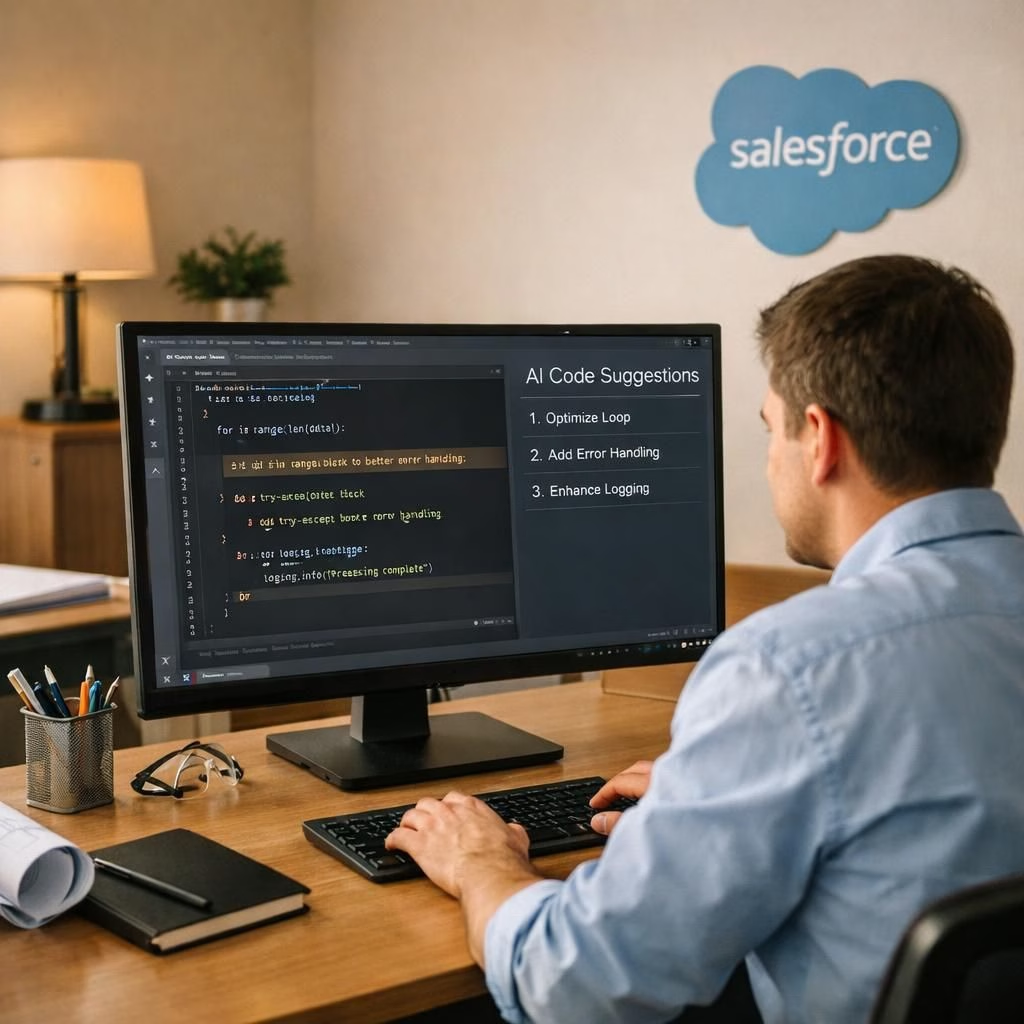
AI and Salesforce are writing a new chapter in the office saga, with a pragmatic twist: AI won’t replace engineers; it will elevate them to supervisory roles, guiding coding agents from Anthropic, OpenAI Codex, and Cursor. The 15,000-strong engineering team at Salesforce now works alongside these AI helpers, increasingly supervising the agents rather than doing all the heavy lifting themselves. They can become somewhat supervisory over these agents, while still needing engineers to set direction, audit results, and keep the ship on course. The model isn’t autonomous yet—no rogue software stunts here—but the conversation around AI feels less like a threat and more like a productivity upgrade. Meanwhile, the biggest AI labs continue to hire engineers at scale, underscoring a cooperative path between humans and machines rather than a cliff to jump off.
AI and Salesforce: A Modern Tandem Redefining Work
Inside Salesforce, AI and the platform form a modern tandem that blends machine precision with human judgment. When AI handles routine coding, engineers ascend to architecture, governance, and creative problem-solving roles. This is the core of the digital labor revolution—AI acts as a capable assistant, and Salesforce acts as the conductor guiding the orchestra. In early 2026 disclosures, the company noted it did not hire new engineers in fiscal year 2026, relying on AI-augmented capacity to sustain momentum. The strategy isn’t about shrinking the workforce; it’s about reallocating talent to higher-leverage work while AI covers repetitive tasks.
AI at Salesforce: Engineers as Supervisors, Not Replacements
Let’s reframe the optimistic headline in plain language. The shift isn’t about erasing craft; it’s about elevating it. In the Salesforce ecosystem, engineers become supervisors, reviewers, and design partners for AI coding agents. The idea is to keep the human in the loop for governance, safety, and direction, while the agents handle code generation, testing, and rapid iteration. This reframing yields real benefits: faster product cycles, more consistent quality, and mentoring teams toward higher-value work such as system integration and security engineering. This shift is not a threat to the workforce but a blueprint for a more resilient engineering culture inside Salesforce.
Pragmatically speaking, the numbers cited by Salesforce narratives are bold but believable in the right context. They’ve suggested AI now handles up to half of the company’s workload in certain domains, with accuracy in the high ninety-percent range. That framing resonates for teams that treat AI as a collaborator rather than a gimmick. The Salesforce narrative is not hype; it reflects how business models evolve when tools scale with disciplined governance. The engineers’ challenge is to stay curious, stay hands-on with the data, and stay committed to making AI responsible, explainable, and well-integrated into the overall product lifecycle. The result is a culture where AI accelerates learning, and Salesforce accelerates deployment, all while keeping the human touch front and center.
Putting People First in the AI-Driven Era
As this story unfolds, the human factor remains the most important variable. AI can draft code more quickly than a single developer, but it’s the engineer who interprets business needs, negotiates trade-offs, and ensures the solution aligns with customers’ real-world workflows. The Salesforce approach offers a practical best practice: treat AI as a partner that expands the scope of what engineers can achieve, rather than as a mandate to shrink the team. Training and upskilling become ongoing rituals rather than one-off events. Engineers are invited to own the quality of AI outputs, design robust governance around model use, and participate in cross-functional teams that connect product design, compliance, and field feedback. In this ecosystem, AI and Salesforce are not antagonists; they are co-authors of a more capable, responsive organization. The emphasis on responsible deployment matters: accuracy, reliability, and explainability remain your north stars, and governance provides a solid model for others to follow.
The broader takeaway for readers and organizations is clear: AI is not an existential threat to skilled labor when paired with strong leadership and clear upskilling pathways. In the Salesforce case, AI augments the workforce, while the company grows its capacity with sales talent and strategic hires in areas that drive revenue and customer value. The net effect is a business that can move faster without sacrificing trust or quality. If you’re running a tech team, consider how your own AI strategy mirrors this approach: level up the engineers, keep the humans in charge of decision-making, and use AI to take care of repetitive tasks while you solve the hard, creative problems that really move the needle. AI, Salesforce, and a culture of continuous learning together map a future where technology amplifies talent rather than erases it.
We invite you to share your thoughts on how you see AI and Salesforce shaping your own work in the coming year. How would you reframe your roles to leverage AI while preserving the human edge? Join the conversation in the comments below.
Special thanks to the original article for the inspiration: Salesforce AI and Engineer Shift – Original Source. Your source material helped shape this thoughtful, optimistic take on the AI-enabled workplace. Thank you!
Additional reading on how AI reshapes work lives: McKinsey on AI in the workplace, Harvard Business Review on AI and the workplace, and Brookings on AI and the labor market.
Practical steps for teams to adopt AI responsibly
- Define governance, safety, and explainability standards before adopting any coding agents.
- Invest in upskilling: pair engineers with AI literacy, architecture training, and security focus.
- Run controlled pilots that measure impact on cadence, quality, and customer value.
- Foster cross-functional collaboration between product, compliance, and field teams.
- Monitor outcomes and iterate on governance as capabilities evolve.
References
Original source: https://timesofindia.indiatimes.com/technology/tech-news/salesforce-ceo-marc-benioff-has-a-message-for-software-engineers-as-ai-takes-over-coding-you-can-become/articleshow/130188707.cms