

AI and OpenShell in 2026: A Bright, Silly Summary
AI and OpenShell headline 2026: a sunny sprint from Minecraft Dungeons 2 to Nvidia GTC, smart wearables, Artemis II, and policy debates. This roundup blends playfulness with serious trends, proving that tech news can be both informative and entertaining.
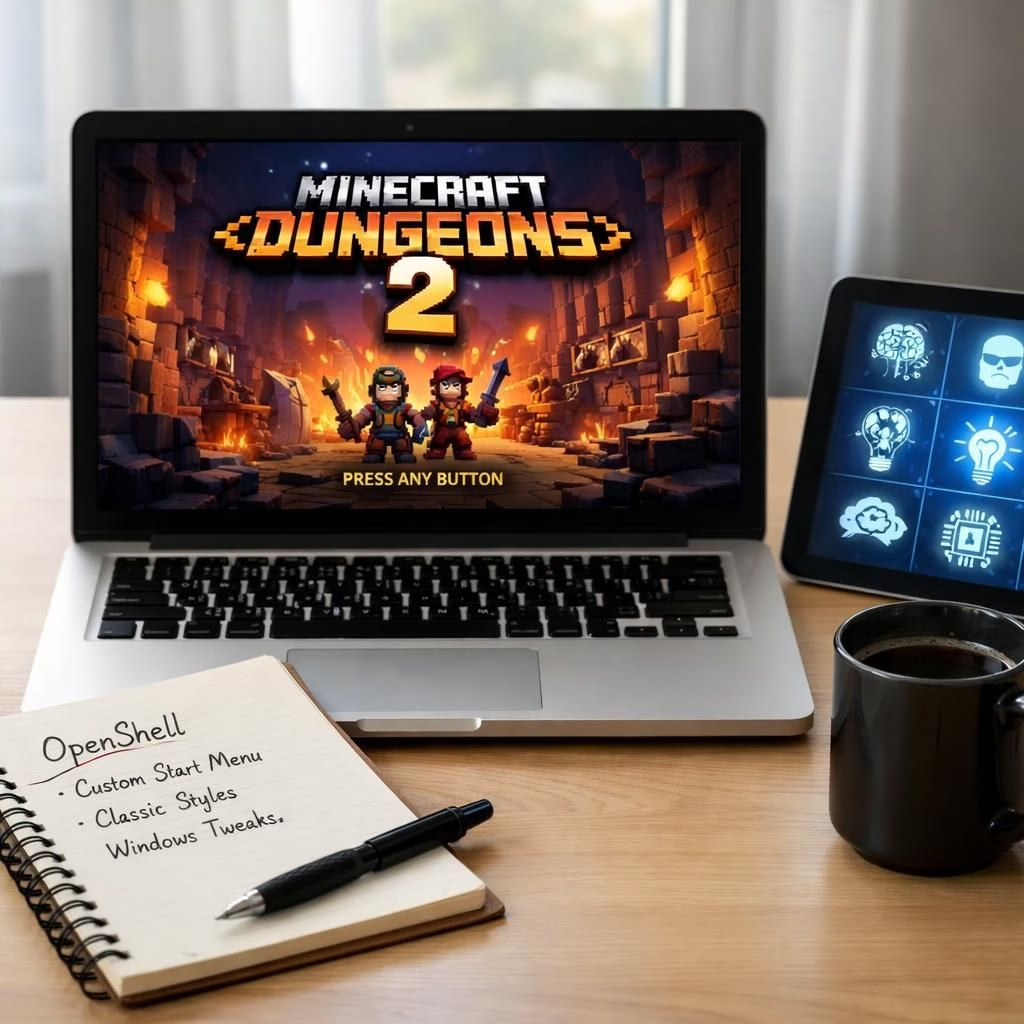
The Minecraft Dungeons 2 reveal lands on PC via Xbox and Steam, PS5, Nintendo Switch and Switch 2, and Xbox Series with Game Pass later this year. The announcement followed an apparent leak before an official Minecraft Live reveal. The team frames the game as an all-new action-RPG in the Minecraft universe with loot and up to three-player co-op to save a world in crisis. The sequel builds on the 2020 spin-off, which has grown to 25 million players by April 2024. The original game has sold about 350 million copies, underscoring how a beloved universe can grow with new systems and cooperative play.
In the spirit of AI and OpenShell governance, the broader tech scene isn’t just about launch hype; it’s about smarter workflows. Nvidia’s GTC 2026 centers Vera Rubin CPUs and OpenShell OpenClaw/OpenShell, signaling a shift toward agent-based compute and governance-aware AI stacks. Huang framed ambitions like a trillion-dollar AI agent ecosystem and multi-trillion-dollar physical AI ambitions, while executives cautioned about ROI and risk. The company projects billions of dollars in order potential for its Vera Rubin family by the end of 2027, and the OpenShell initiative hints at a broader ecosystem where developers can deploy autonomous AI agents with built-in security and policy tooling.
Retail deals dominate the consumer window: Nike Powerbeats Pro 2 variations, Galaxy wearables, and a flurry of smartphones. The deals reflect a larger trend toward health tracking and smart audio as everyday productivity tools. Behind the scenes, AI and edge compute power battery optimization, sensor fusion, and smarter notifications, while OpenShell governance offers a framework for safer agent-based experiences across devices. It’s a friendly reminder that the best gadgets are the ones that quietly learn your routines and adapt to your day.
On the space front, Artemis II readiness puts humans back on a lunar path. NASA’s rollout to the launch pad signals a near-term horizon for crewed deep-space work, with careful emphasis on reliability and testing that will feed later AI-enabled mission planning. The event also echoes the broader AI compute push, where Vera Rubin-class systems and partner clouds would enable massive simulations and mission optimization. OpenShell remains a quiet enabler here, offering governance and transparency for the AI-enabled data pipelines that power the mission’s analytics and operations.
AI-driven trends and OpenShell security playbooks
OpenClaw and NemoClaw rise as security cornerstones for AI work. The OpenShell strategy aims to demystify model governance, give developers clearer safety rails, and help enterprises deploy agents with auditable behavior. The ecosystem approach shifts the focus from a single heavyweight model to a web of agents that collaborate across apps, messaging, and workflows. AI agents can scout markets, monitor inventory, and bid in auctions, while security and policy tools keep everything within guardrails. This is not hype; it’s a practical path to safer automation that still unlocks real productivity gains.
OpenShell isn’t just about defense; it’s about enabling responsible experimentation. In parallel, AI-enabled commerce platforms get more sophisticated, with policy-led guardrails, data-center governance, and transparent reporting emerging as features rather than afterthoughts. The White House’s national AI framework signals federal alignment with industry best practices, while industry players test OpenShell-enabled workflows in hybrid cloud environments. The result is a more predictable AI-enabled shopping experience, with better controls over data, privacy, and provenance. AI remains a moving target, yet the path forward looks realistic and exciting when governance keeps pace with capability.
Other stories reinforce the broader arc: cloud validation of Vera Rubin in major providers; the drift toward agentic AI that can coordinate fleets of devices and robots; and the ongoing push to democratize access to powerful AI while maintaining safety standards. The tone remains pragmatic and optimistic: AI can augment human work if governance, testing, and accountability keep pace with capability. The takeaway is simple—expect smarter devices, safer AI pipelines, and open platforms that invite responsible experimentation.
To close, this digest highlights a year when AI and OpenShell become more than jargon; they become practical scaffolding for gaming, wearables, space readiness, and policy alignment. The future looks dynamic and approachable, not dystopian, if we keep transparency, collaboration, and user trust at the center of every deployment. If you enjoyed the tour, share your thoughts in the comments and tell us which AI-enabled trend you’re most excited about this year.
Special thanks to the original article source for material used in this rewrite: Bez-Kabli technology news archive (original article) – thank you!
Practical steps for AI and OpenShell adoption
- Start with a focused pilot: pick one workflow where AI agents can add measurable value, then scale gradually.
- Implement governance from day one: define safety rails, data provenance, and auditable logs for all agents.
- Limit risk with sandboxed environments and clear rollback plans for experimentation.
- Monitor outcomes with simple, repeatable metrics across performance, privacy, and user trust.
FAQ: AI and OpenShell in 2026
- What is OpenShell? OpenShell is a governance framework designed to help developers deploy AI agents with safety rails, auditable behavior, and policy controls across devices and services.
- Why is Vera Rubin important for AI workloads? Vera Rubin-class systems aim to deliver high single-thread performance and scalable data throughput, enabling larger AI models and faster simulations in data centers.
- How should I approach adopting AI safely at work? Start with small pilots, enforce strong data governance, monitor for bias and drift, and ensure there are clear rollback and human-in-the-loop options.
- Where can I learn more about AI governance? Look for official AI policy frameworks from government or industry groups, plus vendor documentation on governance tooling like OpenShell.
Conclusion: a practical, not dystopian, AI decade
The year 2026 feels more like a cooperative playground than a fear-filled frontier. AI and OpenShell governance are evolving into usable foundations for gaming, wearables, and space readiness. With transparent governance, real-world safety, and open collaboration, readers can expect smarter devices that respect privacy and trust. Share your thoughts below, and tell us which AI-enabled trend you’re most excited about this year.