

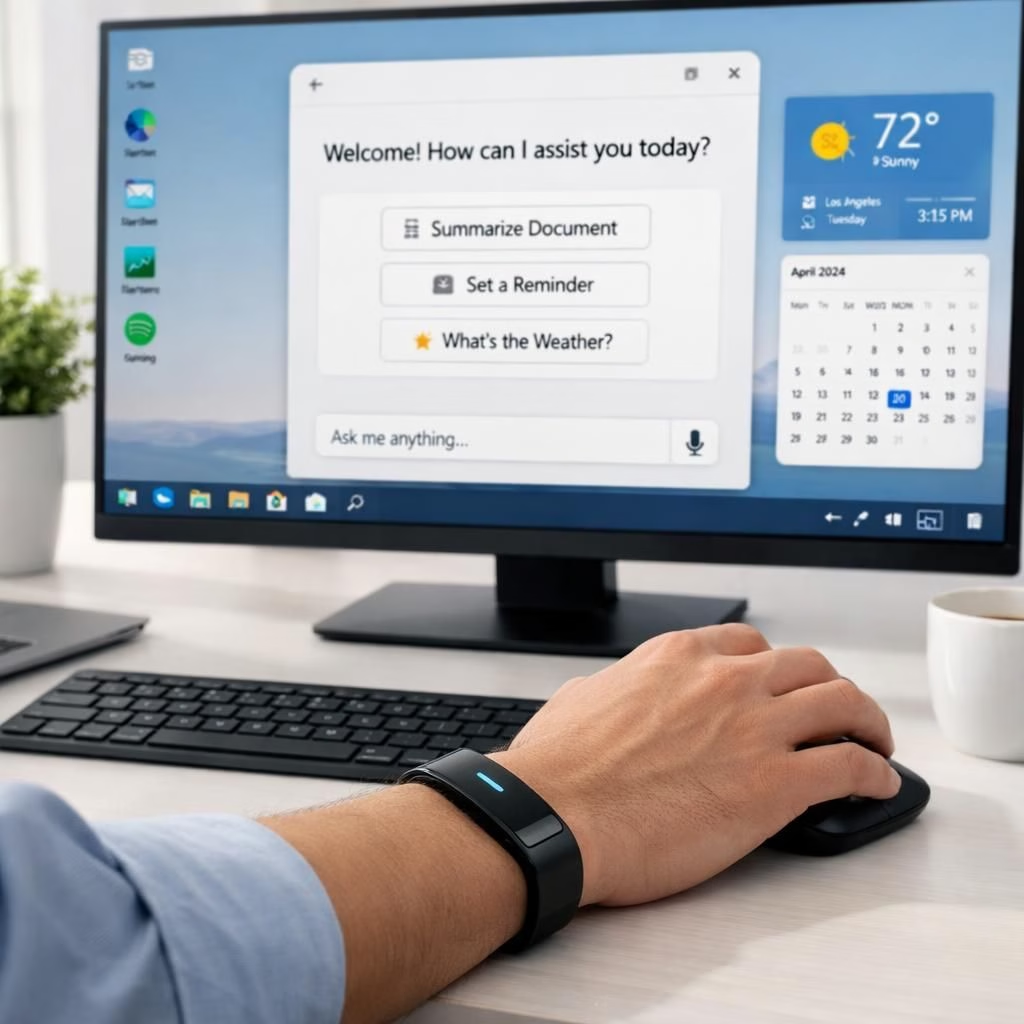
AI and Microsoft are steering the next wave of office gadgets, mixing wearable tech with Windows efficiency and a dash of friendly sarcasm. The goal: make daily tasks lighter, faster, and a little more delightful, without turning the desk into a data farm. This isn’t hype for hype’s sake; it’s a practical push toward hands-free workflows and smarter prompts that respect your attention.
The BBC’s coverage points to a wearable AI gadget aimed at office workers. Picture a discreet device that talks to your PC, nudges you when you’ve been staring at a spreadsheet too long, and suggests small, timely actions to cut friction. It isn’t a magic wand, but it does promise to squeeze a bit more flow from a busy day. In the real world, experiments like this test how often we actually want a digital assistant on our wrist, not on the side of our screen. The core truth remains: the wearable is meant to handle routine tasks, surface context, and keep you in the loop without turning every moment into a notification bonanza.
Windows enthusiasts will smile at the Build era chatter that stresses Windows as the trusted platform for development. The sentiment is not merely nostalgia; it’s a practical stance that developers crave a stable, secure base to ship innovative features. The Windows Blog champions this vision, outlining a future where the operating system is more than an engine—it’s a reliable craftsman that helps AI reach its practical potential. In short, Windows remains the backbone, with AI-ready tools that feel familiar, not foreign, to developers.
Meanwhile, CNBC’s report on AI models aimed at reducing reliance on external providers makes a persuasive case for cost efficiency and control. Microsoft’s own messaging hints at a world where you can tune models, run them locally or in controlled cloud environments, and adapt them to a company’s exact use cases. The idea isn’t to replace OpenAI or any single vendor; it’s to diversify, to create options, and to reduce exposure to rising compute costs. For developers and enterprise teams, this translates into more predictable budgeting and faster iteration cycles. It’s AI that works in your shop rather than AI that ships with unpredictable expense notes.
Ars Technica rounds out the picture with Project Solara, described as an Android OS designed for agents instead of standalone apps. The distinction matters. Agents—think persistent assistants with goals—need a platform that supports continuous context, safety boundaries, and seamless handoffs. If you’ve ever wrestled with app-switching fatigue, the Solara-influenced approach promises to smooth those edges. The broader takeaway: the push toward agent-first design can redefine how software behaves on devices used in the office, at home, or on the move.
Microsoft Build Live adds the final piece of the ecosystem puzzle. The event signals how the company plans to knit wearable AI, agent-driven software, and a more developer-friendly Windows into a coherent stack. The message is clear: the future is not a single gadget or a single model. It’s a suite of tools that empower people to do more with less friction, all while keeping security and privacy front and center. In practice, that means better onboarding, clearer prompts, and a smoother bridge between human intent and machine action.
AI and Microsoft: The Wearable Office Gadget In Focus
When we talk about an AI-driven wearable for the office, we’re not simply chasing novelty. We’re pursuing a workflow companion that can read the room—the user’s schedule, the tempo of a meeting, the urgency of tasks—and respond with timely, respectful interventions. The emphasis stays on enhancing cognition, not crowding it with noise. The wearable’s role is to support decision-making by surfacing the right data at the right moment, guiding actions that align with priorities and deadlines. In this sense, AI is less about flashy demos and more about dependable assistance embedded within the rhythm of a workday. And Microsoft is positioning Windows as the platform that can host this AI with security, governance, and tooling that teams already trust.
Expect to see better integration between wearables and common office patterns: calendar-aware nudges before back-to-back meetings, context-aware alerts during deep work, and proactive suggestions that reduce unnecessary toggling between apps. The idea is to reduce the friction of digital life so you can focus on human tasks—planning, creativity, collaboration—while the device handles the routine, repetitive, or data-heavy portions of work. This isn’t a gadget vanity project; it’s a thoughtful attempt to rebalance attention in an age of constant connectivity, using AI to steer focus rather than scatter it.
And yes, this is a collective quest. Microsoft wants to bring developers and end users along for the journey. It’s not about a single gadget or a single feature; it’s about a cohesive platform where wearables, agents, and Windows work together. The future is not a single product release; it’s a steady arc toward more capable tools that integrate into real work without demanding a dramatic lifestyle change.
What might this look like for you next year? A wrist device that gently channels your energy toward priorities, a Windows environment that makes AI more predictable and controllable, and an ecosystem where agents handle repetitive tasks while you tackle the creative edges. If you’re a developer, expect improved SDKs, more sandbox opportunities, and clearer guidance on security and data handling. If you’re an office worker, anticipate fewer interruptions, smarter prompts, and a smoother collaboration flow. It’s a light, hopeful shift rather than a sci‑fi leap, and that’s what makes it feel plausible—and exciting.
We invite you to share your thoughts in the comments. How would a wearable AI gadget change your workday? Which features would you test first, and what concerns do you have regarding privacy and control? Your perspective helps shape practical, human-centered AI on Windows and beyond.
Original material and inspiration come from several sources. Special thanks to BBC, Windows Blog, CNBC, Ars Technica, and Microsoft Build Live for the baseline material and context. For readers who want to explore further, here are the original articles and pages that informed this rewrite:
BBC News: Technology,
Windows Blog,
CNBC,
Ars Technica,
Microsoft Build Live — with thanks for the thoughtful material that sparked these ideas.