

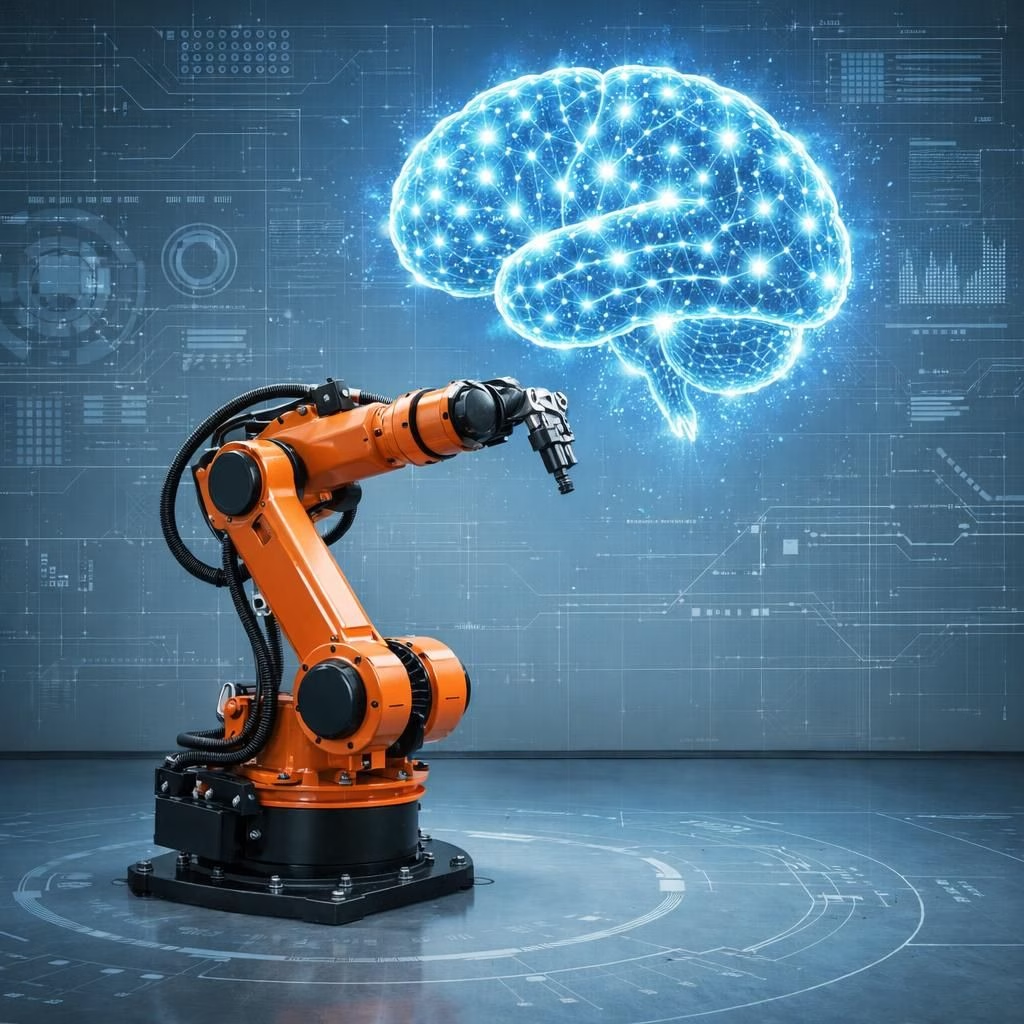
AI in Manufacturing is waking up on the factory floor as Skild AI unveils a generalized brain for robots, with Nvidia’s Blackwell GPUs humming behind the scenes. Robotics Automation takes another step forward as ABB Robotics and Universal Robots join the software rollout, promising a flexible mind rather than one-task obedience.
In Houston, Skild AI pilots its concept on a Foxconn-style line where robots swap tasks with a click of software and data feedback. The pilot runs on Nvidia’s Blackwell GPU server racks, a tangible sign that hardware and software are learning to dance together on the factory floor. The aim is a broad capability that can adapt to many assembly tasks in 2026 and beyond.
AI in Manufacturing: The General Brain Hears the Robot Choir
The Skild AI team partners with ABB Robotics and Universal Robots to embed the general brain across industrial robots. Their pitch is simple: a general-purpose brain can overcome the one-task limitation that plagues traditional automation. By connecting to robots across OEMs, the data loop grows quickly, turning deployments into training data, with Pathak calling this a data flywheel. This AI in Manufacturing push is reinforced by the Robotics Automation approach.
ABB and Teradyne’s Universal Robots will integrate the software into their lines, exchanging data and refining models. The collaborations aim to broaden the library of tasks and reduce engineering effort for new processes. The result could be a more flexible fleet of robots that can switch roles with less downtime and less manual reprogramming. The shift mirrors a broader push by the United States to bring manufacturing back home with smarter tooling and smarter software.
In a broader sense, the project highlights how data, hardware, and institutional partnerships fuse into a more adaptable automation stack. The goal is not merely to replicate a single task but to empower a family of tasks across lines and OEMs. If the data flywheel works as advertised, each deployment will reduce marginal engineering effort and improve performance through shared experience. This is the Robotics Automation approach in action.
Robotics Automation: Scaling with a Data Flywheel
The US push includes big investments and a plan to build AI hardware domestically, with Nvidia leading software and hardware at scale. Nvidia executives describe a multi-hundred billion infrastructure wave that will rely on more autonomous factories. SoftBank’s ABB robotics acquisition and Skild AI’s 1.4 billion funding round underscore capital-backed maturation of the Robo-Industrial ecosystem, fueling the Robotics Automation data flywheel. This momentum helps seed a broad deployment across hundreds of thousands of robots.
Behind the scenes, new U.S. production investments worth about 1.2 trillion were announced in 2025 by electronics, pharmaceutical, and semiconductor manufacturers. This fiscal environment gives Skild AI and its partners a fertile field for experimentation and deployment. Nvidia’s chips power the AI surge, and the hardware push remains central to this plan. The company’s strategy hinges on broad deployment across hundreds of thousands of robots, creating a scalable data flywheel through real-world operation.
The ecosystem shift could loosen the old constraints on automation. We may see more autonomous factories, smarter robot fleets, and software ecosystems that favor interoperability and rapid iteration. The path forward will require careful attention to data quality, security, and human oversight during transitions. The potential is undeniably large, and the mood remains cautiously optimistic.
As Skild AI’s plan moves toward real-world deployments, what does this mean for workers, managers, and developers? It means better toolkits, faster iteration, and the chance to move beyond one-task loops toward broad capabilities. The future of manufacturing could rely on a smarter brain attached to every arm, but execution remains the key. AI in Manufacturing will require careful workforce training and governance as projects scale.
Original reporting by Reuters. Special thanks to Reuters for the original article that informed this post. Read the original here: Reuters article on Skild AI and the US manufacturing push.