

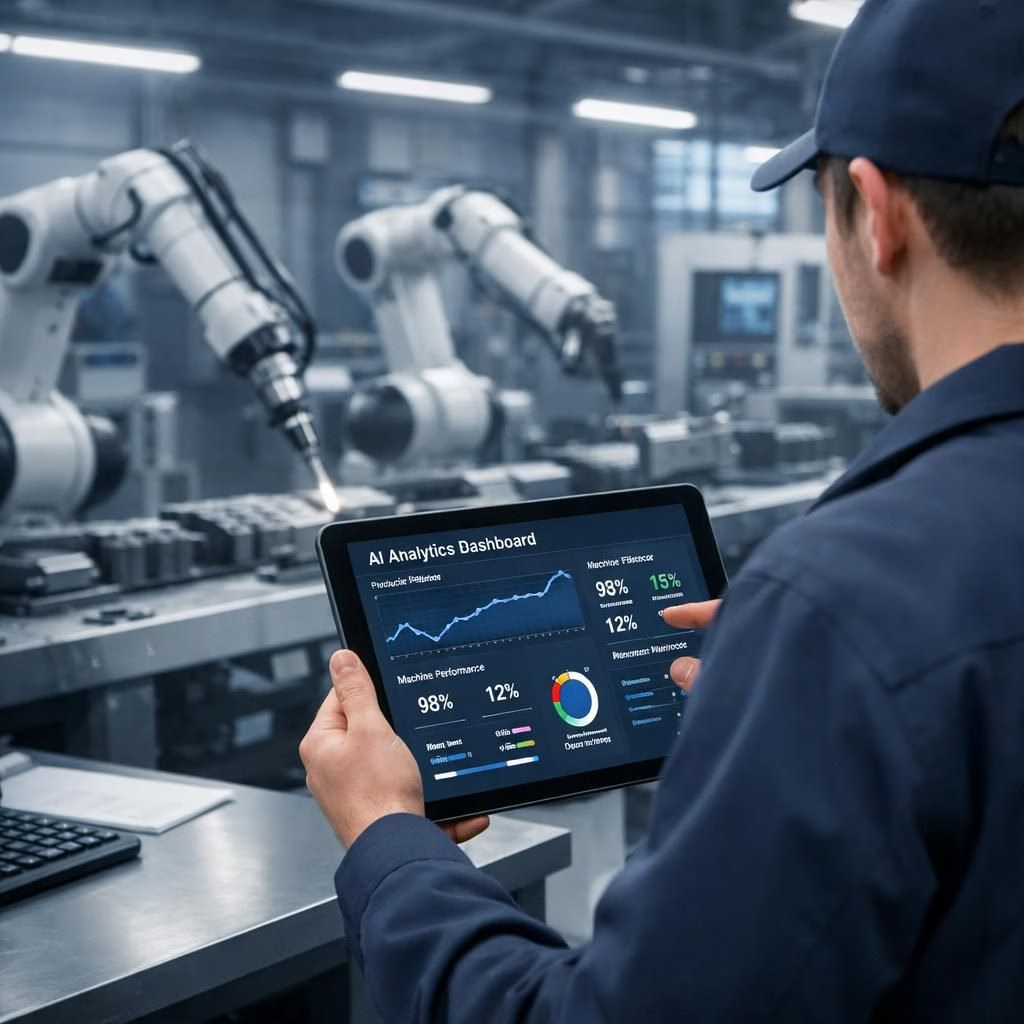
AI and Manufacturing aren’t just buzzwords; they’re engines of modern productivity. Google backs that shift with $10 million to help 40,000 Manufacturing workers master AI.
Funding flows through Google.org’s AI Opportunity Fund to the Manufacturing Institute, the workforce development arm of the National Association of Manufacturers. This collaboration translates technical know-how into hands-on shop-floor solutions. In simple terms, Google brings the AI toolkit, and Manufacturing translates it into work-ready knowledge for the floor crew.
Two new courses form the backbone of the program. AI 101 for Manufacturing and Advanced AI for Manufacturing Technicians illustrate the plan. AI 101 adapts Google’s AI training to Manufacturing realities. It covers predictive maintenance, quality gates, and process optimization. A line worker can ask the machine for help, not shout at it. The Advanced AI for Manufacturing Technicians will be developed by MI. It dives into automation, data pipelines, and on-site AI deployment. Technicians will learn to configure, monitor, and troubleshoot AI-enhanced systems.
The expansion goes beyond courses. Manufacturing Institute will launch Federation for Advanced Manufacturing Education (FAME) chapters in at least 15 new regions. They will weave AI-enabled learning into more communities. The plan embeds AI-focused content across all existing FAME chapters, giving apprenticeships a modern touch without losing the hands-on feel that makes Manufacturing work real.
AI on the Shop Floor: Training for Manufacturing Sector
With AI on the shop floor, workers gain practical skills that translate into tangible improvements. The goal is not just AI theory but real-world application—setups, calibrations, and inspections become smarter when AI assists rather than dictates. Google emphasizes that AI is a tool to augment human labor, not to replace it. In this vision, a CNC mill, a welding station, or a packing line becomes a smarter partner, offering hints, catching anomalies, and guiding decisions in real time. Manufacturing frames the courses as bridges from classroom knowledge to factory reality, a pathway that many workers navigate with curiosity and grit.
Manufacturing Jobs and AI: A Symbiotic Upgrade
The numbers demand attention: this effort addresses a growing shortfall of skilled Manufacturing professionals across the U.S. The projection of nearly 1.9 million such jobs by 2033 is a map for opportunity, not a doomsday forecast. Workers who embrace AI tools can operate more efficiently, reduce downtime, and stay competitive on a global stage. Carolyn Lee, president of the Manufacturing Institute, notes that the training helps workers see how AI can be applied in real Manufacturing production settings. When workers understand the context, adoption happens faster, and AI becomes a trusted teammate on the line.
AI and FAME: Expanding Federation for Advanced Manufacturing Education
The FAME expansion means scale with practical context. By adding at least 15 new regions, the initiative spreads best practices in AI-powered Manufacturing training, creating communities where apprentices, mentors, and seasoned technicians share lessons learned on the shop floor. MI embeds AI for Advanced Manufacturing Technicians across all FAME chapters, ensuring a consistent, practical approach to AI deployment that aligns with everyday Manufacturing challenges. The nationwide upgrade aims to keep hands-on expertise front and center while embracing AI-enabled workflows.
On the human side, leaders acknowledge fears about AI and the unknown impacts on jobs. The emphasis remains on demystifying AI and equipping workers with foundational skills they can use today. Clear communication, accessible training, and a steady flow of success stories help reduce anxiety and build confidence—an approach that respects the craft of Manufacturing and the promise of AI-driven productivity.
These training programs showcase the real-world application of AI on the shop floor. The aim is to help people see how AI will augment human skill, support decision-making, and unlock faster adoption of advanced technologies. This clarity matters now, as Manufacturing navigates a future where AI tools become routine partners on the line rather than distant terms on a press release.
As with any large-scale training effort, measurement and feedback will guide adjustments. MI and Google intend to track progress, share outcomes, and refine curricula to address evolving factory realities. The broader aim is not merely to train but to embed a culture of continuous learning and adaptive problem-solving across Manufacturing workforces powered by AI.
Original source: FOX Business reported on this collaboration. See the FOX Business article for the initial reporting: FOX Business – Original reporting.
We invite readers to share their thoughts in the comments about how Manufacturing and AI might reshape your local plant, your role, and your career path in 2026.
Practical steps for workplaces
- Assess processes in your Manufacturing lines that could benefit from AI-assisted insights.
- Provide access to the new AI courses through MI so teams build a common foundation across the Manufacturing workforce.
- Run a pilot in one Manufacturing area, collect data, and share learnings for broader rollout.
- Measure uptime, quality, and throughput across the Manufacturing network to guide scaling.
FAQ
- What is the AI Opportunity Fund? A dedicated pool from Google.org to support training initiatives that combine AI tools with real-world Manufacturing needs.
- How will the courses work? Courses are designed to connect classroom AI concepts with hands-on shop-floor tasks in Manufacturing.
- What does the FAME expansion mean for workers? It creates more places to learn, mentor, and practice skills that integrate AI into daily Manufacturing work.
- Will AI replace jobs? The emphasis is on augmentation—tools that support decision-making and speed up routine tasks while people guide and operate systems.
- How can workers access training? Through MI’s programs and participating Manufacturing community partners across the country.
References
- FOX Business – Original reporting
- Google.org
- The Manufacturing Institute
- AI in manufacturing – McKinsey insights