

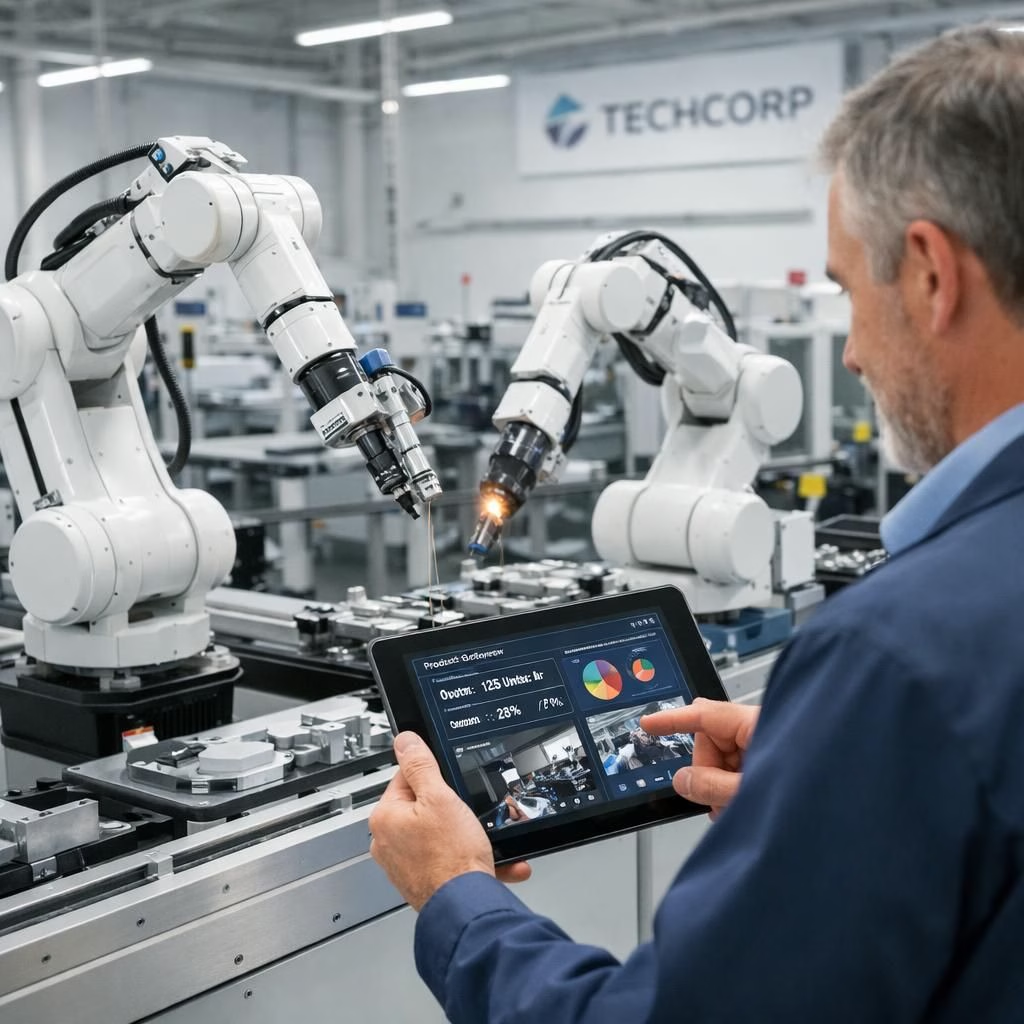
In Troy, Michigan, Tata Consultancy Services unveils its seventh Gemini Experience Center, launching a bold foray into Physical AI for manufacturing. This expansion cements the United States as a key hub, following the first US GEC born in partnership with Google Cloud in New York. The Troy center doubles down on the Physical AI Blueprint—an end-to-end stack that stitches AI-powered robotics, sensing, edge intelligence, and secure cloud orchestration into a single, scalable playbook for factories. With a target of 13 GECs worldwide by 2026 and six more centers slated for launch this year, TCS aims to move enterprises from AI pilots to production-ready programs that actually ship results, all while keeping safety at the center. The collaboration with Google Cloud reinforces Gemini Enterprise as a bridge from pilot projects to real-world industrial transformations.
Gemini Experience Center: Manufacturing’s Next Act
The Troy GEC is more than a glossy display; it is a living lab where manufacturers can explore a guided journey from insight to impact. Leaders and engineers interact with the Gemini stack in action, testing autonomous patrolling, anomaly detection, PPE compliance monitoring, intelligent quality inspection, progress mapping, and predictive maintenance. The center shows how a well-architected Gemini design can scale across environments that are dangerous or hard to monitor, all while preserving a human-in-the-loop approach that keeps safety and resilience front and center. Real-time dashboards, cooperative robotics, and secure cloud orchestration combine to demonstrate how to go from prototype to production with confidence.
Physical AI in Manufacturing: Real-World Use Cases
At the core lies the Physical AI Blueprint—an end-to-end architecture that blends AI-powered quadruped and humanoid robotics with advanced sensing, edge compute, and secure cloud orchestration. This mix yields real-time operational insight and autonomous decision support while maintaining a human-in-the-loop safety net. The goal is to help manufacturers gain visibility and control over environments that are risky or hard to monitor. In Troy, teams compare scenarios that test perception, planning, and action across the Physical AI stack, learning how to reduce downtime and improve worker safety at scale.
Use cases showcase practical value: autonomous patrolling and surveillance; environmental anomaly detection; PPE compliance monitoring; intelligent quality inspection; progress mapping; and predictive equipment health monitoring. Across these scenarios, the Physical AI approach blends sensing with smarter decision-making, so machines support the workforce rather than replace it. The emphasis on safety makes the center a credible path to deeper adoption, and the human-in-the-loop design helps enterprises test, tune, and trust the results before they scale.
Industry partnerships bolster the effort. Through curated demos and scenario-based workshops, enterprises see how to move from infrastructure setup to production-ready outcomes, modernizing enterprise AI platforms and enabling autonomous industrial operations. The collaboration with Google Cloud under the Gemini Enterprise umbrella accelerates the deployment pipeline and opens options to integrate pre-built and custom agents—both Google Cloud agents and third-party agents—that help customers lift efficiency and innovation.
Since its launch, TCS has opened six centers in Bangalore, New York, Chennai, Riyadh, Singapore, and Sao Paulo, forming part of the Pace and Innovation network that links startups, universities, and customers to the technological vanguard. The company is expanding its Google Cloud relationship to widen access to Gemini Enterprise and empower its teams to craft agents for faster, safer rollouts. For manufacturers, the message is clear: adopt a scalable AI platform, back a trusted partner, and translate pilots into a production-line advantage with Gemini’s ability to scale.
What this means for factories is a safer, more adaptive, data-driven future where humans and intelligent systems collaborate. The Troy GEC offers a practical demonstration that transformation can be incremental yet resilient, with measurable impact on safety, quality, and uptime. If you’re considering a similar journey, start with a clear blueprint, test in a controlled environment, and plan for scale with the Gemini-guided path and the Physical AI toolkit in your corner.
We invite readers to share their thoughts in the comments below and tell us how you see Gemini and Physical AI reshaping your operations.
Original article inspiration and gratitude: Tata Consultancy Services. Thank you for this material and for the generous source material.
Practical Steps to Start with Gemini and Physical AI
Launching a factory floor project starts with a clear problem you want to solve using Gemini and its associated Physical AI toolkit. Build a cross-functional team, map data flows, and set safety gates before you pilot.
- Define a concrete manufacturing objective that benefits from Physical AI and Gemini.
- Identify pilot lines and measurable KPIs for safety, quality, and uptime.
- Set up a controlled test environment and collect baseline data.
- Run a short pilot integrating sensors, edge compute, and secure cloud orchestration.
- Scale gradually with governance and change management; monitor ROI.
Frequently Asked Questions
Q: What is Gemini Experience Center?
A: It is TCS’s innovation space where teams test and validate the Gemini stack in real manufacturing contexts, focusing on safety, reliability, and measurable outcomes.
Q: How does Physical AI help manufacturing?
A: The Physical AI approach combines sensing, robotics, and edge-to-cloud orchestration to improve safety, quality, and uptime while keeping humans in the loop.
Q: What role does Google Cloud play in Gemini Enterprise?
A: Google Cloud provides the underlying platform for scalable AI services, enabling pre-built and custom agents to accelerate deployments from pilot to production.
Conclusion and Next Steps
The Troy Gemini Experience Center demonstrates a practical, scalable path for manufacturers seeking smarter operations. By combining Gemini’s orchestration with the Physical AI toolkit, factories can move from pilots to production-ready gains with safety and resilience at the core. If your organization is exploring similar journeys, start with a clear blueprint, run controlled tests, and partner with a trusted provider to guide every stage of scale.
External sources
References
- Times of India — TCS launches its 7th Gemini Experience Center (second in US) to develop Physical AI