

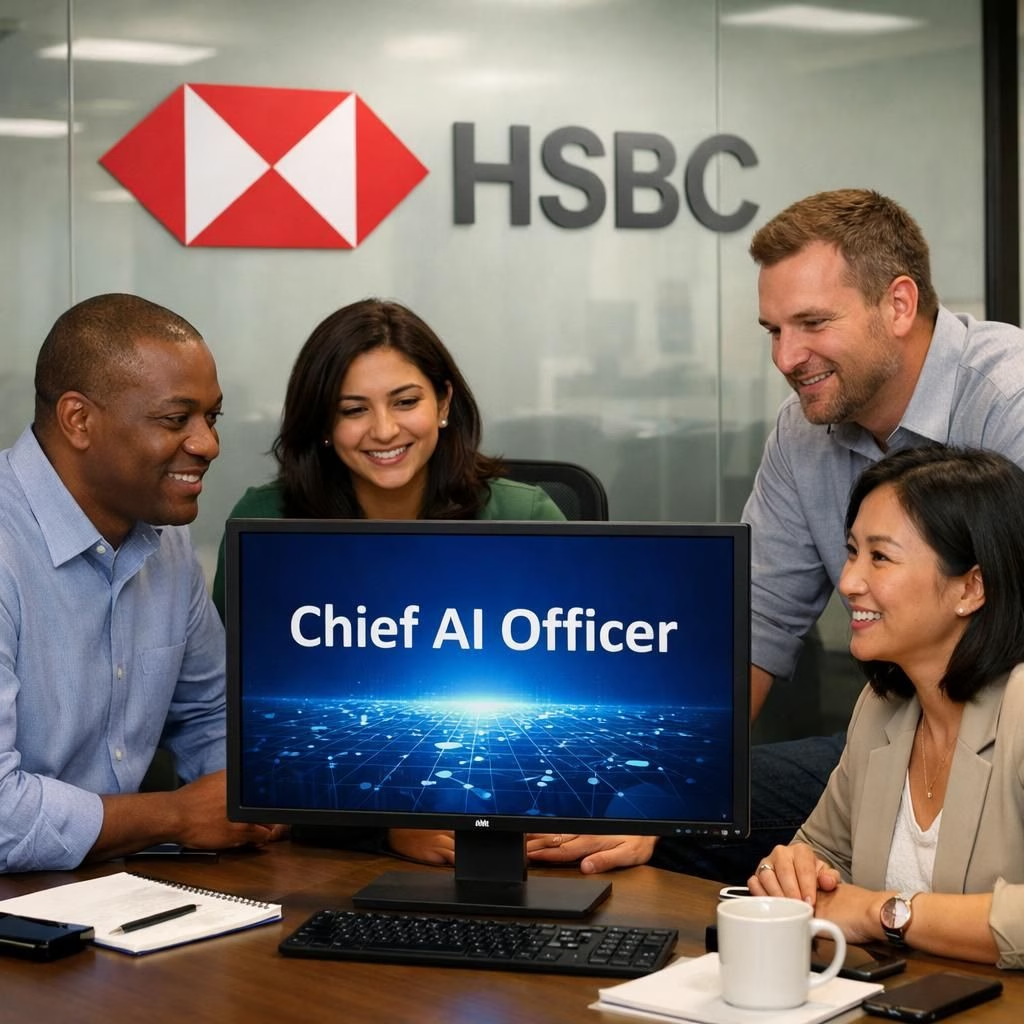
In a move that reads like a cheerful reboot, AI HSBC is embracing AI at scale as it appoints its first Chief AI Officer. This bold step from HSBC places AI leadership at the highest level and hints at cross-border efficiency gains that could ripple through every unit from retail to corporate banking.
AI at HSBC: A practical path to 2026 transformation
David Rice will take office on April 1, 2026, transitioning from his previous role as chief operating officer for HSBC’s Corporate and Institutional Banking to lead enterprise AI adoption across the bank. At HSBC, the move is framed as a practical, not a theatrical gesture: AI is here to help people, not to replace them, at least not on day one. Rice will guide the rollout of generative tools across global teams, focusing on simple wins that accumulate into a broader, sustainable AI-enabled future for HSBC.
HSBC staff will access a central AI platform as part of a wider modernization program, a project that ties AI to everyday workflows. The goal is to reduce repetitive tasks, speed up decision cycles, and give colleagues more time to spend with customers. The appointment also signals to customers that HSBC intends to embed AI into the service experience in safe, controlled ways, while preserving human judgment at the core.
HSBC’s strategy: AI at scale to boost ROE and efficiency
The bank’s leadership has publicly framed AI as a core driver of performance. Georges Elhedery, HSBC’s CEO, has set a target to lift return on tangible equity (ROE) above 17% during 2026–2028, with AI delivering savings through automation and streamlined processes. The math is simple in principle: identify common, repeatable tasks; automate them; push the savings into better returns. In practice, this means a wave of AI-enabled efficiency across operations, risk, and customer-facing processes at HSBC.
Bloomberg News recently reported that HSBC could eventually trim thousands of roles as AI and automation scale, though the plans were described as early-stage and no decisions had been taken. HSBC has not disclosed a precise job-cut figure, and the bank emphasizes that the AI program is designed to augment human work, not to hollow out the workforce overnight. The tone from HSBC is careful but confident: AI can help the bank deliver faster, cheaper, and more personalized services while preserving accountability.
AI governance and tech backbone: The central platform and partnerships
Alongside Rice’s appointment, HSBC expanded Mario Shamtani’s role as Chief Technology Officer to support a broader AI strategy. His remit includes updating core systems, building a central AI platform for employees to use different models, and managing key partnerships with tech vendors and startups. This governance layer is essential; AI without architecture tends to drift into misalignment with policy and customer protection standards. HSBC wants to stay ahead of that risk by delivering a repeatable, auditable AI flow—from model deployment to monitoring, logging, and governance.
In the bank’s own words, the new role “provides clear enterprise leadership for AI adoption within HSBC in support of its ambition to build a bank designed for the future by embedding AI solutions that benefit colleagues and customers.” That phrasing captures the dual focus: AI should simplify procedures and policies for staff, while also enabling more personalized services for clients. The emphasis on safety, compliance, and human oversight remains a cornerstone of HSBC’s AI plan.
AI adoption across staff and customers at HSBC
As the plan unfolds, HSBC is positioning AI as a tool for frontline teams and back-office staff alike. The aim is to make AI tools accessible to all staff, enabling faster responses, smarter recommendations, and personalized service for customers—without sacrificing the human touch. HSBC envisions AI supporting customer-facing colleagues with real-time insights, while back-office teams gain better automation, data quality, and governance.
Core technology: A centralized AI platform and safe deployment
The core technology story centers on a central AI platform that can host multiple models, including generative AI, and provide a safe environment for experimentation, governance, and scale. The emphasis is on reusability, interoperability, and security. HSBC wants to ensure that deployments follow a strict but practical playbook: guardrails, monitoring, and clear accountability for outcomes. In this sense, HSBC’s AI journey mirrors a modern software program—incremental, auditable, and aligned with customer needs.
Industry context and cautious optimism
Across the global banking sector, AI is already making inroads in coding, fraud detection, and credit applications. The market is watching HSBC’s AI experiment closely, not because it seeks surprise, but because it seeks reliable, scalable change. A dedicated head of AI in a large bank remains uncommon, and HSBC’s approach—placing AI in the hands of a capable executive and supporting technology leadership—could become a model for others navigating AI adoption at scale.
At a recent investor call, Elhedery asserted that “the biggest investment today is in generative AI,” which underscores the bank’s stance: AI isn’t a fad; it’s a strategic enabler. The caution, of course, is to balance innovation with responsibility, speed with safety, and automation with the human duties that customers still expect.
In sum, HSBC’s appointment of a Chief AI Officer signals a concrete commitment to an AI-infused future. It’s a move that blends ambition with pragmatism, tech with touch, and a bit of humor with hard numbers. For stakeholders, the message is clear: AI will be part of the fabric of HSBC’s operations, and the journey will be guided by governance, collaboration, and accountability in service of better banking.
We invite readers to share their thoughts in the comments to discuss how this AI-led transformation might affect you, your team, or your next banking interaction at HSBC.
Special thanks to Reuters for the original reporting that inspired this article. Original Reuters piece: Reuters coverage. Thanks also to Bloomberg News for additional context.
Practical steps for HSBC’s AI rollout (illustrative)
- Audit and map key processes ripe for automation, starting with repetitive back-office tasks.
- Establish a central AI platform with clear governance, logging, and safety guardrails.
- Pilot model deployments with human oversight, then scale successful pilots across regions.
- Train staff to use AI-enabled tools with customer privacy and data protection in mind.
- Monitor outcomes and adjust policies to ensure accountability and transparent decision-making.
FAQ
-
Q: What does the Chief AI Officer role mean for customers?
A: It signals a focus on faster, more personalised, and safer services delivered at scale, with human oversight preserved where it matters most.
-
Q: Will jobs be affected by this AI push?
A: The bank emphasizes augmentation over replacement, aiming to shift workloads toward higher-value tasks while maintaining accountability.
-
Q: How will governance work across the AI program?
A: The approach includes guardrails, monitoring, model logging, and an auditable deployment process to align with policy and customer protection standards.
-
Q: When will benefits start to show?
A: Early wins are expected as pilots expand; broader impact will unfold over the next few years as systems mature.
Conclusion: a measured, ambitious path forward
HSBC’s decision to appoint a Chief AI Officer reflects a deliberate, governance-led plan to embed artificial intelligence into everyday banking. The strategy blends ambition with practical steps, balancing speed with safety and human judgment. For readers and stakeholders, the takeaway is clear: AI will be part of the bank’s everyday operations, guided by a structured framework that aims to improve efficiency, personalization, and accountability in real time.
We welcome your thoughts on how this AI-led transformation could influence your interactions with the bank or your team’s work. Share your views below.
References: Reuters coverage linked above. Original Times of India article: Times of India – technology news.