

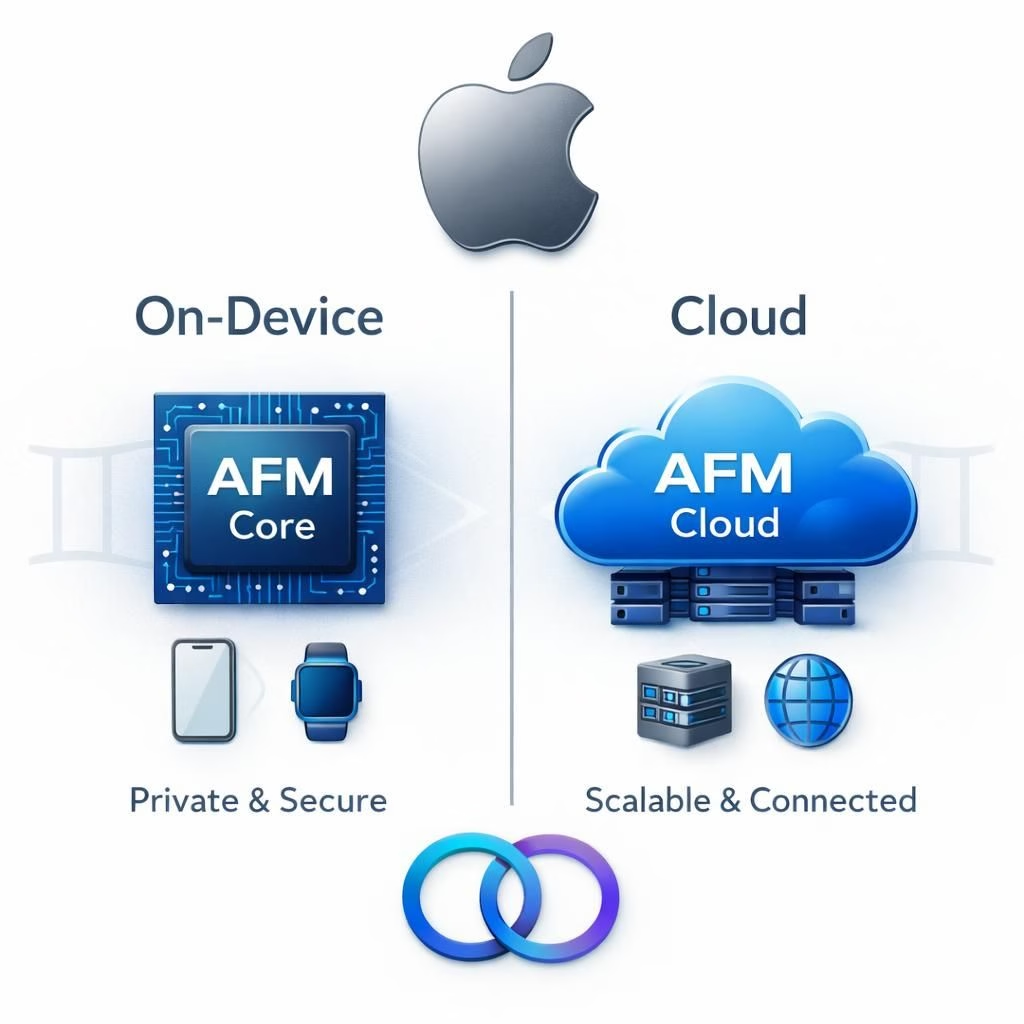
Apple executives revealed AFM’s architecture and clarified how Gemini touched the project, even as they insisted they did not borrow Google’s code, data, or knowledge backbone. The emphasis was on a privacy-first orchestration layer that guides a hybrid stack blending on-device intelligence with a careful server-backed support system.
AFM Architecture: On-device Core & Core Advanced
The AFM Core is a dense on-device model that runs locally on Apple Silicon. It supports real-time inference with low latency. AFM Core Advanced uses a sparse architecture and adds native multimodal capabilities. This pair forms the bedrock for private, offline-friendly AI that still feels fast and responsive. Apple positions this tier as the hands-on workhorse for everyday tasks, from smarter assistants to offline content analysis.
In the public briefing, Subramanya described how the two on-device variants operate side by side with a privacy-conscious orchestration layer. The System Orchestrator decides whether to route a query to Core, Core Advanced, or to the cloud when the user context and timing justify it. The emphasis is on keeping sensitive inputs processing on-device whenever possible, a move that sidesteps concerns about data drift and cloud roundtrips.
Gemini-Inspired Refinement in AFM Cloud
On the server side, AFM Cloud handles latency-optimized Private Cloud Compute requests, while AFM Cloud Image powers image generation and editing features, including spatial reframing. Here the team stresses that Gemini frontier models inform refinement, but Apple builds its own distillation-based path rather than adopting Gemini wholesale. The result is an architecture that blends Apple Silicon-native training with proprietary data and reinforcement learning loops. Gemini serves as a high-quality teacher, not a duplicate copy.
The fifth and most capable model, AFM Cloud Pro, is designed for agentic tool use and deeper reasoning, with quality that Gemini frontier models. This model marks a departure from the standard Private Cloud Compute setup, introducing more capable, context-aware assistance. The engineers emphasize a careful alignment between tool use, model capability, and user control.
AFM Privacy Orchestrator and Cross-Cloud Trust
To run Pro without compromising privacy, Apple collaborated with Google and Nvidia to extend its private cloud to Nvidia GPUs hosted in Google Cloud, while ensuring data remained unreadable by those infrastructures. Nvidia’s ambiguous confidential compute technique reportedly helps isolate compute while protecting data. Apple’s architecture thus transparently leverages third-party hardware while preserving user privacy through cryptographic and policy controls. The end result is a hybrid stack that remains auditable and privacy-forward.
Federighi summarized the design as a System Orchestrator-driven network that routes each query based on complexity and context. This orchestrator taps into an App Toolbox for in-app actions, a Spotlight Semantic Index for personal content, and on-screen context for situational awareness. For current events, responses rely on Apple’s World Knowledge Service, a homegrown knowledge backbone built over several years to stay fresh yet private.
Apple also stresses that all Private Cloud Compute infrastructure, including the extended Nvidia GPU capacity in Google Cloud, can be independently verified by third-party researchers. The aim is to demonstrate that user data is never stored or read by those external resources, a claim the company makes with confidence and a hint of healthy pride.
Looking ahead to 2026, the company hints at continuous refinement: faster on-device inference, smarter bilingual multimodal support, and smoother tool use while keeping eyes on privacy and user consent. The AFM stack is pitched as a living system that learns in the background but always respects the user’s boundaries.
In practice, this architecture translates to a product cadence that favors user-visible improvement without the drama of a data flood. The AFM stack remains a disciplined blend of local computation, edge-assisted inference, and cloud-backed generation, all under a privacy-first governance model.
What matters most to users is not a marketing claim but the everyday experience: faster replies, fewer unnecessary cloud calls, and clearer control over what data leaves the device. The Gemini collaboration narrative is then less about a magic trick and more about a thoughtful engineering philosophy that values privacy, transparency, and practical usefulness.
Original material and inspiration from 9to5Mac coverage: https://9to5mac.com/. Thank you for the original source material.
Practical takeaways for users
- Expect faster on-device responses with fewer cloud calls as AFM learns user patterns locally.
- Control privacy by permitting only essential data to leave the device, thanks to the System Orchestrator’s routing decisions.
- Explore tool use cautiously, knowing AFM Cloud Pro aims to balance capability with privacy safeguards.
FAQ
- What is AFM? It stands for Apple Foundation Models, a family of on-device and cloud-backed AI models designed for fast, private interactions.
- How does privacy stay protected? The System Orchestrator routes requests to the appropriate model while keeping inputs on-device when possible, with cryptographic protections for any data processed in the cloud.
- What role does Gemini play? Gemini frontier concepts inform refinement, but Apple trains its own models with proprietary data and reinforcement learning.
- Will AFM rely on external infrastructure? The architecture uses a controlled mix of on-device computation and a private cloud, with third-party verification to ensure data privacy.
Conclusion
AFM represents a privacy-centered approach to AI at scale, blending fast on-device inference with cloud-backed capabilities when needed. The architecture emphasizes user control, transparency, and ongoing refinement that respects privacy boundaries.