

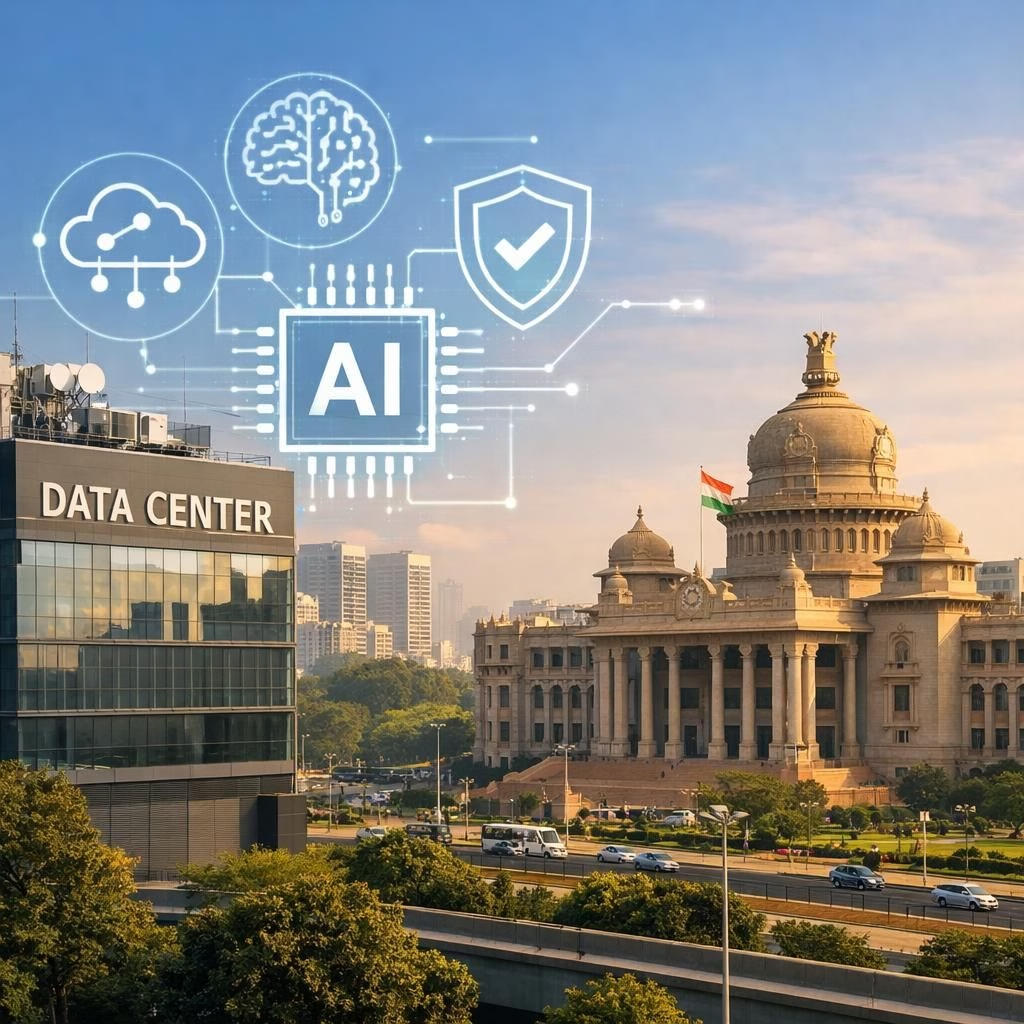
India’s AI future is no longer a rumor; it is a well-lit parade where AI and DPI march together, each lamp powered by public trust. At the AI Impact Summit 2026 in New Delhi—the first global AI summit hosted in the Global South, with 35,000+ delegates from over 100 countries—the message was crisp: own the data, own the infrastructure, own the models. The government unveiled twelve indigenous foundation models, BharatGen’s multilingual promise across 22 Indian languages, and a Rs 10,370 crore national AI mission to fund it all. And right in the middle of that push, Microsoft placed a bold bet: $17.5 billion in India over four years, aiming to help build the pipes for sovereign AI, guided by a DPI-inspired architecture that keeps data processing in-country. In short, the moment is less about shouting AI and more about delivering on a practical, scalable AI future.
AI and DPI: India’s sovereign AI moment
Five signals are lining up to form a coherent, practical path: infrastructure, capital, talent, policy, and market demand. The infrastructure builds are visible: global players expand data centers; India plans hyperscale capacity and faster networks. Microsoft reports 22,000 engineers in the country contributing to the world’s AI stack, and a bold skilling drive. ADVANTA(I)GE India has already trained 5.6 million people since January 2025—well ahead of the goal—and the team keeps looking ahead to 2030, when 20 million Indians join the AI workforce. DPI data sovereignty sits at the center, and the public sector is riding shotgun with policy and procurement that make a real difference for citizens.
From DPI to AI PI: Public infrastructure powering AI
In-country processing and sovereign cloud options for Copilot in India place data within borders, safeguarding government and enterprise information while enabling scalable AI use. The implications are far greater than a technologist’s dream: banks, hospitals, and defence operations benefit from legally anchored data residency. Hyderabad hosts the flagship hyperscale region—the footprint is described as roughly the size of two Eden Gardens stadiums—plus ongoing expansions in Chennai and Pune. The focus remains balanced: hardware is crucial, but so is the talent that builds and uses it. India’s DPI, already a remarkable public backbone, becomes the launchpad for AI PI—the public AI infrastructure that serves the many, not just the few.
AI talent, data sovereignty, and public benefits
The AI narrative shifts from gadgetry to governance and growth. BharatGen, India’s first government-funded multimodal model, runs across 22 languages, while Bhashini supports 35+ languages with 1,600+ AI models deployed across public services such as trains and government portals. DPI-enabled platforms empower AI to reach 310 million workers via e-Shram and the National Career Service, with AI-powered job matching, skill analytics, and automated resume tools. For farmers, 38 million smallholders received AI-driven monsoon forecasts via SMS in 2025, yielding tangible returns and confidence that data can improve livelihoods. The strategy is to diffuse AI across the population, not just to enterprise clients.
The broader Microsoft play shows India as a technology hub, not a captive market. With 22,000 engineers across Bengaluru, Hyderabad, Pune, and other cities, teams build core tools—from Copilot Studio to Azure AI Search and translation services—while delivering local impact. India also hosts more than 1,800 Global Capability Centers, including 500+ focused on AI, making it one of the world’s largest AI engineering hubs. That concentration helps explain why the $17.5 billion commitment is not a stunt but a long-term investment in an integrated AI ecosystem.
What comes next is about execution. The foundation is strong—the data centers, the sovereign cloud, the DPI-AI integration, and the skilling programs. What gets built on top will determine everyday usefulness: safer governance, transparent AI services, and practical benefits for small businesses and public agencies alike.
What are your thoughts on India’s path to sovereign AI in 2026? Share your ideas and questions in the comments below.
Original article: Times of India — Thank you for the original article.
Practical steps for businesses and public agencies
- Assess data residency needs: Map your data flows to in‑country processing options and DPI-enabled services to ensure compliance and trust.
- Leverage public DPI services: Explore government-backed AI tools and multilingual platforms to scale reach while preserving sovereignty.
- Invest in skilling: Partner with local training programs to build AI capabilities; aim for 20 million skilled professionals by 2030.
- Design governance: Implement transparent AI governance, data usage policies, and audit mechanisms across projects.
FAQ
- What is DPI? DPI stands for Digital Public Infrastructure, the public backbone that underpins services like Aadhaar, UPI, DigiLocker, and related platforms to enable scalable, inclusive digital public services.
- What does AI PI mean? AI PI refers to building AI on top of DPI – creating an AI public infrastructure that’s safe, open, and trustworthy for broad use.
- How will this affect small businesses? Public DPI and sovereign cloud aim to give small businesses reliable access to AI tools with data staying in country, reducing risk and enabling innovation at scale.
- When can we expect tangible benefits? While timelines vary, the next few years should show increasing adoption in government services and enterprise tools built in India.