

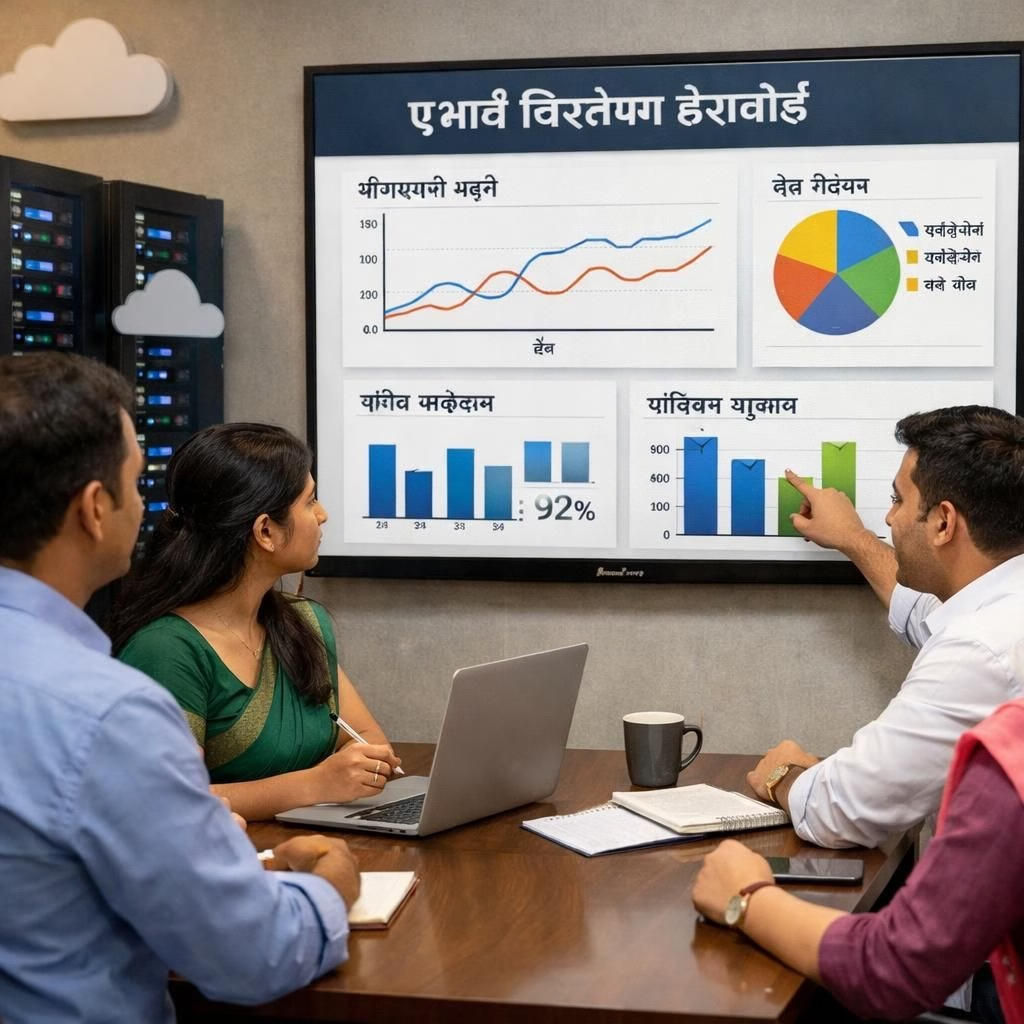
In 2026, AI and India’s sovereign push read less like a headline sprint and more like a deliberate upgrade to the national digital toolkit. The focus isn’t merely chasing frontier glory; it’s about building local, language‑savvy AI platforms that keep critical data and power within national lines. Sarvam AI and BharatGen aren’t mere accessories; they’re India-centered mirrors—engineered, owned, and trusted to serve governance, education, health, and business with a distinctly regional sensibility. The goal isn’t to outpace the world on every frontier, but to outthink the competition by addressing the realities of India languages, the data center footprint, and a governance framework that blends privacy with practicality.
Industry voices echo tempered optimism. A Dell Technologies executive recently suggested frontier models may become less decisive over time; the real differentiator is how a nation tunes its AI to local contexts. In India’s case, that means language support, regional customization, and vertical applications built around real needs. The message: AI advantage will ride on sovereignty, not just sophistication, and this is about ensuring India can own the interpretation and application of AI for its own people and industries.
AI and India’s Sovereign Path: Local Models over Frontier Fantasies
India is actively pursuing sovereign AI platforms that are developed, owned, or controlled within the country. The idea is simple and powerful: keep critical AI capabilities, data, and decision pipelines under national jurisdiction so policymakers, educators, clinicians, and farmers can rely on systems that understand local contexts. Local models aren’t a retreat from global progress; they’re a strategic complement—tools that can be tuned to India’s languages, governance needs, and sectoral quirks. When you pair this sovereignty with a living ecosystem of startups, universities, and public institutions, the potential to improve diagnostics, care, and preventive health becomes tangible rather than theoretical.
Language coverage stands out as a practical battleground. India’s 22 official languages pose both a challenge and an opportunity: a frontier where AI gains heart by speaking in many tongues. The world’s most popular chatbots today don’t fully cover all India’s languages, which can impede access to education, government services, banking, and healthcare. Sovereign platforms that embrace multi-language capabilities can bridge gaps, enabling more inclusive access. The broader implication is clear: AI can expand benefits to millions who previously faced a digital divide—if the models are built with linguistic nuance and local data stewardship in mind.
Frontier AI models aren’t irrelevant, but their value lies in collaboration rather than domination. The future of AI in India is likely a mix: strong, globally informed models for broad capabilities and locally tuned models for regional relevance. This blend can deliver regionally aware search, more accurate translation, vertical-tailored automation, and governance-ready AI that respects local regulations and data sovereignty. If frontier models are the high-speed expressway, sovereign models are the regional rail network—reliable, context-aware, and designed to handle the locals’ routes with efficiency and safety.
AI and India’s Language Edge: Local Context Rules
Language—the lifeblood of effective AI in a multilingual nation—has to lead the design. India’s languages shape user interfaces, education, and public services. The absence of comprehensive language coverage means millions can be left behind as AI becomes more capable. By investing in localized data, language models, and verticals such as agriculture, healthcare, and education, sovereign AI projects can unlock tangible benefits across sectors. This isn’t a luxury; it’s a practical necessity for a diverse democracy where the value of AI multiplies when citizens can interact in their mother tongue.
Vertical specialization matters too. Healthcare diagnostics, agriculture optimization, and public-service automation all benefit from AI that understands local workflows and regulatory realities. Sovereign models can incorporate India-specific taxonomies, clinical guidelines, and farm-management practices in ways that global models sometimes miss. The payoff is improved outcomes for patients, farmers, and students—and a stronger, more resilient digital backbone for the nation.
Cost dynamics are a recurring theme in enterprise AI discussions. In India, enterprises weigh model usage against local data sovereignty, latency, and the complexities of integrating AI with entrenched systems. The conversation often centers on tokenomics and the desire to consume high-quality models without breaking the bank. Local models that are tuned for local economics—without sacrificing security—answer a real need. In turn, this supports a robust ecosystem where startups can build, pilot, and scale AI solutions that align with India’s regulatory and business environments.
India’s Language Edge in AI: Facing Costs with Clever Localization
Startups and large enterprises alike recognize that “one size fits all” rarely fits India. Building locally fueled AI—guardrails, data privacy, and region-specific models—helps reduce cost pressures by allowing onshore customization and data governance that aligns with local needs. The cost conversation is not merely about cheaper models; it’s about sustainable, regionally appropriate AI that can be deployed quickly, updated regularly, and maintained with predictable budgeting. In practice, the best outcomes come from combining cloud-scale compute with on-premise data stewardship, enabling faster iterations while respecting privacy and security requirements.
New Delhi’s push to cultivate a domestic AI industry mirrors a broader global trend: governments supporting homegrown ecosystems to complement global advances. The goal isn’t to close doors to foreign technology; it’s to ensure India can steer, adapt, and apply AI in ways that fortify its own economy and public services. In this light, the $1.2 billion AI Mission is a modest but meaningful investment when viewed against the multi‑billion-dollar budgets of some global tech majors. The real value lies in creating a sustainable pipeline of talent, startups, and public-private collaborations that keep India competitive while preserving national priorities.
The human element remains central. India has a huge talent pool of graduates and engineers who can help stitch together complex AI systems. System-level thinking—understanding how data, software, hardware, and policy interlock—may be the most valuable skill in the coming years. AI can handle many specialized tasks, but intelligent integration—seeing how the parts fit—will separate sustained success from short-term wins. The human edge isn’t erased by automation; it’s amplified by it when AI is guided by clear strategy and robust governance.
And yes, the government’s role is not to replace enterprise innovation but to enable it. A balanced partnership between sovereign AI initiatives, industry players, and academic research can accelerate progress while maintaining transparency, accountability, and regional relevance. The future of AI in India will be a collaborative narrative where sovereignty and openness walk hand in hand, ensuring the technology serves people across languages, sectors, and geographies.
As India marches toward a more sovereign AI posture, the broader lesson for other nations is clear: regional context matters. Frontier models will coexist with local models, and the most meaningful progress will come from systems that understand and respect local languages, industries, and governance realities. The result could be AI that is not only powerful but also practical—AI that helps India’s people, businesses, and institutions thrive in a complex, multilingual world.
If you’re curious about how sovereign AI might reshape education, healthcare, and governance in India, I’d love to hear your thoughts. Share your perspective in the comments and tell us which local AI capability you’d like to see next turned into a scalable, real-world solution.
External sources and context can strengthen this discussion. For example, see the National AI Portal India for policy and implementation details, the World Economic Forum on AI governance, and broad scientific coverage from Nature to understand how language technologies evolve in diverse markets.
External sources
References
- Original article source: Indian Express. Link: https://indianexpress.com/article/technology/tech-news-technology/sovereign-ai-india-edge-dell-satish-iyer-interview-10707062/