

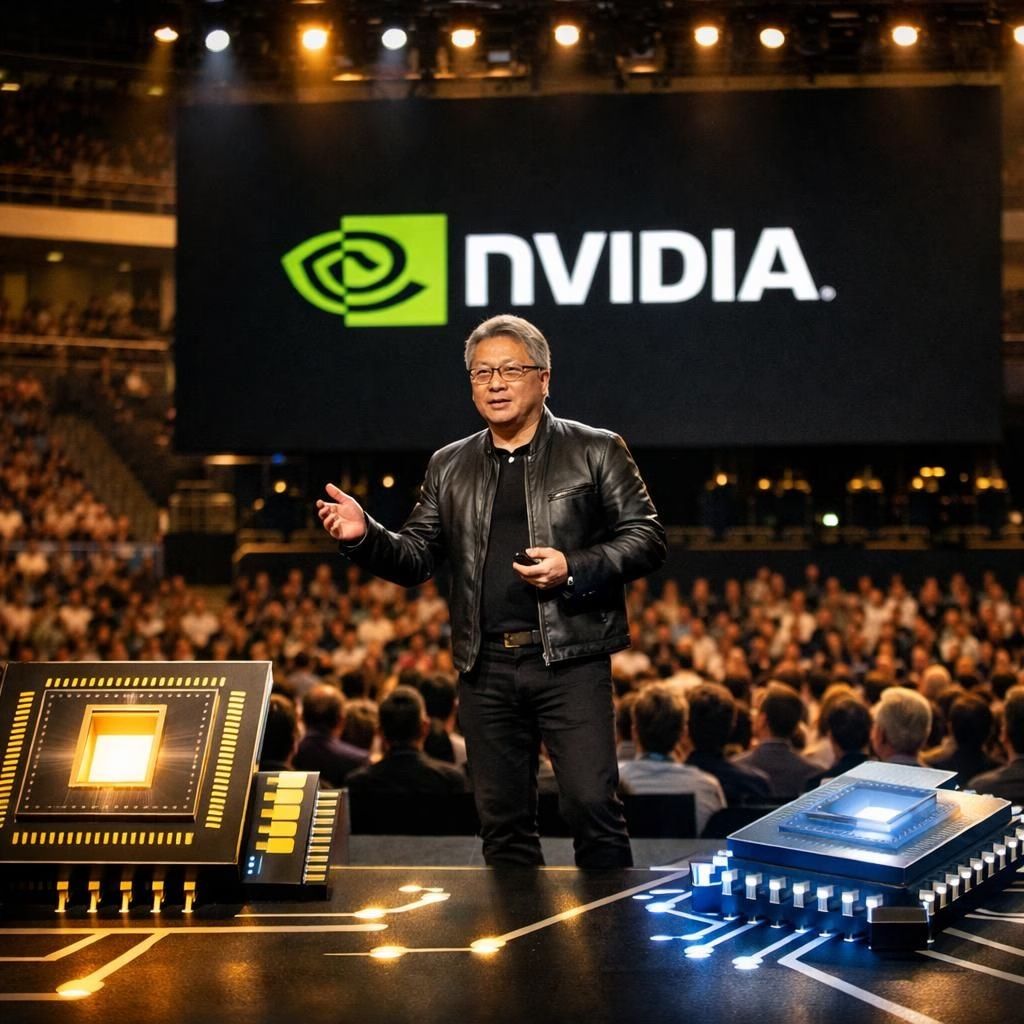
Inference computing is no longer a niche buzzword; AI chips are moving from backroom labs to real-world deployments. At Nvidia’s GTC, CEO Jensen Huang outlined a plan to push revenue toward $1 trillion by 2027, expanding real-time inference from cloud data centers to edge devices. Huang wore his signature black leather jacket and laid out a pragmatic road map for winning the inference computing and AI chips duel that dominates the show floor. The centerpiece is a new central processor and an AI system built on Groq technology, licensed for $17 billion in December in San Jose. The pitch is simple: cement Nvidia’s leadership in AI chips and in inference computing as demand climbs for production-grade AI across industries from healthcare to manufacturing and beyond.
inference computing and AI chips: Nvidia’s bold forecast
The message is ambitious but anchored. Nvidia argues the inference inflection is real and scalable. Its Vera Rubin chips will handle the prefill stage — translating human language into tokens that AI chips systems can process. Groq’s new chips take over the decode stage, delivering the final answers users request. After years of heavy investment in training chips, the industry is tilting toward serving hundreds of millions of users who rely on these AI systems in daily operations. OpenAI, Anthropic, and Meta are pursuing large-scale deployment, and CPUs are increasingly viewed as viable, cost-effective alternatives to classic GPU horsepower for certain workflows. Nvidia bets that practical throughput and lower per-query costs will matter as organizations scale production beyond experiments, not just prototypes.
Huang emphasized a pragmatic balance between compute supply and operational realities. While GPUs remain formidable for training, the new approach positions Nvidia to win where latency, throughput, and total cost per inference matter most. That includes a broader push into CPUs, where Nvidia has begun selling stand-alone Vera CPUs as part of a diversified portfolio. The Feynman roadmap promises an ambitious lineup of AI processors and networking chips that could reshape how data centers are built for inference workloads. And yes, the roadmap keeps a lively pace, with Rubin Ultra chips following the Rubin family and a 2028 arrival window for some pieces of the architecture. The punchline is that Nvidia wants to own both the hardware and the software stack that turns questions into fast, reliable answers.
Why inference computing matters for 2026
In a move that reflects the industry’s reality, Nvidia isn’t pretending one chip fits all. It’s building an ecosystem that blends high-performance AI chips with programmable CPUs to cover a spectrum of workloads. NemoClaw, an autonomous AI agent platform, is pitched as a way to extend privacy and safety controls into tools that can autonomously perform tasks with minimal human oversight. OpenClaw, which has generated global buzz, is positioned as a governance-forward extension that helps organizations keep pace with rapid automation while maintaining oversight. In practice, that means more trustworthy AI deployments and fewer headaches for operators who worry about compliance and safety in real time. This balance between capability and control is the strategic core of Nvidia’s move from pure training to practical, scalable inference computing and reliable AI chips.
>
Investors have reacted with mixture of awe and cautious skepticism. The $1 trillion forecast signals durable demand rather than a single surge. Analysts like Jacob Bourne of Emarketer noted Nvidia’s strategy signals leadership in AI infrastructure as the broader AI industry moves from experimentation to deployment at scale. In this world, AI chips and inference computing are about delivering predictable, scalable value as systems mature. The company’s emphasis on a mixed architecture — GPUs for training, specialized AI processors for inference, and CPUs for orchestration — reflects a plan to balance performance with reliability in a market that values both.
On the technology front, Nvidia’s presentations leaned into real-time practicality. The two-step inference pipeline — prefill and decode — maps a clear division of labor, with specialized hardware optimizing each phase. Vera Rubin handles the initial interpretation of user prompts, while Groq’s decode stage delivers crisp, final answers. This modular approach could enable a broad range of applications to deploy AI at scale without forcing every workload into a single chip. In short, AI chips and inference computing are becoming a mosaic of purpose-built components designed to optimize cost and speed across tasks.
Beyond the hardware, governance and safety topics received attention. NemoClaw’s privacy features and OpenClaw’s safety controls are framed as essential complements to performance. The industry increasingly recognizes that scale without guardrails can be risky, so Nvidia’s framing points to a future where fast inference sits alongside accountable AI use. For businesses, that translates into a clearer path to compliance and a stronger grip on risk as AI becomes embedded in critical decisions and customer interactions. For technologists, it’s a reminder that progress happens through coordinated moves across hardware, software, and policy.
From a market perspective, the conversation also touches on competition and ecosystem dynamics. CPUs, once a niche, are re-entering the frame as viable deployment targets for AI workloads in latency- and energy-conscious environments. Nvidia’s strategy embraces a hybrid reality: GPUs train the world’s largest models, AI chips accelerate inference, and CPUs provide orchestration, offering customers more options to tune performance to specific needs. The outcome is a pluralist hardware landscape that promises better choices for real-world deployment.
Societal and industry implications deserve attention too. A more capable inference stack could speed medical breakthroughs, smarter industrial automation, and more responsive consumer services. It also raises questions about energy use, supply chain resilience, and the need for robust safety assurances as AI moves deeper into daily life. The outlook remains practical: more capability should come with smarter governance, transparent cost structures, and clearer pathways to responsible use. Nvidia’s presentation nods to all of this with the same calm confidence that has defined its public messaging for years: push the frontier, but do so with a plan, a timeline, and a sense of shared benefit for developers, businesses, and end users alike.
We invite readers to share their thoughts in the comments below. How do you see the balance between AI chips, inference computing, and real-world deployment shaping your industry in 2026 and beyond?
External perspective: Reuters coverage of Nvidia’s AI hardware bets offers additional context on the company’s market positioning and investor reception.
References and original material can be found from independent reporting sources to provide broader context and verification.
Original article: Nvidia bets on AI inference as chip revenue opens 1 trillion (Indian Express)
Practical steps to deploying real-time inference
- Assess workloads to identify where prefill (language interpretation) or decode (final answers) will drive the most value.
- Start with a hybrid stack that blends GPUs for training with dedicated AI processors for inference and CPUs for orchestration.
- Implement governance and safety controls early, using platforms like NemoClaw and OpenClaw to manage privacy and compliance.
- Pilot edge-to-cloud deployments to measure latency, cost per inference, and scalability across regions.
FAQ
- What is inference computing? A shift from training-only AI to real-time answering and action execution across devices, using specialized hardware for each stage of the workload.
- How do Vera Rubin and Groq fit in? Vera Rubin handles prefill (turning prompts into tokens); Groq handles decode (providing final answers). The approach is modular and scalable.
- Will Nvidia’s $1 trillion forecast come true? It depends on continued demand, execution, and governance. The plan aligns with growing production AI across industries and edge deployments, but outcomes vary by market and execution risks.
- What about CPUs in this mix? CPUs are increasingly seen as essential for orchestration and cost-effective deployment, complementing GPUs and AI processors.
Conclusion
Nvidia’s strategy signals a broader shift: a plural hardware stack optimized for real-time AI workloads rather than a single-chip race. The emphasis on governance and edge-to-cloud deployment suggests a practical path toward broad, responsible AI adoption.