

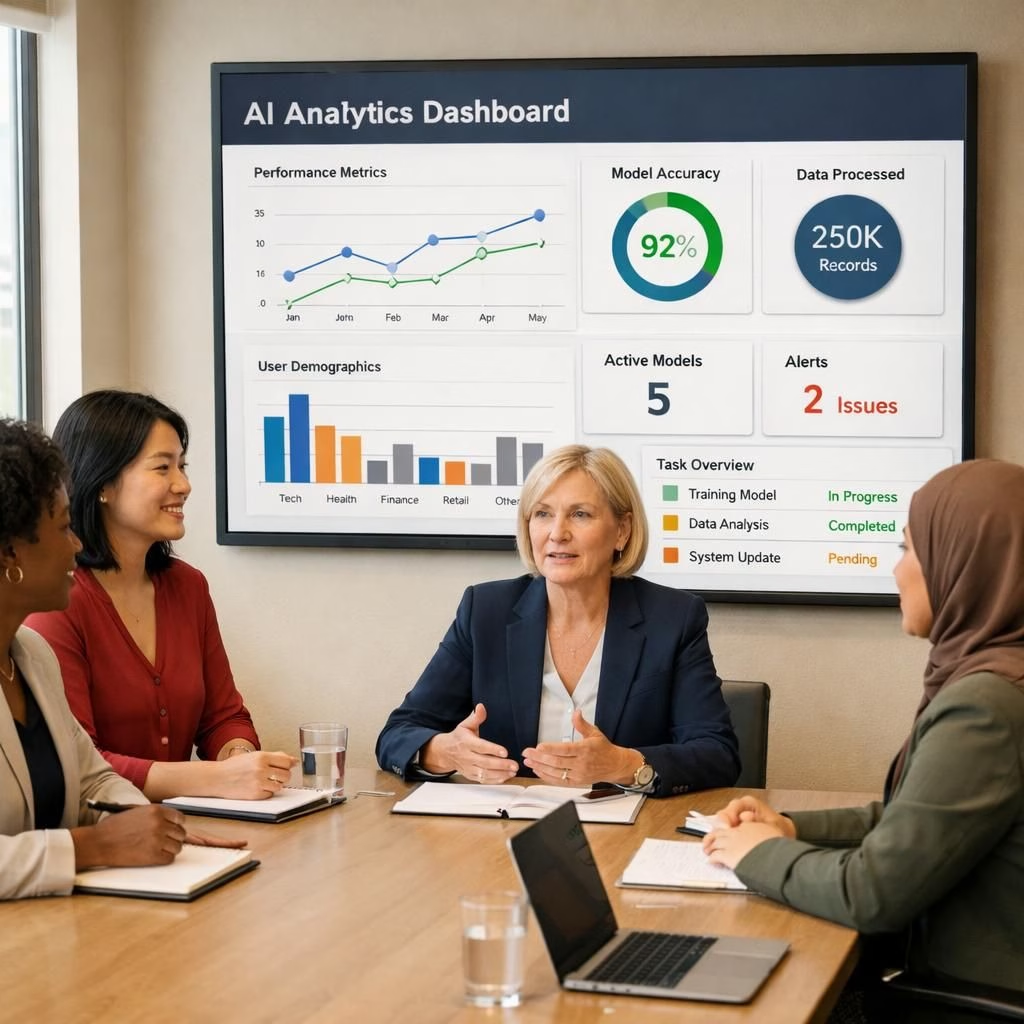
In 2026, Women in Tech are reshaping Enterprise AI governance with practical charm and a laser focus on safeguards by design. Across global tech firms, female leaders are shaping the architectures, governance frameworks, and engineering practices that keep AI transparent, reliable, and responsible as it scales. Not all heroes wear capes; some wear manager badges and lead from the front even when they started as non-coders who turned curiosity into deployments. This is not magic—it’s a disciplined transformation where business understanding meets ethical design, and where governance is not a page in a policy manual but a daily reflex guiding decisions.
Women in Tech: Governance by Design for Enterprise AI
The journey begins with a charter that says, plainly, we build trust into the system, not slap it on later. In countless boardrooms and sprint reviews, leaders insist that data governance, model auditing, and responsible deployment are embedded into the architecture from day one. The message is simple: governance should be a feature, not a fossil. When you design for accountability, you reduce drift, minimize bias, and make AI outcomes legible to business users and regulators alike. This is governance with a grin: rigorous enough to keep risk in check, light enough to invite collaboration rather than resistance.
Across regions, non-coders are leading AI adoption with surprising fluency. People who once ran operations or managed HR pipelines now interpret dashboards, not just numbers. They ask practical questions: Will this resume screening tool perpetuate bias? How do we prove the model’s decisions are fair? Can we trace why a recommendation happened without exposing sensitive data? The answers lie in modular, interpretable pipelines that pair governance checkpoints with real-time observability. In this world, governance charter holds steady as a living framework that bridges theory and day-to-day impact.
Take the case of internal AI-enabled workflows that accelerate hiring, learning, and performance reviews. When governance is built in, the same AI that speeds up processes also explains itself. It tells a recruiter why a candidate is flagged for further review, or clarifies why a learning path is recommended to a particular employee. The dual benefit is speed with accountability, which is exactly the balance that enterprise stakeholders crave. And yes, it can be practical without feeling bureaucratic: guardrails that are obvious to users, not obtuse to auditors, and that scale as smoothly as the software itself.
Enterprise AI at Scale: Leadership by Women in Tech
Scaling Enterprise AI is less about sprinting to the latest model and more about resilience, architecture, and a human-centric approach. When leadership emphasizes scalable design, the entire organization learns to treat AI as a system of interconnected parts—data, models, pipelines, and people—rather than a collection of isolated experiments. Data integrity and governance are not garnish; they are strategic levers that determine whether AI reshapes the enterprise or merely nudges it forward.
From the CIO suite to business units, the emphasis is on responsible upskilling and governance that sticks. Leaders advocate for building AI foundations that are auditable, drift-detectable, and resilient against unexpected inputs. Practical upskilling focuses on turning teams from automation-first thinkers into redesign-minded operators who see AI as a partner in problem solving. When you train people to design for governance, you empower them to spot risks early, test hypotheses robustly, and adjust course with confidence. That is leadership in action—where the charter guides strategy and ethics stay in the driver’s seat as capabilities grow.
In real-world terms, Enterprise AI is increasingly about tightly governed end-to-end platforms. Organizations deploy composable AI architectures that weave generations of AI tools—generative models, agentic systems, and domain-specific copilots—into enterprise platforms. The focus is on secure data pipelines, robust model governance, and credible AI that is aligned with risk frameworks. The goal is not to chase novelty but to deliver reliable, transparent, and measurable impact across product development, customer operations, and back-office functions. Leaders envision a future where AI literacy is universal and human judgment remains central, enhanced by trustworthy automation.
Another key theme is the factory floor of AI—how teams implement practices that scale without sacrificing quality. This means explicit attention to security-first design, continuous integration of governance checks, and the ability to audit outcomes without slowing teams down. When leaders take the helm here, the message is consistent: scale responsibly, maintain explainability, and invest in governance as a whole-system capability. It’s not enough to deploy; you must sustain, monitor, and adapt, all while keeping the human partnership front and center.
Across industries—from HR to healthcare to IT—applications proliferate and the need for trustworthy AI grows louder. AI-assisted resume screening, personalized learning paths, and decision-support tools are increasingly common, but only if governance keeps pace. Leaders insist that responsible AI at scale requires ongoing collaboration among data scientists, legal, compliance, and business units. The result is a more humane, capable enterprise where AI magnifies human strengths rather than erasing them. In this landscape, women technologists are champions who shape policy, culture, and the very architecture of enterprise intelligence.
So what does this mean for teams trying to navigate the 2026 AI landscape? It means prioritizing governance-as-a-feature, championing non-coder leadership, and elevating women in tech to guide broad adoption without bending ethics. It means designing AI systems with transparency baked in and with credible accountability structures that users can trust. It means recognizing that the most impactful AI is not the loudest experiment, but the steadily improving system that helps people do their jobs better while feeling secure about what the AI is doing and why.
To make this practical, organizations can start with a few core actions: codify an AI charter that links business outcomes to governance metrics; implement modular pipelines with clear audit trails; invest in AI literacy across the workforce; and nurture mentorship that helps emerging leaders rise to senior roles where they can influence scale, safety, and ethics in tandem. The goal is a pragmatic, measurable path to responsible AI at scale.
Practical steps to implement governance by design
- Codify an AI charter that ties business outcomes to governance metrics.
- Build modular pipelines with clear audit trails and explainability checkpoints.
- Invest in AI literacy across the workforce to empower non-experts.
- Nurture mentorship programs that help new leaders advance to senior roles.
FAQ: practical questions about governance by design
- What is governance by design, and how is it different from traditional governance?
It embeds accountability, auditing, and risk controls into the AI development lifecycle from the start, not as an afterthought. - Can non-coders participate in AI governance?
Yes. Business operators and non-technical leaders can define risk thresholds, review model outputs, and ensure compliance with policies. - How do you measure success for governance in AI projects?
Metrics include explainability, drift detection, auditability, regulatory alignment, and stakeholder trust. - What are the risks of scaling AI without governance?
Risks include bias amplification, privacy breaches, regulatory penalties, and erosion of trust.
Finally, this shift is more than a trend; it is a long arc toward responsible, inclusive innovation. Elevating women in tech expands the range of perspectives that shape thoughtful, scalable, trustworthy AI that serves people and business alike. The takeaway is clear: invest in governance, empower non-coders, and celebrate leadership that brings both rigor and optimism to Enterprise AI at scale.
References
- OECD AI Principles: https://oecd.ai/en/delivery/principles
- NIST AI Risk Management Framework: https://www.nist.gov/itl/ai-risk-management-framework
- Original source: https://timesofindia.indiatimes.com/technology/times-techies/the-women-writing-ais-rulebook/articleshow/129429977.cms