

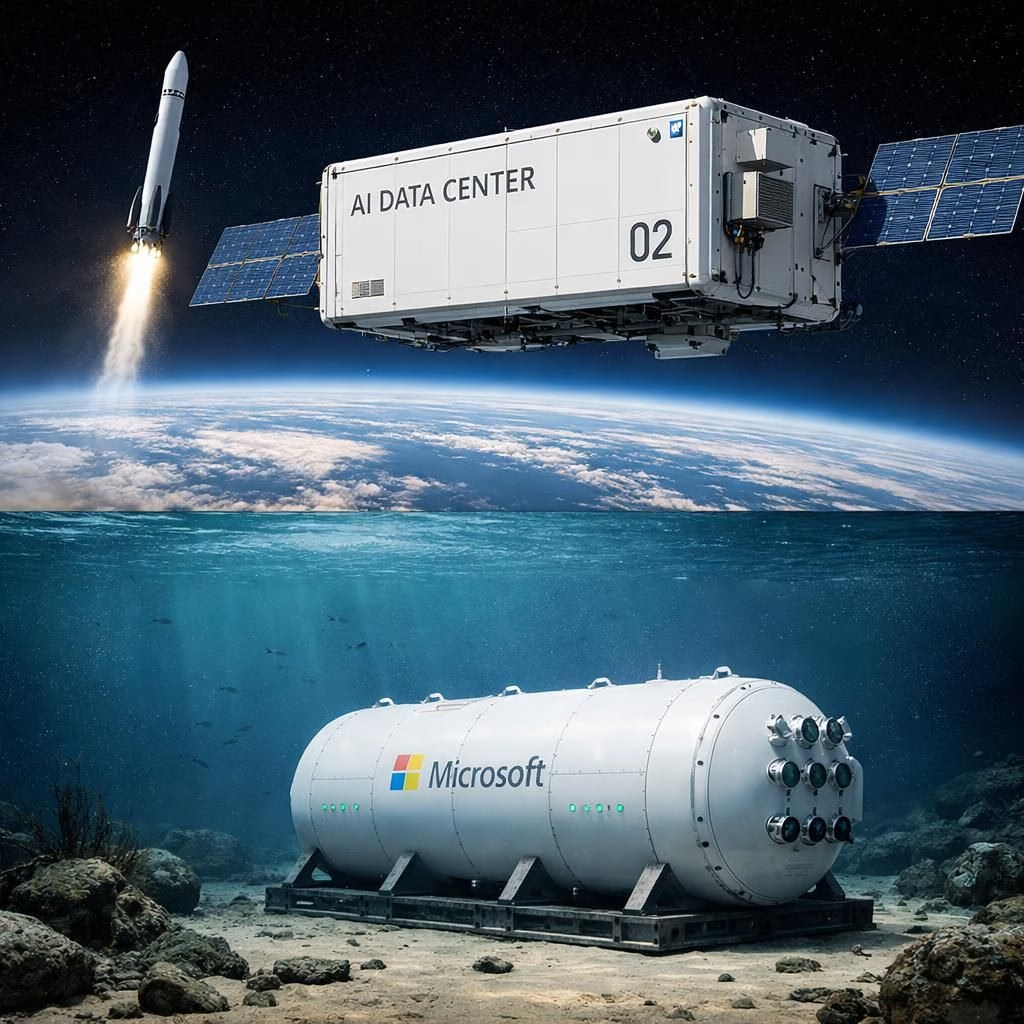
SpaceX’s AI data-center-in-orbit idea reads like a bold sci‑fi mood board—and it’s a real bet SpaceX is pursuing with its AI ambitions. The plan hints at an IPO tied to xAI and a project to deploy up to a million data‑center satellites to push beyond Earth’s limits on power and water. The ambition is compelling, but the key questions are about feasibility, costs, and timing as much as the hardware.
SpaceX’s Orbit AI Data Center Dream
SpaceX, propelled by bold headlines and big bets, aims to place an AI-powered data center in orbit. The company hints at leveraging xAI, its AI initiative, with talk of an IPO that could move tens of billions. The goal isn’t only to deploy hardware; it’s to build resilience for an AI-driven era. The tech is ambitious, the math is sharp, and the practicalities remain challenging: cooling in microgravity, radiation, and ongoing hardware refresh cycles every few years.
Sea Lessons and the Data Center Debate
Microsoft’s Project Natick showed a seabed data center that used natural seawater and offshore power to cool. The targets were met, but demand and economics lagged. Reuters reported that the project faded not from technical failure but from a market that didn’t scale. The takeaway: innovation must prove how it scales in real markets. That’s a timely nudge for SpaceX to balance dream with demand and to test not only feasibility but a strong business case.
From Ground to Orbit: Economics, Tech, and Reality Checks
Analysts say space‑based data centers would require a dramatic drop in launch costs to be economically viable. Today’s price per kilogram remains a barrier to mass deployment. A million satellites would push the bill into trillions unless the economics improve dramatically. Still, the conversation stays constructive. Experts like Tim Farrar remind us that the question isn’t merely “can it work?” but “does it make sense versus expanding terrestrial infrastructure?” In this view, SpaceX’s goal is not to replace ground data centers but to explore what orbit could offer beyond land‑based compute.
The plan leans on a few bold bets: cheaper launches, more robust AI-chips, and Starship‑level reusability. The Starship program aims to be the backbone of a new orbital data‑center ecosystem. Yet Starship is years behind its milestones, and reliability remains a work in progress. Still, the idea persists. If launch costs fall and chips become robust enough, SpaceX might unlock capabilities that today feel like a distant sci‑fi script—providing orbital compute where it makes sense, not merely where it sounds exciting.
In the AI context, observers say orbital compute could tackle space missions and ground tasks with AI workloads that benefit from local compute, reducing round‑trip data traffic and improving latency for critical operations. AI workloads could be a strong early use case if reliability improves and launch costs fall.
Who Counts as the Customer? The Market Reality Check
Blue Origin’s Sunrise concept and others echo caution: orbital compute could be a niche that complements, not replaces, ground facilities. Analysts say orbital data centers would serve specialized contexts: military satellites, space stations, and critical infrastructure where downlink bandwidth is a premium and latency is a secondary concern. The economics must pencil out in those niche cases first, while broader adoption waits for a longer runway of cost reductions and reliability gains.
In the AI context, observers say orbital compute could tackle space missions and ground tasks with AI workloads that benefit from local compute, reducing data traffic and improving latency for sensitive operations. AI workloads could be a strong early use case if reliability improves and launch costs fall.
Analysts like Claude Rousseau of Analysys Mason emphasize that space‑based AI compute remains a niche, not a replacement, because orbit carries unique risks and maintenance cycles. Nvidia’s Jensen Huang has urged a grounded approach, noting that orbital AI infrastructure is a longer‑term engineering challenge rather than a short‑term fix. The thread remains: space computing will likely find its sweet spot only when macro costs, chip tech, and demanding use cases align.
Observers say SpaceX should pursue pragmatic milestones rather than a full fleet at once. The path likely involves a handful of high‑impact pilots, measured cost, and clear demand signals before broader deployment. For AI teams chasing speed and resilience, the takeaway is simple: pilots first, not fantasies first.
As with Microsoft Natick, the real lever is a package: reliable cooling, modular upgrades, and a business case that is sound both technically and financially. The space‑centric idea should learn from the sea and from the ground. A balanced outcome might be a fleet of orbiting compute pods that handle peak workloads and backhauls, while terrestrial data centers stay lean, nimble, and updatable. In 2026, this balance could be the sweet spot that keeps imagination and practicality in a productive duet.
In practice, orbital AI workloads would need reliable, scalable chips and cooling to remain attractive, a condition that is still under development.
Practical Takeaways for 2026 Readers
- Ambition can drive breakthroughs, but market fit keeps the lights on. SpaceX’s orbit data center dreams illustrate the power of bold goals paired with pragmatic milestones.
- Undersea and orbital experiments teach the same lesson: you need reliable cooling, scalable upgrades, and a path to affordable operations.
- Data center economics matters more than the wow factor. Whether on land, sea, or in space, the cost curve matters as much as the capability curve.
In short, the future of compute may bend toward a hybrid model where space adds value in select contexts and earth remains the backbone. The specifics will hinge on technology advances, launch economics, and the ability to find early adopters who value orbital compute for mission‑critical tasks. If you’re planning for 2026, keep an eye on modularity, maintenance cycles, and the economics of scale. The space dream remains exciting; the practical path to it remains the real battle.
Original article and sources: Original source: Indian Express. Special thanks to Reuters for the source material and the valuable context that sparked this piece.
FAQ
-
Can orbital data centers work today?
Not yet at meaningful commercial scale. The concept hinges on dramatic cost reductions for launches, improved reliability of AI chips, and proven maintenance cycles in space.
-
What would be the main advantage of space‑based compute?
Orbital compute could reduce ground data traffic during deep‑space missions or dense satellite networks, and it might enable near‑instant processing for space assets where downlink is costly.
-
Why did Microsoft’s Natick approach struggle?
It met technical targets but failed to achieve scalable demand and a favorable economics, underscoring that feasibility must meet market reality.
-
When could we see pilots or early deployments?
Most analysts expect early pilots to occur only after tangible reductions in launch costs and a clear return on investment for niche use cases.
References
External sources
- Reuters: SpaceX, Microsoft, and orbital data centers
- IEEE Spectrum: Orbital data centers and compute
- SpaceX Starship