

AI isn’t merely a buzzword for tech teams and boardrooms; it’s quietly steering geopolitics by redefining what counts as critical infrastructure. In 2026, the Iran–U.S.–Israel standoff spills into digital spaces, turning hyperscale AI data centers and cloud platforms into strategic assets. The latest IRGC video injects geopolitics into the data room, reminding investors and operators that AI and [cybersecurity] are concrete, high-stakes levers. The premise is simple, unsettling, and practical: the networks behind banking, ride-hailing, and climate science can become the battlefield. This isn’t alarmism; it’s a call to strengthen AI governance and [cybersecurity] planning so uptime remains a competitive edge, not a political casualty. And we’re keeping a measured, human tone—resilience without humor is like a data center with no backup generator: loud, expensive, and prone to darkness.
AI-Driven Geopolitics and the Data Center Moment
The IRGC briefing is blunt: if the United States pushes its stance on Iran’s power plants, retaliation will be swift. The warning then expands to include all information and communications technology in the region, signaling that cloud platforms, telecom networks, and AI data centers alike could be drawn into the crossfire. The rhetoric may be theatrical, but the implications are real: a crisis can ripple through AI workloads, disrupt [cybersecurity] protections, and destabilize regional cloud services that modern businesses rely on. This is not a fantasy scenario for IT teams; it’s a reminder that risk planning must account for geopolitical volatility, not just cyber threats. The takeaway for leaders is clear: strengthen redundancy, diversify providers, and bake political risk into budget cycles—AI and [cybersecurity] budgets can no longer be treated as separate, siloed line items.
The video also foregrounds the role of global hyperscalers, implying that AI data centers are not merely neutral utilities but assets that could become strategic targets. That framing matters because it nudges the industry toward more transparent security standards, shared best practices, and a broader conversation about responsible AI deployment in fragile regions. In practical terms, that means tighter access controls for AI inference servers, more robust monitoring, and a renewed focus on physical-layer security for data facilities that sit at the intersection of policy and power reliability. AI is the engine; [cybersecurity] is the shield—and both demand equal respect from executives who care about uptime as a primary performance indicator.
Abu Dhabi Stargate: The Desert Data Dream With Real Stakes
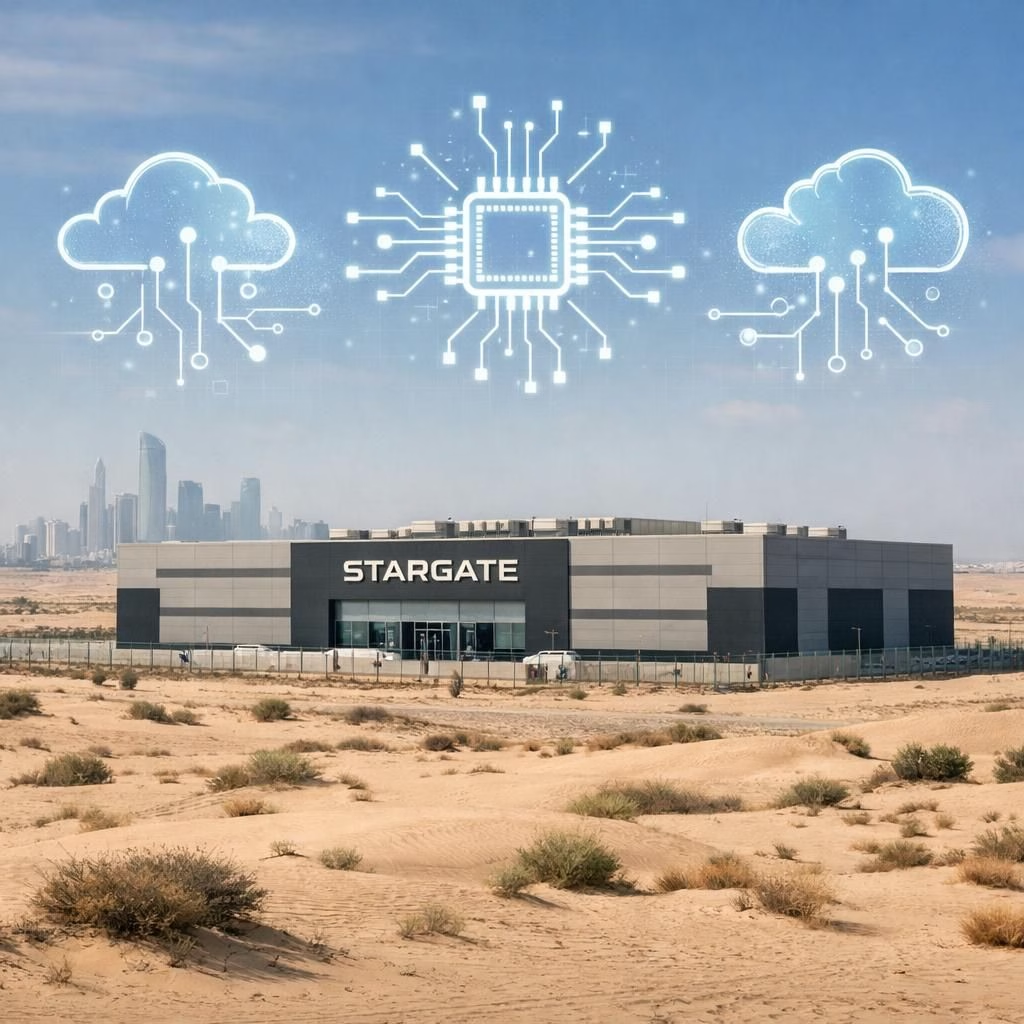
The same video zooms in on a desert location near Abu Dhabi, allegedly revealing a large AI data center tied to a project sometimes called Stargate. The image is dramatic, but the message is practical: a facility of this scale—valued at about ₹2.5 lakh crore or roughly $30 billion—reconfigures regional resilience baselines. The on-screen caption, “Nothing stays hidden to our sight, though hidden by Google,” plays like a line from a tech thriller, yet it underscores a real policy signal. For operators and investors, visibility matters: the more stakeholders can observe where data sits, the easier it is to map risk, plan contingencies, and communicate incident response clearly under pressure.
From an operations standpoint, Stargate-type facilities push CIOs to reassess capacity planning, energy sourcing, and cooling in a climate-and-politics-fluctuating region. The idea of a centralized AI data center doesn’t vanish in a crisis; it becomes a call to harden networks, diversify physical locations, and embed [cybersecurity] into every layer of the data stack—from routing and switching to cloud orchestration and AI model governance. AI-driven analytics can help detect anomalous access in real time, and [cybersecurity] teams can use synthetic data to test resilience without risking real customer information. This isn’t fearmongering; it’s smarter risk management for a world where AI data centers sit at the heart of national and regional competitiveness.
Cybersecurity Realities: Cloud, AI, and Regional Resilience
[cybersecurity] considerations aren’t a luxury add-on; they are a baseline for any enterprise that relies on cloud and AI. The broader tech ecosystem must acknowledge that geopolitical flare-ups can cascade into cloud outages, service degradation, and delayed settlements across markets in Asia, Europe, and Africa. When hyperscale data centers in the Middle East face new risk profiles—physical security, supply chain integrity, and cross-border data flows—the ripple effects touch fintech apps, ERP systems, and beyond. The practical response is to build more resilient architectures: multi-region deployments, standardized incident playbooks, smarter DDoS defenses, and automated failover mechanisms that keep AI workloads humming even if one data center goes dark. Uptime Institute notes that resilience is non-negotiable for critical services, and that guidance applies with special force where politics and power infrastructure intersect.
There are unverified reports of damage to some AWS facilities following rocket strikes, though no official confirmation has been released. Until factual details emerge, teams should temper sensational headlines with disciplined risk assessment. The real value for 2026 lies in proactive, collaborative security planning: tabletop exercises that simulate geopolitical shocks, AI governance reviews to keep model outputs aligned with policy, and cloud-native resilience practices that minimize single points of failure. AI workloads—whether for predictive maintenance, demand forecasting, or real-time anomaly detection—benefit from distribution, auditability, and cryptographic protection. WEF highlights that governance and resilience go hand in hand with responsible innovation, especially in unstable regions.
From a tech-ecosystem perspective, the episode reminds us that regional policy can shape cloud pricing, data sovereignty decisions, and the pace at which AI services expand across borders. Leaders who treat [cybersecurity] as an operating discipline—and who view AI governance as a core governance issue, not merely a compliance checkbox—will likely achieve faster incident recovery, clearer security metrics, and healthier regulator relationships. AI and [cybersecurity] aren’t separate battles; they’re two sides of the same coin: enabling innovation while preserving trust and safety.
What does this mean for the everyday tech professional? Start with a practical triad: inventory and segment AI workloads, implement region-aware access controls for cloud and AI platforms, and invest in continuous security testing using realistic simulations. Build redundancy into network paths, storage replicas, and model update pipelines so a geopolitical event doesn’t become a service outage. AI can drive efficiency and insight, but [cybersecurity] keeps the door from being kicked in. Together, they form a resilient foundation for 2026 and beyond, especially where data centers and policy intersect in powerful, sometimes unexpected ways.
Source attribution and gratitude to the original article for the material used here: Original article. Thank you to the authors and publishers for providing the foundational material that inspired this discussion.
Practical takeaways for practitioners
- Inventory AI workloads and segment data flows by region to limit blast radii.
- Implement region-aware access controls for cloud and AI platforms.
- Run regular resilience drills, including tabletop exercises for geopolitical shocks.
- Invest in multi-region deployments and automated failover to protect uptime.
- Govern AI through clear model governance, audit trails, and policy-aligned outputs.
FAQ
- Q: What is the Stargate project, and should I treat it as a forecast or a rumor?
- A: The report frames Stargate as a large-scale AI data-center project with geopolitical signaling. Treat it as a cautionary benchmark for resilience planning rather than a confirmed facility; focus on robust risk management for any near-term large-scale AI deployment.
- Q: How should organizations adjust their cloud strategy in light of geopolitics?
- A: Favor multi-region deployments, diversify providers, enforce strong access controls, and maintain up-to-date incident response playbooks that cover both cyber and physical risks.
- Q: Where can I learn more about AI governance and cybersecurity best practices?
- A: Look to industry bodies and standards groups for governance frameworks, and pair them with ongoing exercises. For broader context, credible sources on AI governance and resilience can be found from IEEE Spectrum and major standards organizations.
References
External perspectives:
IEEE Spectrum: AI governance •
Uptime Institute: data-center resilience •
World Economic Forum: cyber resilience