

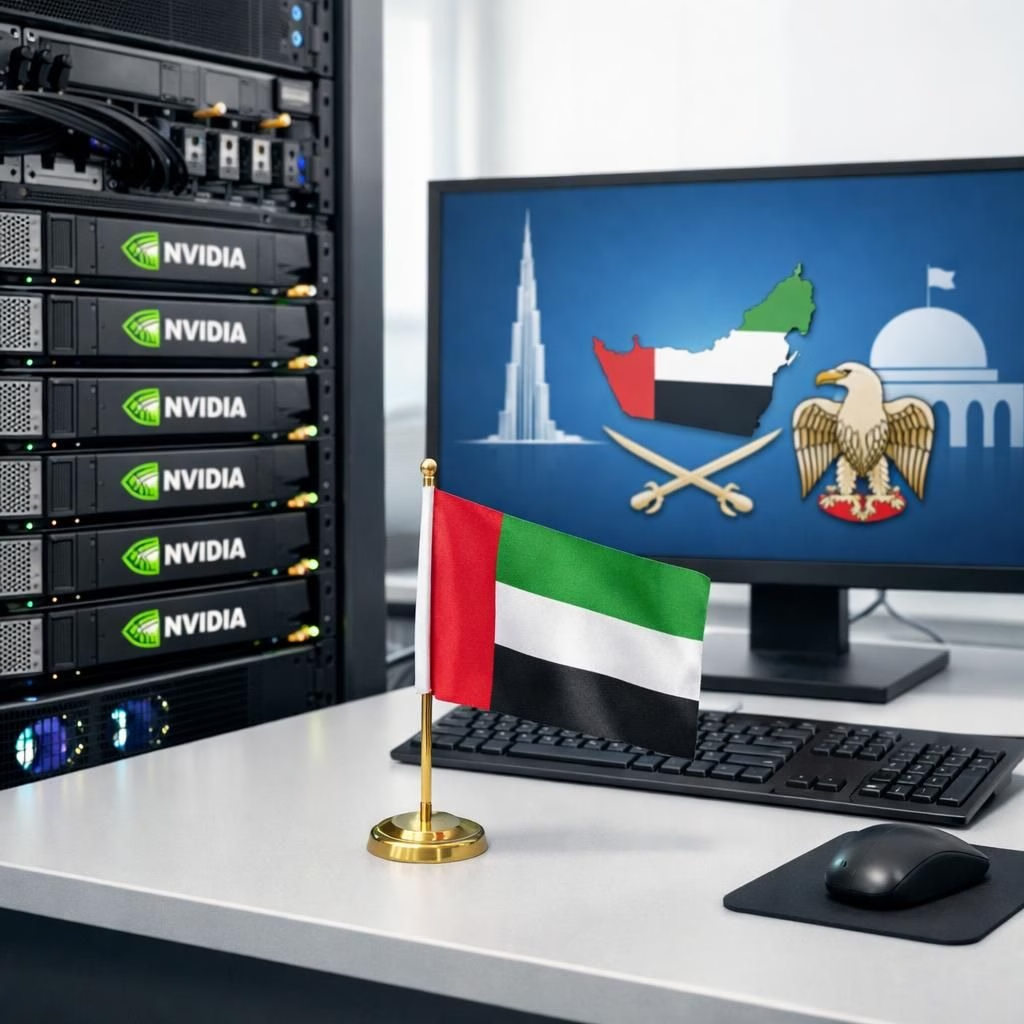
Friday marked a milestone as the UAE shipped Nvidia chips, a bold push for sovereign AI and a concrete step in UAE AI strategy. In a region where instability and disrupted supply chains loom large due to the Iran war, Abu Dhabi argues that control over data and compute is the best path to resilient AI. The UAE ambassador to the US, Yousef Al Otaiba, framed the move as a clear commitment to American tech, insisting this isn’t hedging but doubling down on trusted platforms. Leaning into optimism with a practical streak, officials promise these steps will translate into safer, faster public services and stronger digital sovereignty. By framing the chips as both a tech upgrade and a national security measure, the government signals that sovereignty is not a luxury but a baseline requirement. first shipment of Nvidia’s advanced chips underscored how firmly Abu Dhabi is pushing ahead with sovereign artificial intelligence infrastructure despite regional instability and supply-chain disruption caused by the Iran war.
sovereign AI Momentum in the UAE
The shipment powerfully signals momentum and marks more than a hardware delivery. It’s a public statement about control, locality, and speed. Nvidia’s Blackwell Ultra technology underpins the plan, paired with a key collaboration with Aleria, the UAE’s infrastructure specialist focused on sovereignty. This is not a single product story; it’s a systemic push toward governance where critical workloads stay on domestic hardware and networks. The architecture emphasizes multi-site continuity and offline resilience, so if one center wobbles, others keep the engines running. The aim is to turn theory about sovereignty into everyday, enterprise-ready operating reality. This is a practical journey, not a rhetorical flourish. For UAE AI initiatives, the focus remains on reliability, not just hype.
UAE AI: Enterprise-grade, distributed ambition
Behind the headlines sits a quiet conviction: AI should serve real people and real institutions. The UAE AI strategy aims to distribute compute and data across several sites, not because geography is trendy, but because security, latency, and redundancy matter for health, finance, and defense. The Aleria–Nvidia collaboration is designed to power a distributed factory model that can scale up or down, with Blackwell Ultra chips offering the computing punch needed for demanding workloads. This is about building a governance framework for sensitive tasks while enabling lighter workloads to operate in the open cloud. In this era, sovereignty is most valuable for the 30 percent of workloads that touch national security or personal data. The broader industry consensus is that this isn’t about shutting out the world; it’s about ensuring there is a protected lane for indispensable workloads while the rest can ride the open cloud. UAE AI adoption is increasingly seen as a practical capability rather than a theoretical exercise.
Microsoft’s diffusion report ranks the UAE among top AI-adopting nations, with 64 percent of the working-age population engaged. That figure isn’t a mere headline; it’s the momentum behind a broader push to localize critical infrastructure. Executives say the shift from pilot to production is the real leap, with distributed factories enabling lower latency and stronger privacy. Local data processing reduces exposure to cross-border data flows and speeds up response times in urgent sectors like healthcare and finance. Firms report that distributed AI can support real-time analytics on construction sites and logistics hubs, improving ROI and safety. Meanwhile, a cautious optimism runs through policy circles: sovereignty, when well managed, enhances security without choking innovation. UAE AI adoption is a growing reality—this momentum aligns with the country’s broader strategy. UAE AI momentum is advancing with intent.
As the Iran-war shadow lingers, executives emphasize that geopolitical risk accelerates the transition from pilot to production-grade systems. Nvidia’s regional VP, Marc Domenech, argues that the current environment makes UAE AI more urgent, not slower. Eric Leandri of Aleria notes that security sensitivity drives the preference for domestic facilities, and he stresses that some workloads simply must stay inside national borders. This is a moment that marries economics and strategy: the market for reliable, compliant AI infrastructure grows as risk grows. UAE AI is becoming a core tool for national resilience.
Industry chatter is no longer about “if” but about velocity. The UAE AI push is moving beyond talk into concrete deployments. In healthcare, patient data can be processed locally, reducing latency and preserving privacy. In defense, drone systems and video analytics gain from controllable compute that stays under national control. The shift is gradual, but the direction is unmistakable: sovereignty as a practical governance model that enables secure, scalable AI operations while remaining open where appropriate. UAE AI adoption is progressing with tangible outcomes.
Global context and practical deployment
In parallel, the regional technology conversation stays firmly anchored in tangible outcomes. Singapore’s National AI Strategy 2.0 focuses on sovereign digital capabilities across health care, transport and public services. France-backed Mistral AI has become central to Europe’s efforts to maintain independent AI capabilities. Meanwhile, Saudi Arabia’s Vision 2030 strategy includes major investments in domestic AI and cloud infrastructure to localise advanced technologies. The focus is increasingly on use rather than experimentation. UAE AI leaders say the time is now, and the network of sites is the backbone of resilience rather than a mere architectural diagram.
Operational AI factories are increasingly real. Executives describe them as capable of processing critical national data with enterprise-grade reliability and security. The plan emphasizes measurable uptime, transparent governance, and secure data flows, with the goal of enabling rapid scale across health, finance, logistics, and public services. The narrative shifts from a whiteboard exercise to a production line, where the factory floor becomes the proving ground for sovereignty in practice. UAE AI readiness is being built with concrete metrics and tested capabilities.
Beyond domestic deployment, the UAE’s sovereign AI platform is beginning to show an export-ready face. Aleria reports a growing international footprint, with customers in the United States, Europe, Africa, and the Americas, many relying on localized compliance frameworks. This cross-border presence signals a maturity curve: sovereignty is not a barrier to collaboration but a reliable foundation for global engagement under local rules. The platform’s flexibility supports different regulatory environments while maintaining core security guarantees and performance standards. UAE AI capabilities are being applied across multiple markets with consistent governance.
The policy and business communities now wrestle with the balance between openness and protection. The aim is to preserve collaboration for less sensitive tasks while maintaining tight controls for national-security workloads. The UAE’s strategy is a pragmatic blend: keep critical data in-country, but welcome external expertise in areas that don’t threaten sovereignty. The result is a hybrid approach that strengthens national capacity without blunting the competitive edge that comes from global partnerships. UAE AI remains a policy lever for resilience and growth.
As the push widens, the plan evolves from a handful of pilots to a multi-site, scalable ecosystem. Construction monitoring, healthcare analytics, and enterprise intelligence are early success stories that highlight the tangible benefits of distributed AI. Local processing reduces latency and enhances safety in real-time operations, while governance remains clear and auditable. The ecosystem is designed to withstand disruptions—whether geopolitical, climatic, or cyber—so that critical services stay online when it matters most. UAE AI infrastructure is being designed for continuous availability.
Public and private sector leaders acknowledge a quiet caveat: sovereignty should enable opportunity, not isolation. The UAE’s ambition is to be a sovereign AI hub that attracts talent, builds capacity, and exports know-how under transparent, responsible governance. The region’s trajectory suggests a broader shift toward sovereign AI-enabled resilience across industries, with the UAE positioned as a catalyst for regional and global adoption. UAE AI remains central to that strategy.
To close, the UAE has turned from policy talk into a working, distributed AI reality that touches healthcare, logistics, finance, and defense. The challenge remains to balance ambition with practical governance, to keep critical data in-country, and to ensure that the benefits filter through to citizens and businesses alike. If the trajectory holds, sovereign AI will be a foundational capability that supports a resilient economy and a confident, transparent public sector. The journey is ongoing, but the signs are encouraging. UAE AI momentum continues to grow.
Special thanks to The National News for the original reporting. Original article: UAE AI. If you found this analysis helpful, please share your reflections in the comments to spark a constructive conversation about how sovereign AI and UAE AI shape business and government in 2026.
External sources
- NVIDIA Blackwell Ultra data-center platform
- What is data sovereignty? – World Economic Forum
- NIST data security and cloud guidance