

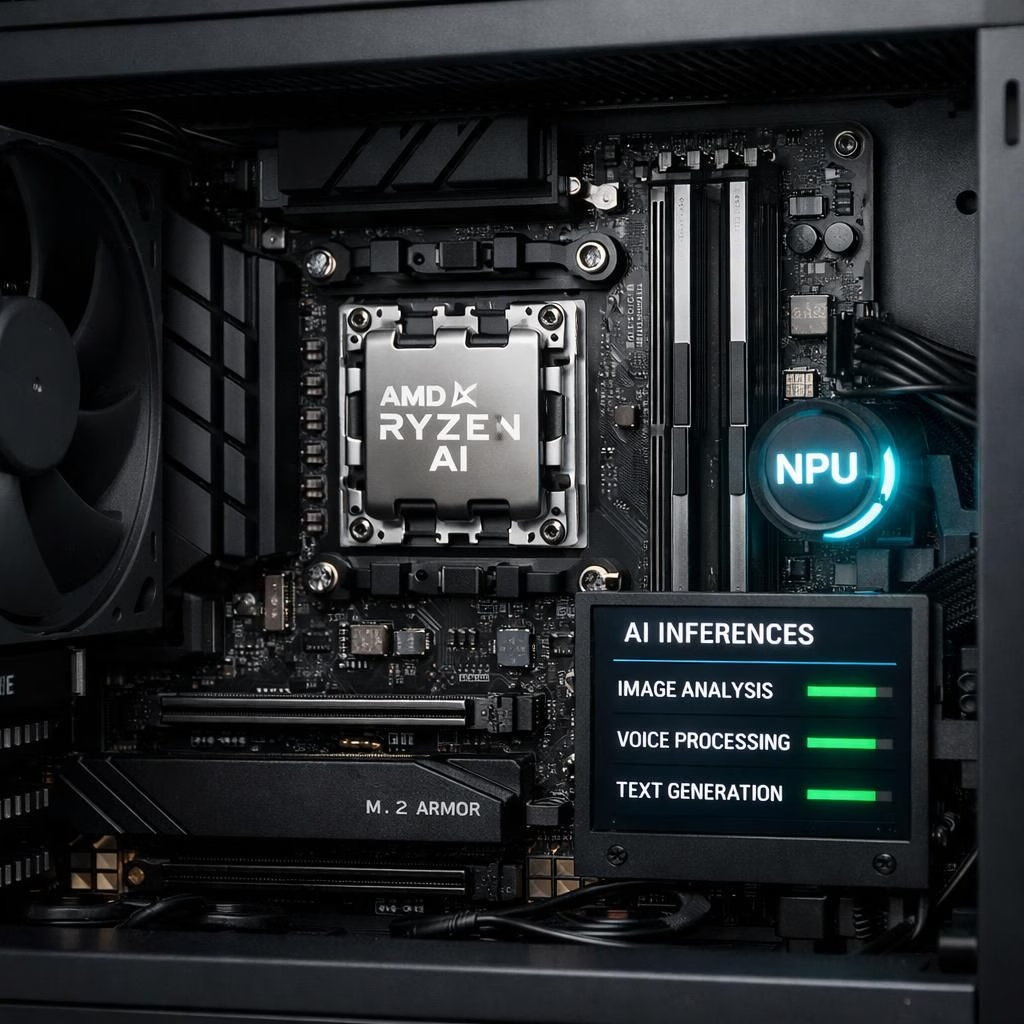
Ryzen AI on AM5 is not a rumor; it’s AMD’s pragmatic push to bring AI-friendly compute into business desktops. It targets corporate fleets rather than DIY gamers, reflecting a rare, practical pivot from AMD. The plan uses the AM5 platform you may already rely on and adds a built-in NPU to accelerate language and image workloads locally. This approach aims to balance on-device AI with enterprise manageability for steady, predictable performance.
Ryzen AI on AM5: Desktop CPU Magic for 2026
Like past G-series Ryzen chips, these desktop CPUs reuse laptop silicon repackaged for a desktop form factor, including AM5-based systems. The 400-series shares much with Ryzen AI 300 laptop processors, but the desktop form factor demands different tuning for AM5-based machines. In practice, the top 8-core models deliver solid performance with an 8-core/8-core mix between Zen 5 and Zen 5c cores, plus an integrated Radeon 860M GPU built on RDNA 3.5. It’s not a gaming beast; it’s a productivity-leaning machine designed for business users who want reliable on-device AI tasks without the distraction of a separate GPU. The goal for AM5-based systems is stability and predictable performance, prioritizing enterprise deployments over raw MHz numbers.
NPU on AM5 in Copilot+ Workstations
AMD is careful to keep the core architecture while adding an NPU that can handle on-device inference. The lineup—Ryzen AI 7 Pro 450G, Ryzen AI 5 Pro 440G, Ryzen AI 5 Pro 435G, plus GE variants—leans toward enterprise management and fleet control. The NPU at 50 TOPS is not just a marketing stat: it enables local inference for language tasks, image processing, and other AI workloads, all while respecting corporate data policies. In practice, Windows Copilot+ features can be leveraged with lower latency and greater privacy on these AM5 PCs, improving automation without cloud data exposure.
Compared to consumer desktop setups, this AM5 family offers a balanced path: compact footprint, integrated GPU, and a dedicated NPU that can handle everyday AI tasks. The 50 TOPS capability enables local inference for tasks such as document understanding, image optimization, and other AI workloads, reducing cloud round-trips. This matters in 2026 when data privacy and cloud costs push many companies toward on-device processing in more scenarios. It’s a measured, practical step toward AI-assisted workflows rather than an overhyped leap.
AMD acknowledges the market is dynamic, and the consumer crowd will have its own taste for gadgets and GPUs. Still, for small and medium teams, enterprise IT departments, and developers testing AI workloads, this approach provides a credible path forward. If the supply chain stays steady and prices align with budgets, the Ryzen AI AM5 pairing could become a familiar staple in offices, quietly powering smarter productivity tools and faster decisions.
Original article: Thanks to Tech Insight for the original material at https://example.com/ryzen-ai-desktop-cpus.
Practical IT deployment on AM5
- Ensure your fleet uses AM5-based desktops that can handle the NPU load and the integrated GPU.
- Plan memory and power needs around DDR5 and the motherboard’s cooling profile for AM5 systems.
- Update Windows 11 to Copilot+ compatible builds to unlock Recall and Click to Do features on enterprise devices.
- Leverage device management capabilities typical of Ryzen Pro–branded configurations to simplify fleet administration for AM5 workstations.
FAQ
- Q: What exactly is the Ryzen AI 400-series desktop CPU?
- A: It is a family built around Zen 5 cores, RDNA 3.5 graphics, and an on-die NPU designed for on‑device AI workloads on AM5 desktops, with business-focused management features.
- Q: Is this aimed at gamers or business users?
- A: The emphasis is on business PCs that need stronger on-device AI and enterprise controls, not on pure gaming performance.
- Q: Do I need a discrete GPU with these CPUs?
- A: They include an integrated Radeon 860M, which suffices for productivity and light graphics tasks without a separate GPU for most business scenarios.
- Q: When will these processors be available to purchase?
- A: AMD has positioned the lineup for availability in early to mid-2026, with priority for business deployments and IT-led rollouts.
- Q: How does Copilot+ interact with these CPUs?
- A: Copilot+ Windows 11 features can run with lower latency on this hardware, thanks to local AI acceleration and on-device processing.
Conclusion
In 2026, the AM5 platform is evolving into a practical, enterprise-friendly path for on-device AI. The Ryzen AI family aims to deliver predictable performance, simplified IT management, and privacy-conscious workflows for business PCs. If supply and pricing remain stable, these CPUs could quietly power a new generation of efficient, AI-assisted workstations rather than flashy gaming rigs.
Takeaway
For teams weighing on-premises AI options, the Ryzen AI + AM5 approach offers a measured upgrade path that prioritizes reliability, manageability, and data control—without demanding a separate GPU or cloud dependency.
References
Original article: Thanks to Tech Insight for the original material at https://example.com/ryzen-ai-desktop-cpus.