

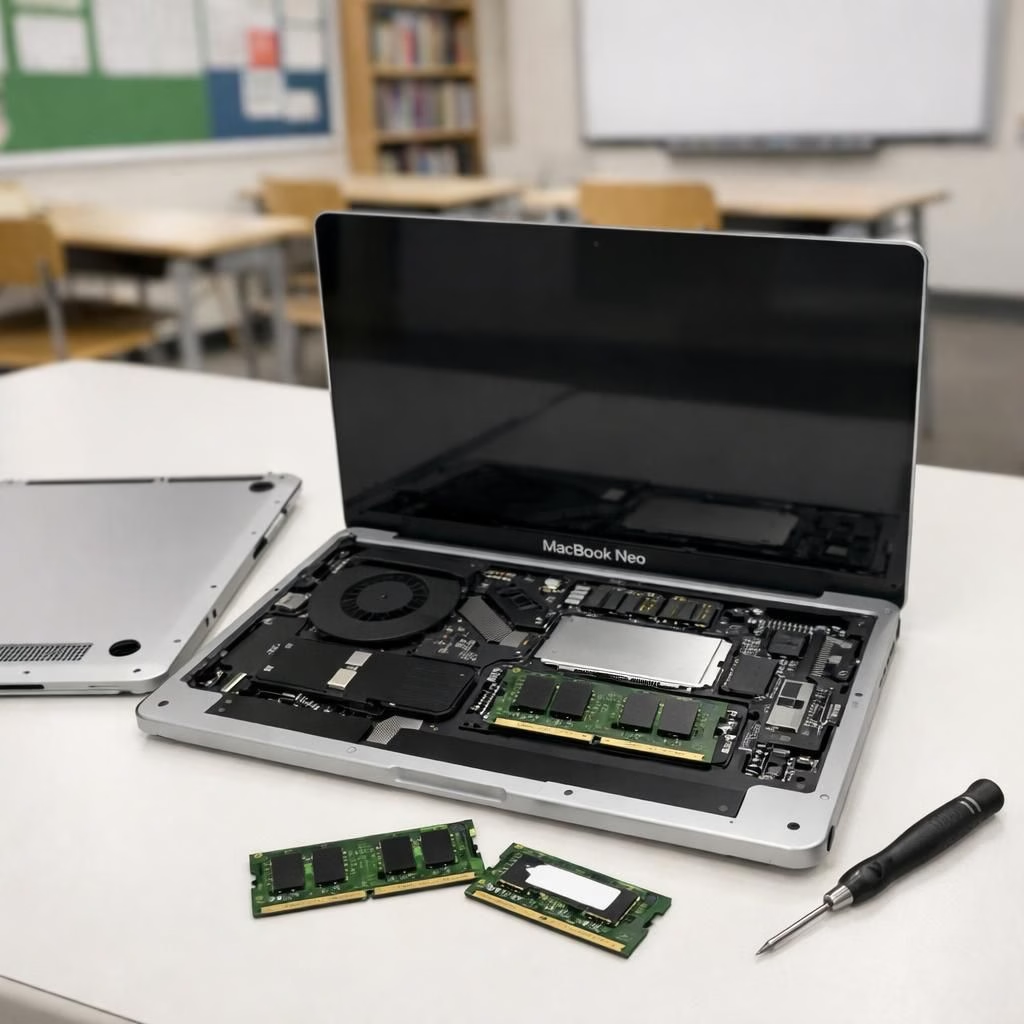
In the world of student laptops, the MacBook Neo arrives with a mixed message about repairability and privacy_ai. It’s pitched at $499 for students, and iFixit’s teardown hints at a device that’s more repairable than Apple’s past efforts but still not the full cure. The signpost is clear: there are screws for the battery and keyboard, and even components like the camera and fingerprint sensor look swap-ready. Yet a stubborn constraint lingers—8 GB of DRAM soldered to the motherboard—pinning memory upgrades to the product’s future road map.
Why does that soldered memory matter? Because memory is the ground truth for performance and privacy_ai workloads. When DRAM sits nailed to the circuit board, upgrading RAM becomes a no-go for the average student. iFixit’s Kyle Wiens notes that the combo of tighter hardware and thinner profiles has tradeoffs: you gain lightness and a sleeker chassis, but not necessarily a simpler repair. The Neo scores 6 out of 10 on their repairability scale, which is a respectable improvement over some previous Apple designs, yet well short of the 9s and 10s you see on many ThinkPads or Chromebooks. iFixit has highlighted these hardware decisions as a different kind of balancing act for schools considering total cost of ownership.
Is there a contrast to Chromebooks? Apple seems to be eyeing education markets like Google does, promising affordable devices and easier maintenance in schools. The MacBook Neo is positioned as a premium rival to a Chromebook class, with the promise of macOS software support and privacy_ai-style safeguards baked in. But the hardware choices complicate long-term upgradability. Windows enthusiasts might smile; educators might sigh. The takeaway is that repairability is not just about screws—it’s about the whole lifecycle, from parts availability to future-proofing.
repairability essentials in the MacBook Neo
iFixit’s teardown highlights the explicit changes Apple has made to the Neo: screws instead of glue for the battery and keyboard, and parts like the camera and fingerprint sensor designed to be swapped with a bit of screwdriver time. Those moves tilt the score upward compared with the pre-2014 era of Apple repairs, but they don’t erase the fundamental design decisions that limit later upgrades. The 8 GB DRAM soldered to the board means any buyer is signing up for a memory ceiling rather than a floor. The practical upshot is that students who run AI-heavy tools or large datasets may hit a ceiling sooner than peers with more memory expandability. iFixit notes that removing bottlenecks through future hardware revisions remains a core challenge for this line.
privacy_ai considerations in education laptops
On the privacy_ai front, Apple leans into the idea of running AI locally rather than sending everything to the cloud. The company has publicly cited privacy benefits, which sounds like a win for students concerned about data sovereignty. Yet the practical reality is that local models demand increasing memory and compute headroom, which the Neo’s soldered RAM does not readily provide. Wiens argues that local models could be the long-term privacy_ai play, but warns that it’s a flaw across many Mac products if upgrades are not a straightforward option. Given the zero-CPU-usage-on-cloud-trips promise, schools weighing AI-enabled lessons should consider both data governance and hardware limits when sizing devices for classrooms.
What could fix this without sacrificing the Neo’s thinness? A modular memory path or an optional upgrade kit could help. Another possibility is to offer a future version with higher base RAM that still maintains repairability improvements. The balance Apple is trying to strike—light weight, privacy_ai-driven AI, responsive devices for classrooms—requires tradeoffs, and those tradeoffs matter most in schools where device lifecycles last years, not quarters.
From a consumer perspective, the analysis reinforces a simple truth: repairability is a spectrum. The Neo marks a move in the right direction with detachments like battery screws and swappable camera components. It still does not solve the stubborn RAM upgrade constraint, which has real implications for AI workloads, future software demands, and the total cost of ownership over a device’s lifetime. Chromebooks have been a reference point for many districts, but Apple is betting on a different ecosystem with its own privacy-first promises.
End-user education markets often push for value, durability, and ease of maintenance. The Neo threads these needles but stops short of enabling a frictionless memory upgrade. For students chasing AI projects, data analysis, and creative tooling, that means planning around the built-in RAM ceiling. The educational promise is strong, but the hardware design decisions create a longer horizon before the Neo becomes an evergreen machine capable of limitless AI exploration.
Original article: iFixit MacBook Neo teardown — thank you to iFixit for the detailed analysis: iFixit MacBook Neo teardown.
If you have thoughts, please share them in the comments. What matters more to you in an education laptop: repairability, upgradability, or privacy_ai features? Your input helps everyone navigate this evolving landscape.
Frequently asked questions
- Can the Neo be upgraded after purchase? The official design emphasizes interchangeability for certain parts (battery, keyboard, camera, fingerprint sensor) but the memory is soldered, limiting RAM upgrades after purchase.
- Is local AI really safer for students? Local models can reduce data sent to the cloud, which supports privacy goals, but hardware ceilings and future software demands may still force tradeoffs.
- How does this compare to Chromebooks in schools? Chromebooks are often designed for easy repair and upgrades in bulk deployments, while the Neo aims for macOS continuity and privacy pillars, trading some upgradeability for form factor and ecosystem benefits.
- What should schools consider before buying the Neo? Total cost of ownership, device lifecycles, software needs, and the likelihood of needing AI workloads that require more memory are key factors to weigh against price and repairability.
Conclusion — key takeaway
The MacBook Neo represents a notable step for Apple toward more repairable design within a sleek, education-friendly package. While it improves repairability versus earlier models, the soldered RAM remains a meaningful constraint for AI workloads and long-term upgradability. For schools, this means balancing short-term affordability and ease of repair with future-proofing and memory needs when planning multi-year device rollouts.
References
- Original article: https://indianexpress.com/article/technology/tech-news-technology/apple-macbook-neo-emerges-as-companys-most-repairable-laptop-in-more-than-a-decade-10582603/