

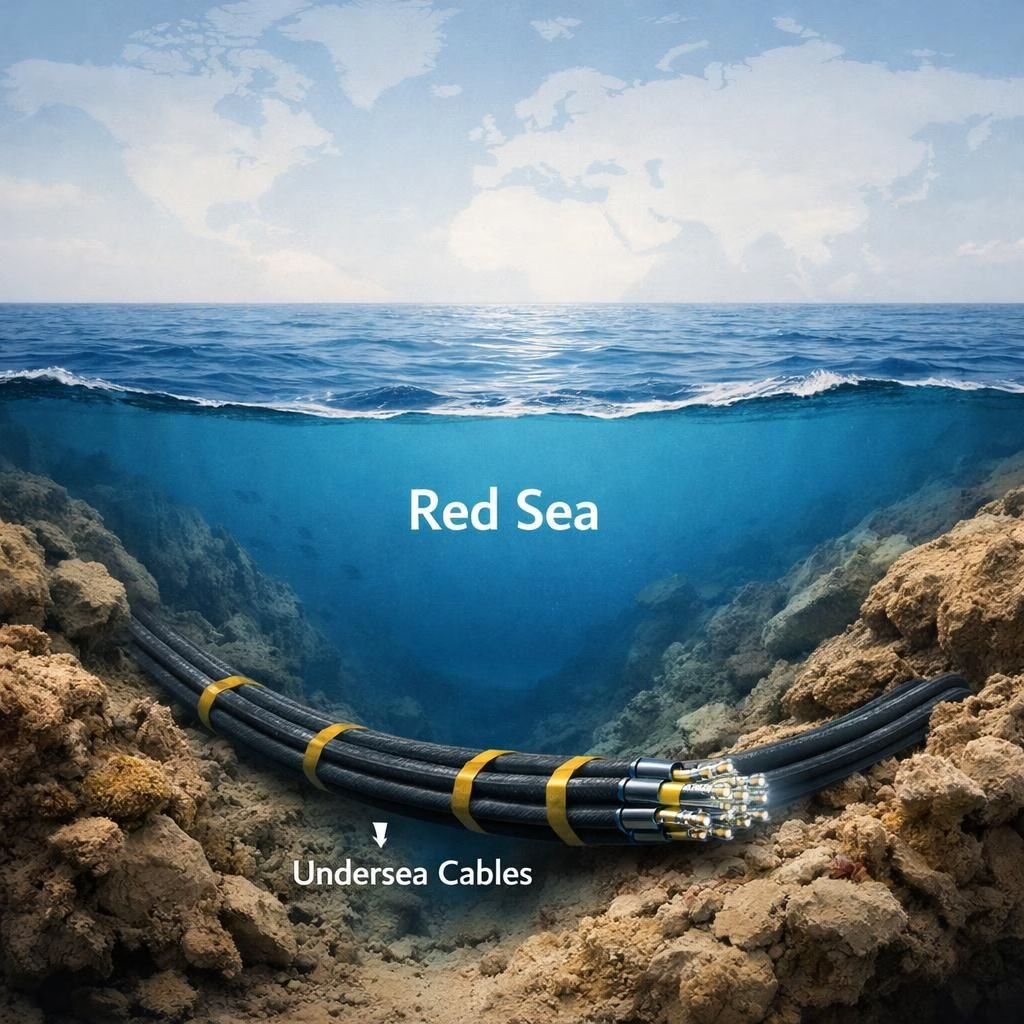
In 2026, the Undersea Cables in the Red Sea region sit at the center of a tense moment. Iran has reportedly hinted at disrupting these cables to pressure Gulf states hosting U.S. troops. No government has publicly confirmed the threat, and major intelligence outlets have not echoed the claim, but a chorus of credible voices online warns that the cables form a core part of global connectivity. The message is simple: Undersea Cables and the Red Sea are not abstract trivia for telecom nerds—they are a planetary nervous system that keeps economies moving.
Undersea Cables at the Red Sea: risks, routes, and resilience
The corridor through the Red Sea region remains critical to global traffic, linking major hubs in Oman, the UAE, Qatar, Bahrain, Kuwait, Iraq, Pakistan, India, and Saudi Arabia. Damage would force networks to reroute via longer paths, increasing latency and challenging cloud services. For India, in particular, even modest outages can ripple across digital payments, streaming, and AI workloads as traffic shifts to distant data centers. Industry observers note that Alcatel Submarine Networks has issued force majeure notices to customers, signaling a preparation mindset, while public details about the status of salvage or repair remain incomplete.
Undersea Cables in the Red Sea: a thicket of cables and India’s digital life
From India’s vantage, the Red Sea corridor passes through Gulf states and Indian landing stations. India remains one of the largest consumers of internet traffic, with data flows powering cloud services, digital payments, and streaming. A sustained disruption would slow services, raise costs, and complicate business operations for hundreds of millions of users. Bloomberg has reported that the Ile De Batz installation vessel was stranded off Dammam, underscoring how supply chains and on‑water operations are sensitive to tension in the region.
Beyond the immediate disruption, resilience matters. The global internet relies on multiple routes, cross-border peering, and dynamic traffic management. Operators can reroute traffic, tap satellite backups in emergencies, and accelerate repairs. The Red Sea corridor thus serves as a live test of redundancy, not a single safety net. Engineers emphasize diversified paths and timely maintenance to reduce risk for users who rely on streaming, payments, and AI applications.
For operators, Undersea Cables remain the backbone of international connectivity.
Practical steps for 2026: preparing for the Red Sea corridor
- Diversify submarine cable vendors and ownership across regions to avoid single points of failure.
- Build redundant routes and multi‑region cloud strategies to keep data moving even if one path falters.
- Strengthen local data centers and edge services to reduce dependence on distant hops.
- Establish clear incident reporting and rapid recovery plans, with practiced drills for both operators and regulators.
Looking ahead: resilience, policy, and daily life connected by the Red Sea
In the grand scheme, the Red Sea network is not a single actor. It connects with networks across oceans, and redundancy plus proactive maintenance keeps internet services humming for millions of users who expect reliable streaming, payments, and AI responses. The moment invites policymakers and civil societies to push for regional cooperation on redundancy, data sovereignty, and rapid recovery planning.
If this topic sparks ideas or questions, share your thoughts in the comments. Your perspective helps readers separate online hype from practical resilience in daily digital life.
References
- TeleGeography – Submarine Cable Map and industry context
- ITU – Facts on internet infrastructure
- Bloomberg – Coverage on global internet infrastructure
- Times of India – Iran reportedly threatening to cut Red Sea cables (original source)
Original article: Times of India