

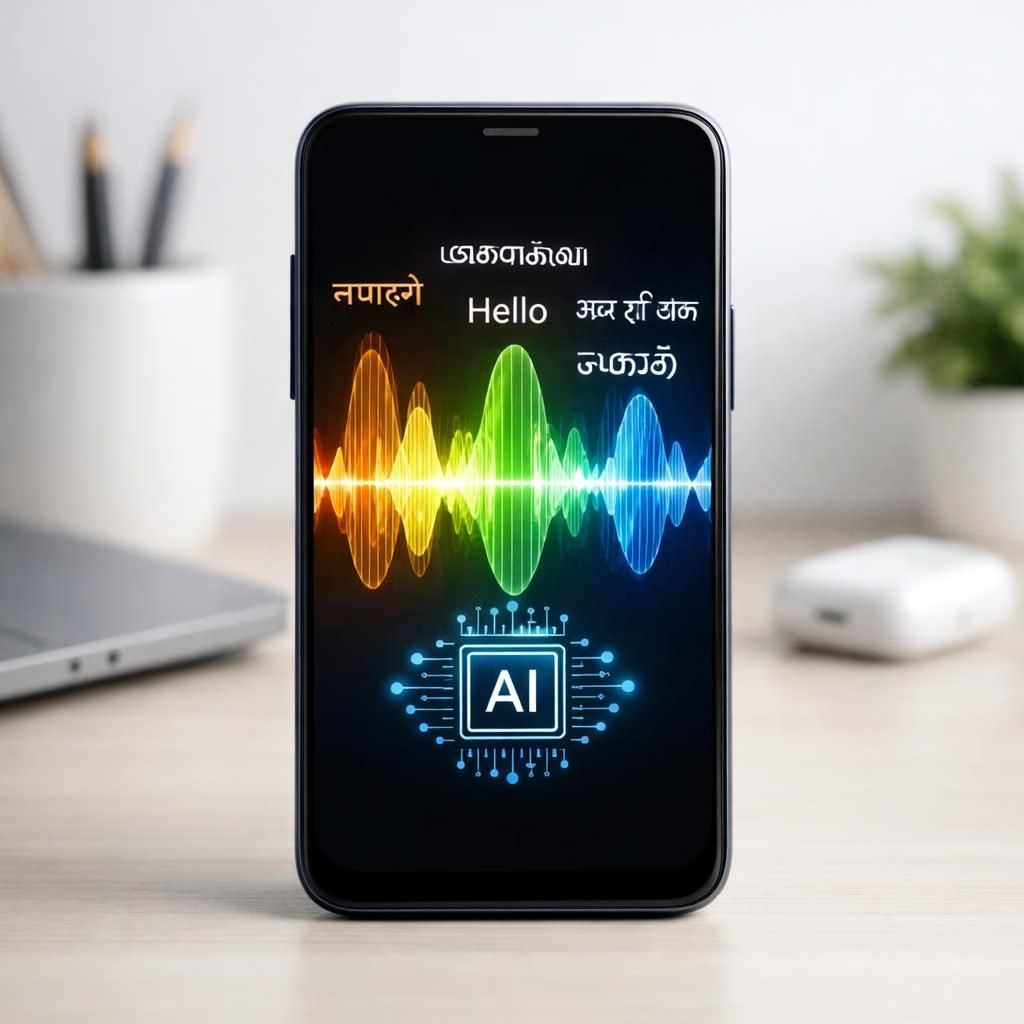
Bengaluru-based Sarvam AI just dropped a bold update: Sarvam Edge is an on-device AI suite for Indian languages that runs entirely on your device. The claim is simple: no internet needed, no per-query costs, and a privacy-friendly path for language tech. In practice, this means speech recognition, speech synthesis, and translation all live on the hardware you already own. Welcome to a world where on-device AI and Indian languages are finally teammates, not distant strangers.
on-device AI and Indian languages in one package
At the core, Sarvam Edge packs ten languages into a single 74-million-parameter model. It runs on consumer hardware, occupying about 294MB on device memory. It identifies the spoken language automatically, so users don’t pick a mode. That means the system does not rely on a cloud server to guess your tongue or dialect. This compact design supports swift operation on modern chips like the Snapdragon 8 Gen 3.
Benchmarks on the Vistaar dataset show real-world advantages for several languages, including Hindi, Gujarati, Kannada, Punjabi, and Telugu. Edge beats Google Cloud STT in those tests, at least in the tested environments. Real-time speed clocks in at roughly 8.5x, with a time-to-first-token under 300 milliseconds on the right hardware.
on-device AI for Indian languages: lifelike voices on-device
Speech synthesis has a modest footprint: about 60MB and 24 million parameters. Eight speakers and ten languages are supported within a single model. Each speaker’s voice stays consistent across languages. The first audio output on a Samsung Galaxy S25 Ultra arrives in about 260 milliseconds, a performance boost over real-time playback. That speed matters for education and accessibility alike.
The synthesis quality shows a mean character error rate of 0.0173 on a standard benchmark, meaning the generated speech closely matches the source text across languages. Custom voice cloning is supported — add a new voice with roughly one hour of audio data and deploy within the same 60MB model file.
on-device AI and Indian languages translation: 110 language pairs
The translation model carries 150 million parameters and about 334MB on-device footprint. It handles bidirectional translation across 110 language pairs, including ten languages and English, without routing through an intermediate language. On a Snapdragon 8 Gen 3 processor, it produces the first token in roughly 200 milliseconds and streams at about 30 tokens per second. On the FloRes benchmark, Edge outperforms Meta’s NLLB-600M, which is four times larger, across all tested languages.
Because all processing happens on the device, no user data leaves the device. There is also no per-query cost, which Sarvam says makes AI tools viable for education, small businesses, and assistive applications where cloud pricing would otherwise be a barrier.
Edge is being developed in collaboration with global device manufacturers. The goal is broad adoption across Android devices and beyond, with demonstrations showing smooth speech, translation, and voice cloning in real-world apps. The approach feels practical: private data, low latency, and a model that actually respects local language needs rather than forcing users into a one-size-fits-none cloud path.
In practice, this setup could cut through connectivity woes in rural and semi-urban areas while giving developers a stable, privacy-preserving foundation to build multilingual tools. The balance of on-device computation with translation, speech, and voice capabilities promises a more inclusive AI experience for a country with hundreds of languages and many script traditions.
From a high-level view, Sarvam Edge represents a shift toward hardware-aware AI that respects local contexts. It suggests a future where you can download a bundle, install it on a phone, and have reliable language tech without streaming. That’s not a sci‑fi dream; it’s a tangible product direction with real-world implications for education, accessibility, and digital literacy in diverse Indian communities.
Is Sarvam Edge a revolution or a clever niche experiment? Time and user feedback will tell. Either way, the emphasis on local processing, privacy, and no per-query costs is a refreshing pivot in the AI race.
Special thanks to the original article at Tech News – Sarvam Edge for material and context. We appreciate the thoughtful groundwork and the chance to explore this promising offline AI frontier.
Want to weigh in? Share your thoughts in the comments below.
Practical uses of on-device AI and Indian languages in everyday apps
- Offline education tools that work without internet, powered by on-device AI and Indian languages.
- Accessible apps for rural communities using private, low-latency speech and translation on devices.
- Small businesses can deploy offline chat assistants with zero per-query costs.
- Voice cloning and customization options offered in a privacy-preserving, device-bound model.
FAQ about Sarvam Edge
- What is Sarvam Edge?
It is a suite of on-device AI models for speech recognition, speech synthesis, and translation built to run directly on consumer hardware, with no cloud dependency. - Does it require internet?
No. The entire stack runs on the device, preserving privacy and scaling to areas with limited connectivity. - How many languages are supported?
Ten languages are supported for recognition and synthesis, with translation covering 110 language pairs including English. Refer to the official specs for the exact list of languages. - Can I clone voices?
Yes. You can add a new voice with about one hour of audio data and deploy within the same 60MB model file. - What devices can run it?
The project is designed for modern devices, with benchmarks cited on Snapdragon 8 Gen 3-class hardware to illustrate real-world performance.
In short, Sarvam Edge highlights a practical, private, offline approach to multilingual AI that fits India’s diverse linguistic landscape.
References
External sources
- Snapdragon 8 Gen 3 mobile platform
- FloRes multilingual speech translation benchmark
- ML Kit: On-device machine learning