

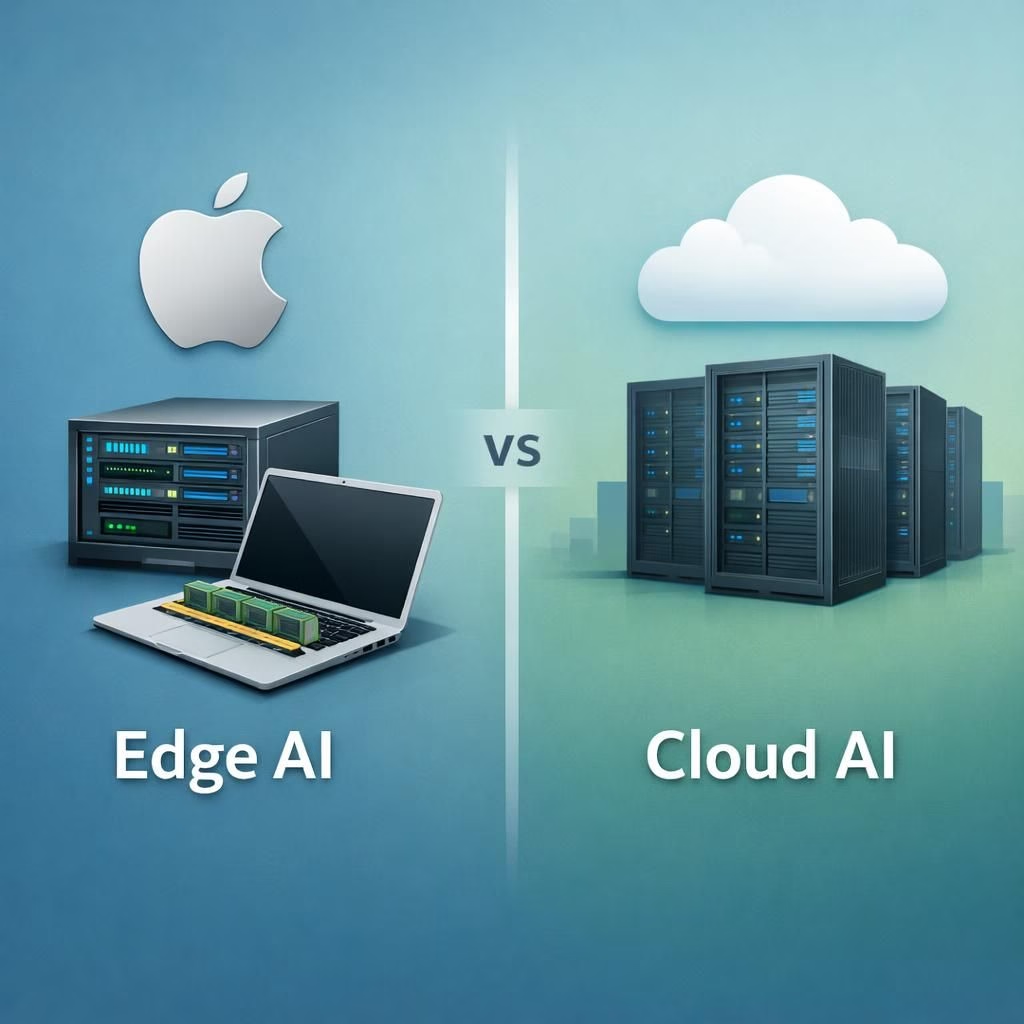
In 2026, Apple’s Apple AI strategy and its Capex choices look less like a misfire and more like a calculated bet. The A16Z chart titled “Apple on Capex: ‘Nah, we’re good’” surfaces a humbling truth: Apple keeps its powder dry while rivals plow billions into AI data centers. This juxtaposition is not a tragedy but a tempo to watch, as Apple curates an on-device future that promises speed, privacy, and a dash of contrarian humor. The numbers, while stark, tell a cleaner story: Capex as a line should not just move up; it should move the product and the customer experience. Apple AI fans know the company loves to finish last in the headlines and first in the product bench. That spend may be small, but the impact is not tiny: the edge, the memory architecture, and the user experience give Apple a different kind of leverage.
Apple AI Outlook 2026: Edge Inference at the Edge
Apple’s on-device AI story isn’t about replacing data centers; it’s about shrinking them. The M-series unified memory architecture, introduced with M1 in 2020 and refined since, is designed for edge inference. In practice that means the MacBook and Mac Studio can run large models locally, without shuttling data to a cloud. The new M5 Max, packing 128GB of unified memory and 614GB/s bandwidth, can run a quantized Llama 70B model on a laptop with surprising speed. Early benchmarks show it handling about 30 tokens per second, outpacing some of the early clusters that cost tens of thousands of dollars. This isn’t a marketing slogan; it’s a hardware reality. The company also quietly inked a deal with Google’s Gemini to power the next generation of Siri and Apple Intelligence—reported to be around $1 billion a year. That’s access to a top-tier model for pennies on the dollar compared to building one from scratch. External collaborators are accelerating the edge-first path without forcing a cloud sprint.
Capex Reality Check 2026: Spending vs Returns
On the balance sheet, the story reads differently. Apple posted a record Q1 fiscal 2026 revenue of $143.8 billion, up 16% year over year, with diluted EPS of $2.84 — a 19% jump. It held $145 billion in cash and returned $32 billion to shareholders in a single quarter. The hyperscalers—Amazon, Google, and Microsoft—saw a rougher stretch. After earnings, combined market value wiped out about $900 billion as investors wrestled with the gap between AI spending and realized returns. The size of the spend is eye-popping: if you add the 2026 Capex expectations of the hyperscalers, you’re looking at roughly $635–700 billion on Capex for the year, most of it poured into AI data centers and GPU clusters. Apple, by contrast, projects a Capex total a little over $14 billion for the year — essentially flat year over year and a stark contrast to the others’ speed. The question this raises is timeless: will AI models become interchangeable commodities, or will brands win by delivering a unique on-device experience? Apple seems to be betting on the latter: a world where the value is in the delivery, the privacy, and the user experience, not in the raw horsepower of every single data center. If they’re right, the flat line on the chart might be the sharpest move in the entire tech market.
Capex and AI Synergy in 2026
In practice, the Gemini deal with Google powers the next wave of Siri and Apple Intelligence—valued around $1B/year—while letting Apple focus on user-facing improvements. Apple’s M-series memory architecture remains the star, cheering on on-device inferences while the cloud weathers its own AI arms race. The strategic contrast is instructive for developers and investors: you can chase big numbers or you can chase clean user experiences that respect privacy and speed. If you’re an engineer, you’ll appreciate the on-device advantage: a 614GB/s memory bandwidth is nothing to sneeze at when you’re trying to run a 70B parameter model on a laptop with no datacenter in sight. If you’re an investor, you’ll enjoy the calm confidence of a company that can return billions to shareholders while still keeping its Capex modest and its Apple AI promise intact. In the end, the real test may be whether Apple AI on-device produces better outcomes than an army of cloud GPUs. The chart will tell us in time, but the early signals look like a thoughtful, deliberate invention rather than a reckless sprint.
For developers, test both worlds. Build edge-first features that rely on the Apple AI stack when possible; design for privacy and instant feedback, but don’t abandon cloud-assisted capabilities where you truly need scale. And for readers chasing the story behind the headlines, the takeaway is simple: Apple’s Capex restraint is not a sign of weakness, but a choice. The company bets on the long game—the idea that on-device intelligence, coupled with top-tier external models via Gemini, can create a faster, safer user experience. If 2026 is any guide, this strategy could redefine what “AI leadership” means in a world where cloud power is abundant but latency, privacy, and control are precious. The question remains open: will AI models become commodities or will someone craft a better, more intimate interface? Time will tell, and the chart will be a helpful clue.
Original article: Apple on Capex: ‘Nah, we’re good’. Thank you to A16Z for the original material.
What do you think? Share your thoughts in the comments.
FAQ
- What does the Capex vs AI spending imply for Apple?
Apple is pursuing an on-device edge strategy that prioritizes privacy and low latency over rapid cloud-scale expansion. - What is edge inference, and why does it matter?
Edge inference lets devices run large models locally, reducing data sent to the cloud and improving responsiveness. - Will AI models become commodities or will on-device compute give brands advantage?
The debate is open; Apple bets the experience and control of on-device AI will matter as much as, or more than, raw compute now. - How should developers approach building for Apple AI?
Start with edge-first features, invest in privacy-friendly flows, and selectively blend cloud capabilities where scale is essential.
Conclusion
Apple’s measured Capex approach could redefine what AI leadership means when speed, privacy, and user experience take center stage.
References
- Original source: Times of India linkback