

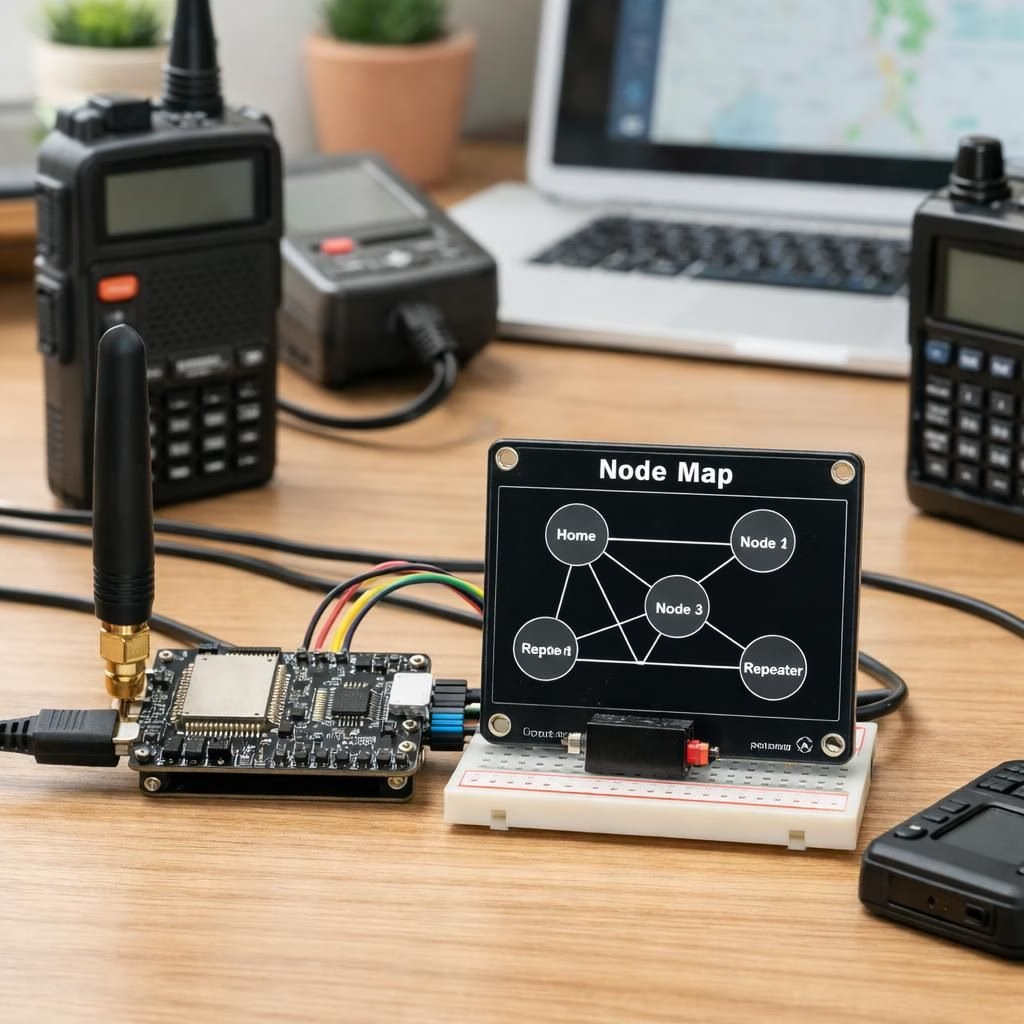
Meshtastic is not just a quirky hobby project; it shows that Meshtastic and Mesh Networking can power much more than chat. In 2026, the system shifts from text messages to off-grid telemetry, local maps, and crowd-sourced updates, proving the core idea scales.
What Hackaday highlighted about Meshtastic is that the hardware and firmware are designed for real-world resilience. The mesh isn’t a novelty; it’s a living network that routes data across several hops when cell coverage vanishes, turning a handful of affordable devices into a capable comms backbone. The design emphasizes openness, ease of use, and practical utility over flashy demos.
The beauty here is simplicity meeting ambition. A small ESP32-based node, sometimes with a LoRa transceiver, can be deployed on a bike, in a backpack, or at a camp site. Each node contributes to a larger web of trust, so one failure doesn’t rupture the entire conversation. The result is a reliable, low-cost way to share messages, GPS coordinates, or sensor readings—without depending on traditional carriers or Wi-Fi hotspots.
Meshtastic and Mesh Networking: Real-World Promise
The core principle remains refreshingly straightforward: many cheap nodes join to share the burden of a message. Each node forwards data, extending reach and improving reliability when network conditions wobble. This is not science fiction; it is a practical, tested approach that shines in real environments—far from the comfort of a tidy lab bench.
Open hardware and software are not afterthoughts here. The project leans into community contributions, clear firmware, and a flexible app that makes setup painless. Users can tailor Mesh Networking networks for text, location sharing, or sensor data. The system allows teams to stay in touch during outages, during fieldwork, or at a hardware meetup where the crowd grows hungry for a quick demonstration. And yes, the little LEDs on devices often blink in solidarity whenever a message hops along the mesh.
From a developer’s viewpoint, the value is in the knobs you can tweak. You can tune routing behavior, set radio power, or swap in different sensors. This flexibility keeps Meshtastic relevant as hardware evolves and as new use cases materialize. The network adapts, scales, and remains affordable enough for casual tinkering while still appealing to professional volunteers and first responders.
Practical Meshtastic in Mesh Networking Scenarios
In disaster-response drills, the off-grid nature of Meshtastic shines. If power lines go dark and cellular towers falter, a local Mesh Networking keeps critical updates flowing and maps visible. Teams can coordinate, share location data, and confirm safe zones without waiting for a central server to reboot. The network behaves like a breath of calm in a chaotic moment.
Researchers working in remote locations appreciate battery life and resilience. Nodes can run for days on a small power bank, constantly relaying temperature or air-quality readings back to a central node. This makes long field campaigns actionable rather than a logistical headache. Mesh Networking extends reach and reliability in environments where cellular data is scarce.
Festivals and community events gain a practical edge too: organizers use the mesh to share schedules, wayfinding, and emergency information across a large area without stressing on-site networks. Hobbyists quickly discover that Meshtastic scales beyond a single neighborhood project. A handful of devices can cover a campus, a hiking route, or a construction site. When you add more nodes, the network becomes sturdier, with multiple paths for messages to travel. This redundancy is not vanity—it’s a hedge against interference, obstruction, and the odd battery hiccup. In short, Mesh Networking with Meshtastic turns a clever idea into a dependable solution for everyday communication needs.
Hardware considerations keep the learning curve friendly. Typical nodes use a tiny microcontroller (like an ESP32) and a radio module optimized for long-range, low-power operation. The software stack is approachable, with clear documentation and community-led tutorials. This combination makes it feasible for schools, clubs, and small businesses to pilot their own mesh networks without a heavy upfront investment.
Beyond the basics, Meshtastic appeals to those who love data. Nodes can publish simple telemetry, map routes, or log events. The result is not merely text passes; it’s a lightweight, shareable data fabric that you can extend with sensors or custom apps. And because everything is open, you can audit, modify, and improve the network to suit your unique scenario. Mesh Networking remains a living platform, inviting people to contribute improvements and new ideas.
The spirit of Mesh Networking with Meshtastic is collaborative problem-solving. It invites people to experiment, fail safely, and iterate quickly. In communities that value hands-on learning, this approach turns a weekend project into a durable communication layer that helps people stay connected when traditional channels falter. The combination of affordability, resilience, and adaptability is what makes this approach truly compelling in 2026.
If you’re curious about getting started, the learning curve is friendly. Start with a single node to understand basics, then gradually add nodes to expand coverage. You’ll soon see how quickly messages traverse a mesh, and you’ll appreciate the way local control feels empowering rather than fragile. The software updates keep improving routing, user experience, and sensor integration, so you’re always stepping into a better version of the same idea.
In summary, Meshtastic and Mesh Networking deliver more than a clever party trick. They offer a practical, scalable, and affordable approach to off-grid communication, data sharing, and collaborative sensing. The project proves that small devices can work together to create a robust network with real-world impact. It’s not merely a proof of concept; it’s a living, evolving tool for people who value autonomy and connectivity in equal measure.
Original article: Hackaday — Meshtastic Does More Than Simple Communication. Thank you for the original material.
Getting started: practical steps
- Begin with a single node to learn the basics of setup, pairing, and message routing.
- Expand by adding a second or third node in adjacent areas to test range and multi-hop forwarding.
- Experiment with text messages, location sharing, and simple sensor data to see how the data fabric behaves in your environment.
- Document your network layout and firmware versions so others can reproduce and build on your work.
FAQ: Meshtastic, Mesh Networking, and off-grid tech
- What is Meshtastic in simple terms?
- It’s a system of small, affordable devices that form a Mesh Networking to carry messages and data when traditional networks fail.
- Do I need internet access to use it?
- No. The mesh can operate entirely off-grid, routing information between nodes until contact with a gateway is reestablished.
- How reliable is it in real life?
- Reliability grows with more nodes and thoughtful placement. The design emphasizes redundancy, multiple paths, and low power usage to maximize uptime.
- Is it secure?
- Security depends on configuration, encryption options, and firmware updates. Open hardware and community oversight help keep the system robust.
Conclusion: a practical, scalable off-grid layer
For makers, field crews, and communities, Meshtastic demonstrates that Mesh Networking can be more than a curiosity. It’s a practical, adaptable fabric that remains affordable while growing with needs—from a backyard test to a campus or disaster-response exercise. The ecosystem invites experimentation, collaboration, and continuous improvement—precisely the kind of open, resilient technology the era demands.
References
- Hackaday: Meshtastic Does More Than Simple Communication
- Meshtastic Official Site
- Meshtastic Documentation
- LoRa technology by Semtech