

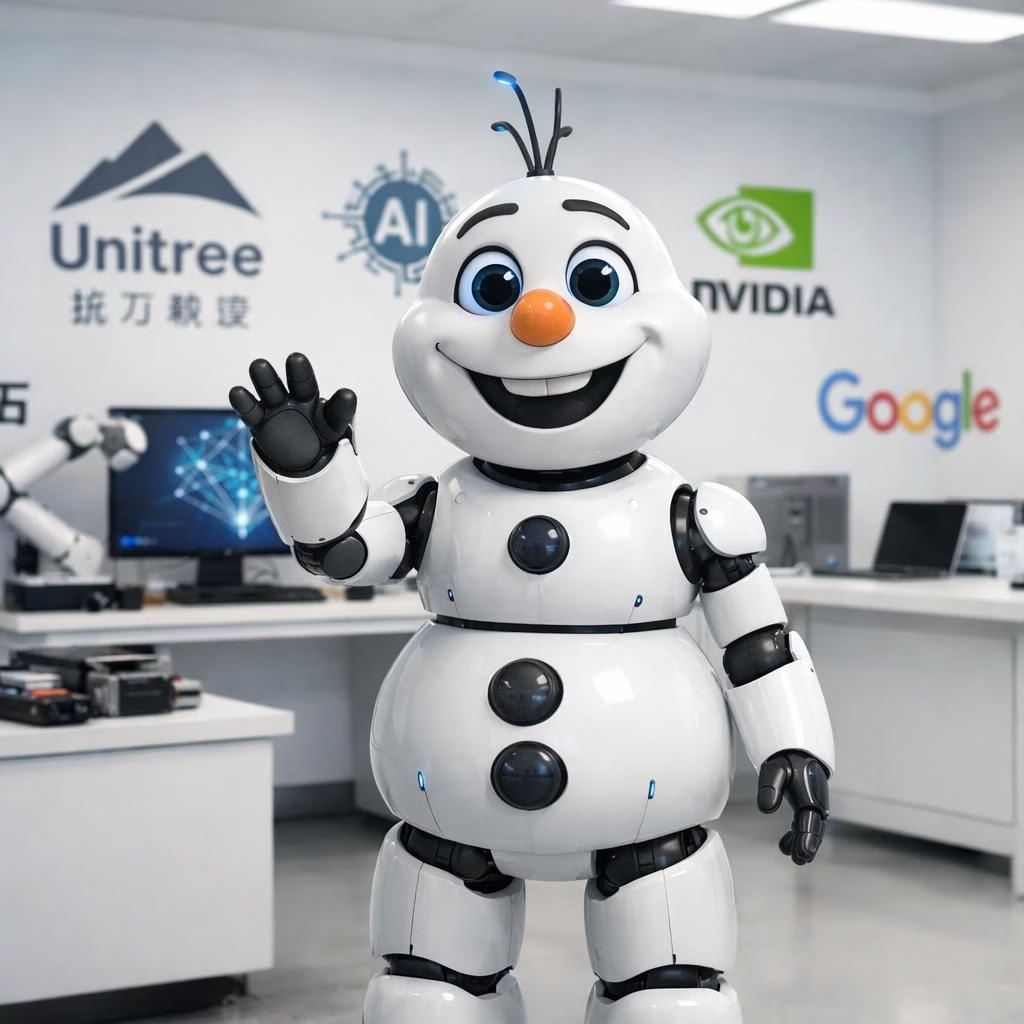
In a sunny demonstration that feels half science fair, Olaf the humanoid-robot steps forward as a real-world example of how global collaboration is reshaping robotics. The demo stitches Nvidia’s AI prowess with Google’s software finesse and Disney’s signature character design into a coherent, moving prototype. Yet Olaf’s mobility—rotating its head, shifting its stance, and making tiny balance calls—depends on hardware components from Unitree, a Chinese robotics firm. The takeaway is clear: the ecosystem of robotics now runs on a fusion of global talents, where software sparkle meets hardware horsepower within a global-supply-chain that keeps turning.
Analysts and engineers add color to the story. The team behind Olaf emphasizes that US firms still lead in AI engines and high-end chips, while Chinese suppliers dominate the movement-critical bits: motors, sensors, and the rare-earth supply lines that power magnets. The Olaf humanoid-robot project demonstrates that the global-supply-chain is a hybrid model built on cross-border strengths and shared risk. The humanoid-robot project also serves as a playful indicator that the global tech economy now runs on partnerships as much as on patents. The collaboration-driven path we see today is practical and optimistic, grounded in real-world deployments rather than abstract promise.
That said, Olaf remains a showpiece—yet a practical one. The design blends Disney’s approachable aesthetics with robust engineering, proving that a humanoid-robot can look friendly while delivering reliable motion. In 2026, the emphasis shifts from isolated invention to scalable integration, where software brains can be updated without replacing the whole machine. The cross-border reality makes the global-supply-chain even more relevant as manufacturers push for durability and cost efficiency across markets.
humanoid-robot milestones in a connected world
The Olaf milestones in a connected world aren’t just about a cute snowman in a lab. They illustrate how a humanoid-robot can move in controlled environments thanks to a clear division of labor: the brain from Silicon Valley, the facial expression design from Hollywood, the joints and actuators from China. Observers note Unitree’s motors and controllers make a key difference in movement quality, which matters for real-world deployments. The humanoid-robot symbolizes cross-border teamwork in hardware and software, a convergence policymakers are watching closely in 2026. The lesson is simple: solid hardware on the shop floor enables software updates to keep a robot current for years, not just months.
global-supply-chain dynamics: motors, magnets, and markets
China’s growing role in the robotics supply chain is tangible, and Olaf makes that role visible. Analysts say the United States remains strong in AI chips and software ecosystems, while China dominates the production of motors, sensors, rare-earth magnets, and essential mechanical parts. The result is not a race to the bottom but a complex market where cost, scale, and reliability all matter. Morgan Stanley notes that Chinese firms released more humanoid robot models last year than U.S. peers, signaling that domestic scale matters for experimentation and price discipline. Cost advantages are especially pronounced for motion components, which account for a large portion of robot costs. The broader lesson is that nearby suppliers can confer a durable edge when the logistics chain stays smooth, though resilience requires diversification and transparent policy settings.
From Yamaha’s venture arm to Unitree’s expansions, the humanoid-robot is becoming a standard partner in the global-supply-chain. The hybrid model is growing as American software and chip leaders collaborate with Chinese producers to deliver reliable, cost-effective motion systems. In practice, this means better integration, more thorough testing, and a marketplace that rewards cadence of improvement as much as raw breakthroughs.
Tesla’s experience offers a parallel case: the company designs many components in-house but still relies on Chinese suppliers for cost-effective, custom-built parts. Export controls on rare-earth materials have already prompted adjustments, underscoring how sensitive global supply chains can be. The Olaf example helps policymakers and engineers visualize the trade-offs: innovation flourishes when we balance domestic capability with foreign collaboration, while maintaining sensible safeguards for security and reliability.
On the quality front, there remains a gap between the best Japanese and some Chinese manufacturing, though that gap is shrinking as suppliers invest in precision and durability. A recent dialogue with a production partner noted that durability is not a luxury—it’s a requirement for robots operating in real-world environments, from factories to smart homes. As supply chains mature, the cost curve bends toward affordable motors and sensors, enabling broader access for developers and schools alike. The Olaf journey signals a shift toward sustainable, international collaboration rather than a single-country sprint.
Looking ahead, the balance between innovation and supply-chain literacy will shape how quickly the world can deploy capable humanoid-robots. We can expect more cross-border manufacturing clusters, shared standards, and joint ventures that align tech leadership with practical needs. The Olaf demo is a bright, entertaining reminder that tomorrow’s robots will likely be born in collaboration—built with a blend of silicon brains, Hollywood aesthetics, and a motors-and-magnets backbone that travels the world with them.
If you enjoyed this analysis and want to share your perspective, please drop a comment below with your thoughts on how global collaboration could shape robotics in 2027 and beyond.
Thanks to the original analysis that inspired this piece. For context and further reading, visit the Wall Street Journal coverage on the Olaf-style robotics collaboration: Wall Street Journal. We’re grateful for the source material and the broader conversation it sparked.
FAQs
- What does Olaf tell us about the future of humanoid robots? It highlights how software and AI from the U.S. can pair with hardware from Chinese suppliers to create capable systems that are affordable and scalable. The hybrid model reduces time-to-market for practical humanoid-robot applications.
- Why is the global-supply-chain so important for robotics? The backbone of motion—motors, sensors, and magnets—comes from a network of global suppliers. A robust global-supply-chain lowers costs and speeds the deployment of real-world robots, while also introducing resilience challenges that policymakers and companies must manage.
- What are the risks of heavy cross-border dependence? Trade frictions, export controls on rare-earth materials, and geopolitical shifts can disrupt supply, underscoring the need for diversified sourcing and clear standards across borders.