

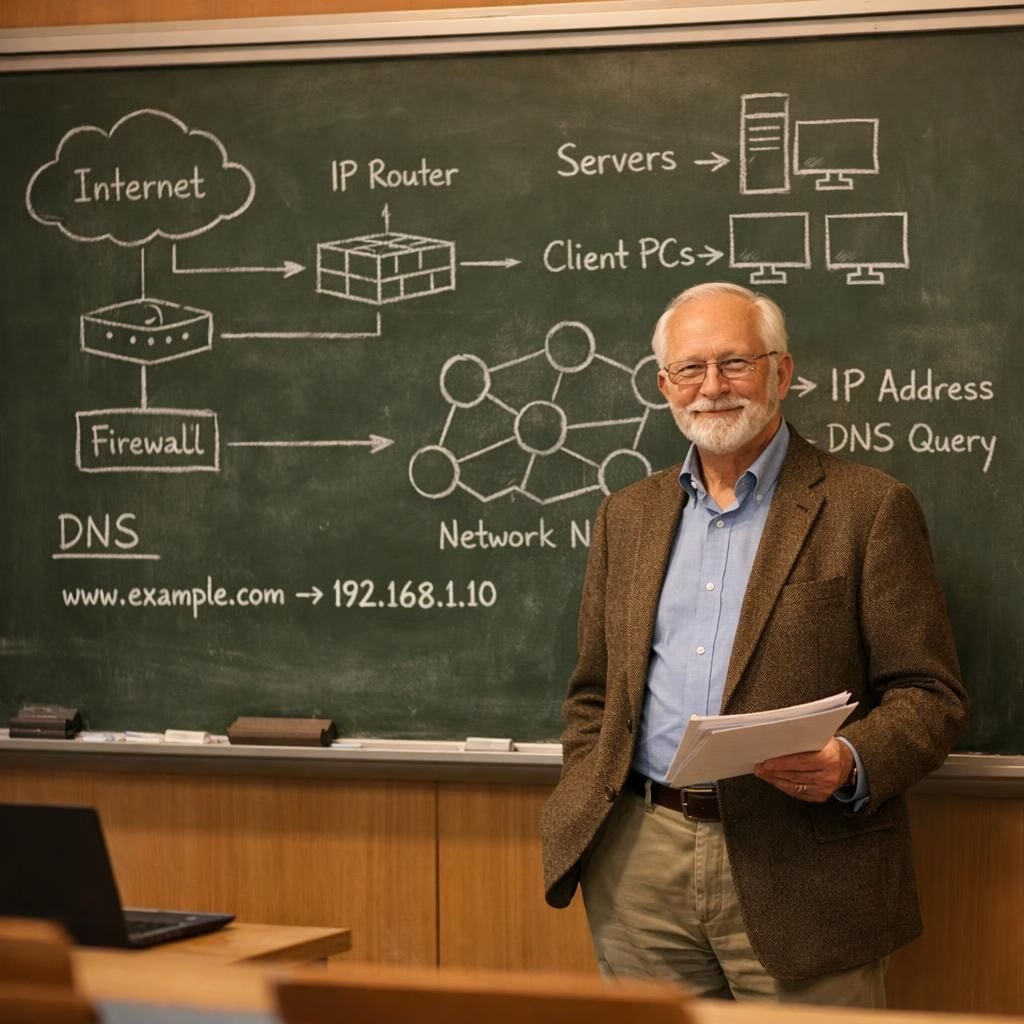
grandfather of the internet and DNS: Farber’s Legacy
David J. Farber, often hailed as the grandfather of the internet, died at 91 in Tokyo from heart failure. The former Bell Labs scientist and professor mentored students who would wire IP and DNS into everyday life, and he helped secure government backing for experimental networks. In 2026 the name still appears in classrooms and conference slides as a reminder that curiosity and collaboration built the connected world.
grandfather of the internet and DNS: Keys to a Connected World
In the early 1970s Farber participated in both discussions and hands-on experiments about data transport and naming. A landmark 1977 paper co-authored with Paul Baran argued that computers had become powerful enough to manage communication tasks beyond calculation alone. The paper framed computers as interactive communication systems that enable collaboration, conversation, and yes, emails that arrive before you finish drafting the message.
Keio University welcomed Farber in 2018, and his seminars helped fuse American and Japanese research approaches. He mentored students across borders, discussed policy implications, and encouraged practical experimentation. His presence in Tokyo reinforced a culture of open inquiry and shared learning that transcends geography.
Today, the 2026 landscape still echoes his philosophy: test ideas, publish results, and explain complex concepts in plain terms. The internet is not a single invention but a living network of people, protocols, and policies. DNS are the skeleton and the street signs of this vast ecosystem, and Farber taught generations how to read them carefully and creatively.
His career reminds us that teamwork matters as much as genius. The balance between technical rigor and humane mentorship is a pattern many researchers still aspire to. By welcoming new students, by showing up at policy meetings, and by arguing for funds to run experiments, Farber modeled a practical approach to turning curiosity into infrastructure that billions rely on today.
As a final note, the title grandfather of the internet and DNS still signals a legacy of collaboration, iteration, and persistent curiosity. The world keeps building on the IP protocols, the DNS naming system, and the mentoring ethos he championed. The work continues because people believe in the power of shared experiments and patient instruction.
In 2026 the digital era is brighter for Farber’s influence, a reminder that a few brave conversations can lead to continents of connectivity. He showed that computers are not solitary instruments but partners in human communication, and that great research thrives when policymakers, academics, and industry teams work together toward shared goals. The internet would not be the same without his patient leadership and his insistence on practical, scalable networks that people can actually use.
Original article: The New York Times obituary — thank you for the inspiration and the in-depth reporting that helped shape this tribute. Read the original article.
Practical takeaways
- Learn how IP routing and DNS naming interact to connect devices worldwide.
- Explore how researchers bridge labs and policy to turn ideas into deployable networks.
- Study foundational papers like the Baran-Farber collaboration to understand early networking concepts.
- Follow current DNS developments, including security risks and defense strategies.
Further reading
- DNS security vulnerabilities in resolving apps
- Malware hidden in DNS records: a wake-up call
- EU DNS resolver and privacy considerations
FAQ
- Who was David J. Farber? A pioneering computer scientist and educator who helped shape early networking and mentored figures who built the modern internet.
- What are IP and DNS? IP provides addresses for devices on a network, while DNS translates human-friendly names into those addresses.
- Why is DNS important? It is the naming system that makes it easy to reach websites and services without memorizing numeric addresses.
- Where can I learn more? See RFC 1034 and RFC 1035 for foundational DNS concepts.