

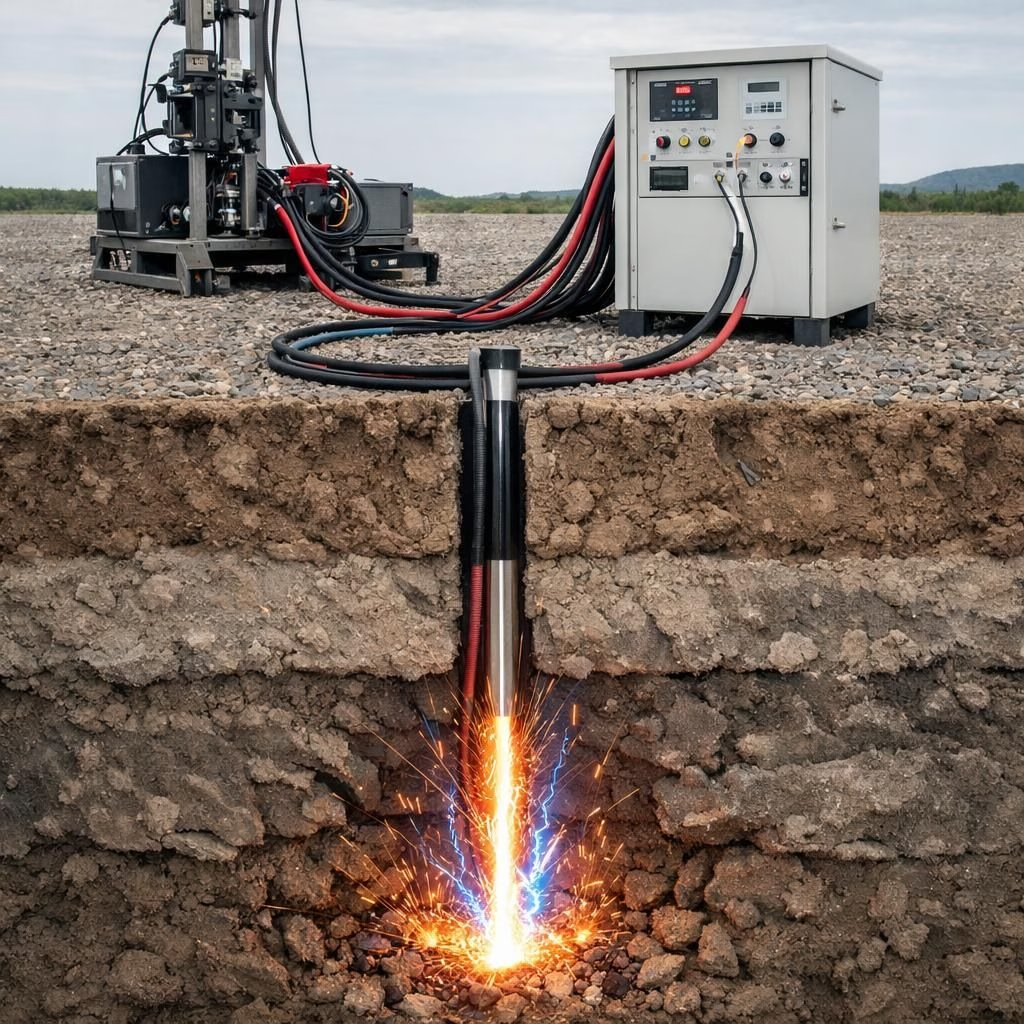
Geothermal energy has long promised clean baseload power, but deep drilling puzzles kept it out of reach. Telura’s electro-impulse drilling approach could change that, turning hard rock in the Earth’s crust into a productive heat source. This bold deep-tech bet aims to make geothermal economically viable almost anywhere.
Geothermal potential meets electro-impulse drilling
But the idea isn’t a naïve dream. Telura notes that electro-impulse drilling has lived in academic labs for more than two decades, with researchers at TU Dresden and ETH Zurich contributing to the understanding of rock fracturing under impulse. Telura argues the time is ripe to turn those findings into deployable hardware that can ride on conventional drilling rigs instead of forcing a new supply chain. Telura designs its system to integrate with conventional drilling rigs, which helps reduce deployment risk and shorten the path to commercial operation. By aligning with existing infrastructure, the company says deployment is more feasible in practice.
Geothermal’s most appealing applications often come as closed-loop systems (CLGS), where a sealed network of pipes keeps the working fluid contained while it traverses deep hot rock. In such a loop, the environmental footprint shrinks, permitting can be simpler, and settings that aren’t friendly to open-loop systems become feasible. Telura’s CLGS concept isn’t a magic bullet, but it’s a practical framework that acknowledges the constraints of geology and regulation while offering a cleaner path to heat extraction.
electro-impulse drilling: a hardware-focused path
The team behind Telura blends rare hardware chops with a taste for scalable energy solutions. Co-founder Philipp Engelkamp, who previously led INERATEC—a Karlsruhe Institute of Technology spin-out that became a notable e-fuels player—now helms Telura as CEO. Andrew Welling, the CTO, brings a deep hardware pedigree from Rolls-Royce and from leading the engineering team at Lilium, the electric aircraft start-up. The pairing of e-fuels know-how and extreme hardware development is unusual in a geothermal start-up, and that mismatch has caught attention from investors and SPRIND, Germany’s federal agency for breakthrough innovations.
Autumn 2025 saw Telura raise a €4 million pre-seed from European deep-tech backers, including Nucleus Capital, First Momentum Ventures, and Possible Ventures, along with angel investors who are well known in Germany’s start-up scene. Separately, the company struck a validation agreement with SPRIND to test the electro-impulse drilling approach under conditions that resemble real deployment. The SPRIND program is designed to support technologies that are too early for conventional funding, and the collaboration underscores a belief that the technology could cross industry lines.
In the broader market, geothermal has not enjoyed the same fanfare as solar or wind. That situation is changing as demand grows for 24/7 baseload power to support data centers, manufacturing, and other energy-intensive activities. California’s Fervo Energy, an enhanced geothermal start-up backed by a major tech giant, raised hundreds of millions in late 2025, signaling investor appetite for improved geothermal. In Europe, a number of deep-tech drilling ventures emerged to tap the continent’s geothermal potential. Munich’s Hades Mining, for example, raised €5.5 million in mid-2025 before closing a larger seed round. Germany’s Geothermal Energy Acceleration Act is intended to streamline permitting, reducing friction in the regulatory process. All of this creates a more favorable climate for Telura’s work, even if success is not guaranteed.
Telura’s core thesis remains provocative: the deepest, hottest rock—superhot rock geothermal at depths where temperatures exceed 374°C—has been largely untapped because existing drilling methods can’t reach it economically. Some researchers suggest that tapping as little as 1 percent of this resource could generate eight times the current worldwide electricity demand. Whether electro-impulse drilling can deliver that kind of scale remains to be proven in field conditions, not just the lab. SPRIND’s validation program and the company’s investors will be significant signals over the coming year as field tests begin or intensify.
So is this a breakthrough or another clever bluff in a crowded climate-tech landscape? The cautious answer is: it’s early, but the combination of academic roots, hardware-heavy leadership, strategic funding, and a concrete path to deployment makes the bet worth watching. If Telura can demonstrate repeatable results outside the lab, the technology could become a cross-industry enabler—reducing risk for other deep-temperature ventures and accelerating the adoption of sustainable baseload power worldwide. The journey from dataset to drilled hole is long, but the premise is simple: give rock a pulse, not a push, and listen for the response.
For context and broader background on geothermal technology, see the Air-to-water technology article: Air-to-water technology using low-grade geothermal heat to be showcased in Texas.
Original article acknowledgement: Special thanks to the original Telura article for grounding this rewrite. Read the original here: Original Telura article. We appreciate the source material that informed this perspective.
Have thoughts on this approach? Share your thoughts in the comments below.
How electro-impulse drilling could work in practice
- Assess site geology and temperature regimes to determine feasibility for CLGS and the required depth.
- Plan integration with existing drilling rigs to minimize new supply-chain requirements.
- Install a closed-loop geothermal system, with risk controls for high-temperature fluids.
- Monitor performance, safety, and regulatory compliance during early field trials.
FAQ
- What is electro-impulse drilling? It uses high-voltage pulses to fracture rock, reducing mechanical wear in deep drilling.
- Is this approach ready for field deployment? Field-ready status depends on SPRIND validation outcomes and field tests in the coming years.
- What is a closed-loop geothermal system (CLGS)? A sealed loop that circulates a working fluid through deep hot rock to extract heat without exposing groundwater to the environment.
Industry context: A growing climate-tech narrative
Industry momentum is rising as the need for reliable baseload power grows beyond the intermittency of wind and solar. In addition to Telura’s work, DOE and IEA pages offer broader context on how geothermal energy could scale with new drilling techniques: the DOE Geothermal Energy Basics and the IEA Geothermal Energy pages provide foundational context for policy and market developments.
Conclusion and next steps
Telura’s journey to field deployment hinges on successful testing and industrial adoption. If results prove repeatable beyond the lab, electro-impulse drilling could become a cross-industry enabling technology for deep-temperature energy.