

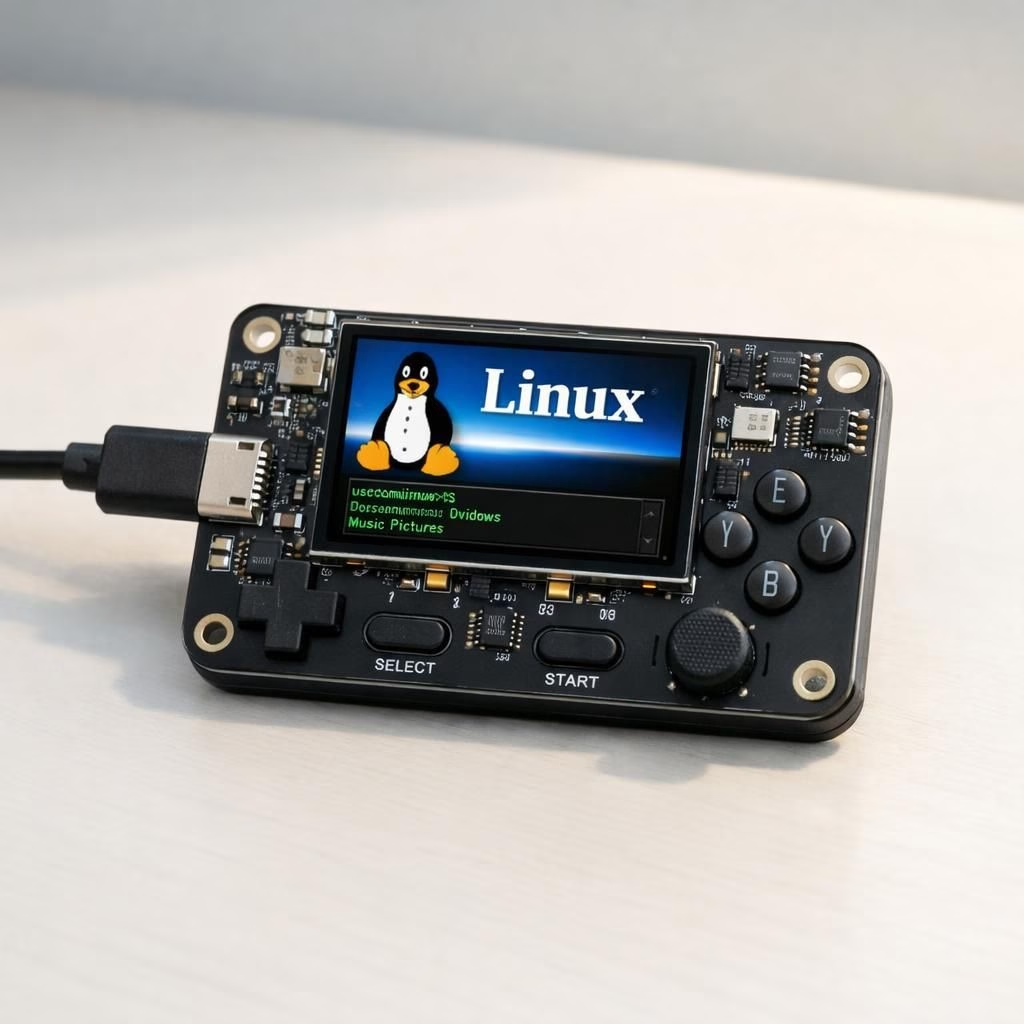
Welcome, curious builders and caffeine-fueled keyboard cowboys. The Flipper One team is asking for a hand, and in return you get a pocket-sized Linux-powered companion that sits quietly on your desk or in your palm, ready for the next big idea. This device is not just a gadget; it’s a portable, Linux-powered multi-tool designed for tinkerers and hackers who want practical capability in a compact form. Across Hackaday, PCMag, The Verge, Hackster.io, and TechCrunch, the same story emerges: a tiny machine with a big appetite for experimentation, a design ethos rooted in openness, and a mission to empower people who like to actually build things rather than admire them on a shelf. The team behind the Flipper One continues to iterate, listen to feedback, and invite contributions from engineers, hobbyists, and students who want to push the boundaries of what a small gadget can accomplish in 2026.
Flipper One: A Linux-powered Pocket-Sized Companion
In practical terms, the Flipper One is described as a pocket-sized Linux-powered computer. It is meant to run a range of open-source tools, host small experiments, and provide a portable lab for on-site prototyping. The team emphasizes openness and modularity, inviting developers to add features via scripts, drivers, and hobbyist projects. The design remains focused on real-world use: network testing, code demonstrations, hardware prototyping, and teaching sessions that fit into a bag or a coat pocket. The aim is not to replace a big workstation but to complement it with a tiny, reliable partner that can travel to a co-working space, a classroom, or a conference hallway in 2026. This is the kind of device that rewards curiosity with tangible results rather than promising miracles on a glossy catalog page.
Linux-powered Networking Meets Flipper One Hardware
The core promise is simple: a Linux-powered device that doubles as a networking gadget built for hackers and tinkerers. It can serve as a compact gateway, a portable router, or a test host for experiments in packet capture, VPN demos, and secure communications. The team highlights add-ons and adapters that expand I/O, letting users attach USB devices, small displays, or new NICs to explore practical networking in the field. This is not theoretical; it’s a tool you can hand to a student or colleague to demonstrate concepts that used to require a lab and a rack full of gear. The device also speaks to a broader software culture: you learn by doing, you share by teaching, and you grow together as a community.
What makes this project interesting is the balance between approachability and power. The device embraces a small footprint while resisting the temptation to be a one-trick pony. It’s designed to be a platform you can grow with: an educational aid, a development board, and a portable lab in one. The community angle is key; the team is listening for feedback, inviting contributions, and encouraging users to publish tutorials that help everyone get more value out of a handheld Linux-powered system. In short, this is not a finished product so much as a living platform that invites you to co-author its next chapter.
Practical use cases you can actually test
Field labs benefit from a device you can carry anywhere. You can run a lightweight server, collect telemetry from a local network, or demo a small security tool during a meetup. In classrooms, it becomes a hands-on outpost where students can see Linux-powered in action, install packages, and learn by breaking and rebuilding. On the road, it serves as a portable test rig for code, drivers, and automation scripts. The ideas multiply once a single, well-documented workflow exists, and Flipper One provides that scaffolding. The project’s openness turns every user into a potential contributor, which is exactly the kind of feedback loop that makes hardware more resilient and software easier to maintain. And yes, the tiny device looks cute when you put it next to a coffee cup, but it’s the capability inside that earns respect from engineers and hobbyists alike.
- Portable lab and test rig for field work, demonstrations, and quick prototyping.
- Educational tool for Linux basics, networking concepts, and open-source tooling.
- Driver and script tutorials to expand device capabilities across use cases.
- Community-driven development with public docs, reviews, and how-tos.
All of this sits within a context of practical sustainability. The Flipper One project emphasizes clean, documented software and hardware interfaces so instructions don’t become a scavenger hunt. Community contributions are welcomed in the form of patches, tutorials, and translations that lower the barrier to entry. The team’s stance is not about hype; it’s about real-world value delivered consistently, a standard that matters as the maker movement expands through 2026 and beyond.
Linux-powered Networking Meets Flipper One Hardware
To recap the core value: this is a Linux-powered handheld that doubles as a flexible networking gadget. The combination matters because it lets you demonstrate concepts that used to require duplicative gear in a compact, portable form. You can show how a VPN tunnels traffic, how a host can be temporarily repurposed as a router, or how a small device can run a miniature web service in a classroom demo. The hardware design is intentionally modular, so people can swap in extra memory, add a display, or attach a USB-C power bank for longer field sessions. The result is confidence in experimentation, not dread at the thought of complex installations. The team invites you to try, document, and share what works—because knowledge grows faster when it’s public, collaborative, and optimistic about the future of hands-on learning in 2026.
As a closing thought, this project demonstrates how a small team can inspire a larger community to rally around a practical tool. It shows that Linux-powered devices aren’t only for servers and developers; they can be friendly, portable, and surprisingly robust learning aids. It also highlights a broader tech culture shift: curiosity, openness, and collaboration as the default setting for hardware development. If you are reading this and you feel the tug of a new project that fits in a pocket and a backpack, you’re not alone. The Flipper One story is a reminder that big ideas can emerge from tiny devices, when the right people are listening and the right hardware is in hand in 2026.
We’d love to hear your thoughts in the comments: what would you build with a pocket-sized Linux-powered platform? What tutorials should exist first? How should the team prioritize features or add-ons? Your feedback can help steer the next wave of experiments and documentation that turn this little tool into a widely used learning and prototyping platform.
Original source and gratitude: this overview nods to the original reporting that started it all. Original article coverage can be found at Hackaday, with thanks for the material that inspired this post: Hackaday — The Team Behind The Flipper One Needs Your Help.
Getting started with Flipper One
Unbox the device, plug in the power, and verify the indicators show ready.
Connect to a network or hotspot, then open a terminal to begin experimenting with Linux-powered toolchains.
FAQ
- What is Flipper One? A pocket-sized, handheld Linux-powered platform designed for tinkering, prototyping, and on-the-go learning.
- What can I actually do with it? Run a lightweight server, demo a VPN, capture packets, and prototype hardware with open-source tooling.
- How can I contribute? Share tutorials, publish patches, and help document workflows for the community.