

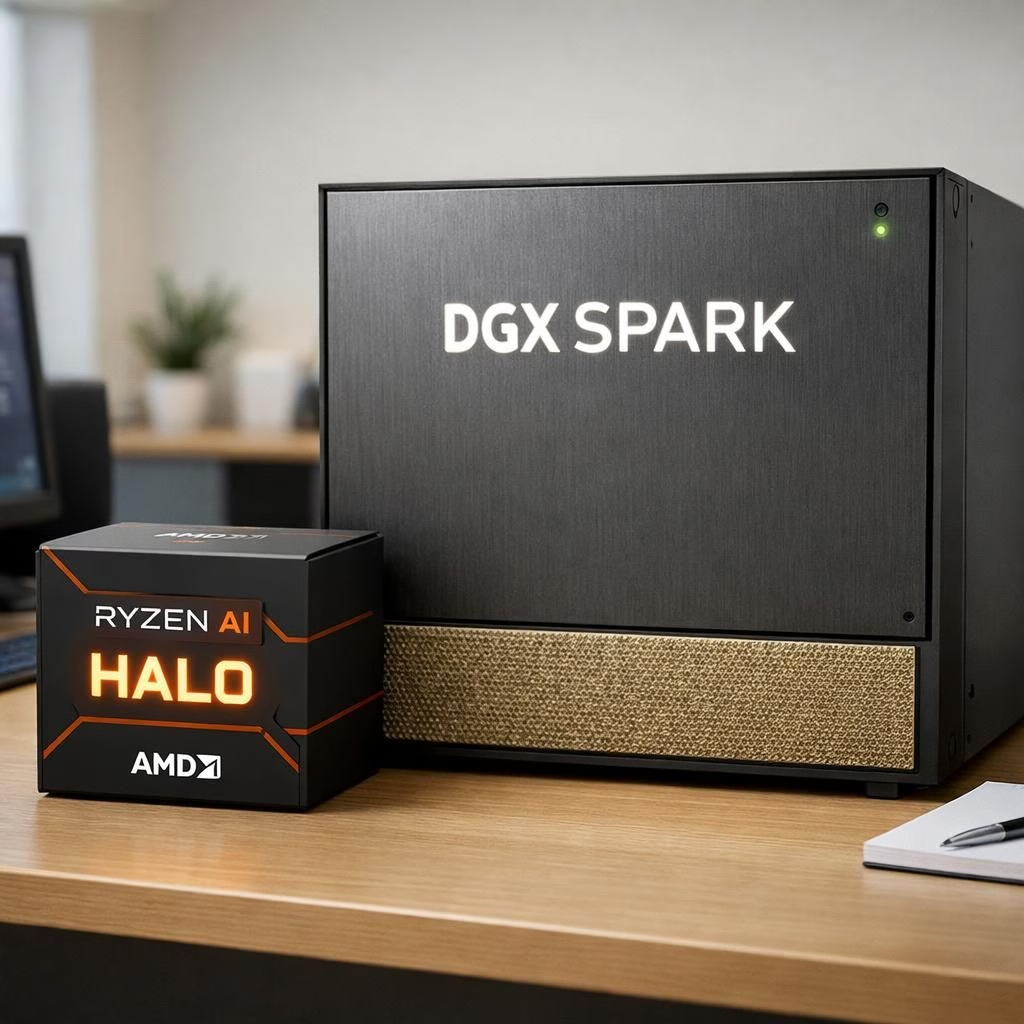
In this playful, hopeful, and slightly satirical look at AI hardware, we compare two crowd-favorites: the DGX Spark and the Ryzen AI Halo. Both promise more independence from cloud APIs and a dash of desk-side swagger for developers who vibe-code into the night. The DGX Spark and the Ryzen AI Halo sit on opposite ends of the spectrum: one leans toward a curated, prebuilt ecosystem; the other embraces the familiar comfort of an x86 box. And yes, both are real hardware with real price tags in 2026.
DGX Spark in the spotlight
The price story is straightforward: there is a premium for the Spark that designers say is warranted by the curated software stack and proven reliability. The DGX Spark now retails for 4,699, up from 3,999 when we last checked last fall. The marketplace conversation centers on whether the value comes from a predictable local AI environment that reduces cloud API spend over time. The Spark is built for teams that want a turnkey, scalable setup that runs models and agentic AI frameworks locally, without chasing API latency or usage caps.
What truly matters is the software stack that ships with the Spark. The hardware is strong, but the preconfigured playbooks and tested configs save time and debugging. For ROI-minded buyers, the Spark’s price is often offset by predictable costs and fewer early chaos moments, especially for workflows that rely on robust local inference and well-documented dependencies.
Ryzen AI Halo in a tiny package
Ryzen AI Halo fits in a tiny 5.9 by 5.9 by 1.7 inch chassis and runs on a 120 watt Ryzen AI Max+ 395 APU, codenamed Strix Halo. It ships with 128 GB of LPDDR5x memory, 16 Zen 5 cores, and 40 RDNA 3.5 GPU compute units, delivering up to 256 GB/s of bandwidth. For local AI enthusiasts this is enough to run models up to 200 billion parameters in 4-bit precision, which is frankly impressive for a device of this size. The integrated graphics peak around 56 teraFLOPS at 16-bit precision, a solid figure for many tasks, though not the fastest among the options.
In hardware terms, the Ryzen AI Halo declines FP8 and FP4 in hardware, a contrast to certain high-end accelerators. The Halo shines in flexibility: you can install Windows or your preferred Linux and shape the software stack to taste. That matters for developers building for Microsoft’s NPU-accelerated AI PC ecosystem or for teams that want a familiar workstation feel at the edge.
The Halo adds an XDNA 2 based neural processing unit rated for about 50 TOPS, a modest accelerant for some tasks, though real gains depend on the workload. And yes, the Halo is a standard x86 box, which means you can run your favorite distro, set up your chosen frameworks, and tune memory and compilers the way you like. In networking, the Halo ships with a single 10 Gbps NIC, which can be a bottleneck for large model downloads but can be mitigated with RDMA over USB-4 when the right software is in place. The Spark, by contrast, tends toward higher-throughput networking with a more cluster-friendly NIC option for multi-node setups.
AMD emphasizes validated environments and documented playbooks for common workloads. At launch, the Ryzen AI Halo ships with five preinstalled playbooks, ten more online, and additional playbooks added monthly. The 128 GB Ryzen AI Halo will be available for pre-order next month at $3,999, and a 192 GB model with the AI Max+ 495 APU is on the horizon, offering a larger memory pool for bigger models, should the price feel right in 2026.
Which path makes the most sense for you? If you want a curated, predictable environment and strong software support, the Spark still has the edge in that arena. If you value hardware flexibility, Windows compatibility, and a familiar desktop experience, the Halo is hard to beat, especially for teams that want to tinker and optimize locally. In real-world terms, the two devices are not solely about raw speed; they shape how you approach model development, deployment, and debugging.
Bottom line: these devices are not purely about chasing the highest peak FP numbers. They are about providing the right balance of compute, memory, and a developer-friendly environment that makes local AI accessible without losing control of your tools. The Spark may sing a slightly higher-pitch note in FP8-friendly workloads, but the Halo offers flexibility, a real operating system, and a straightforward upgrade path for bigger projects in 2026.
Have thoughts? Share your thoughts in the comments and tell us which path you would pick for your next project.
Special thanks to the original article for inspiration: Original article. We appreciate the insights and data you provided.
Practical steps for evaluating DGX Spark vs Ryzen AI Halo
- Assess your workload: local inference, data residency, and latency needs.
- Consider memory and expandability: 128 GB vs 192 GB and future model sizes.
- Evaluate software readiness: prebuilt playbooks vs DIY stacks and toolchains.
- Check networking needs: multi-node clustering vs single-box deployments.
- Choose your OS and toolchain: Windows, Linux, and preferred frameworks.
FAQ
- Which device is best for small teams?
If you want a predictable, turnkey environment with strong backed playbooks, the Ryzen AI Halo can be compelling. For teams prioritizing a managed software stack and turnkey collaboration, DGX Spark is appealing. - Can I run Windows on the Ryzen AI Halo?
Ryzen AI Halo supports Windows and Linux, giving you flexibility for your preferred workflow. - How does memory size affect model performance?
More memory enables larger models and longer contexts, reducing swapping and enabling smoother fine-tuning. The 192 GB model helps with bigger workloads, if the price fits. - Is the price worth it compared with cloud APIs?
Local hardware can save ongoing API costs for steady workloads, but total ownership depends on usage patterns and model sizes.
Conclusion
In 2026, both options aim to give developers more control over AI workloads while keeping a clear line to local deployment. If you value a curated ecosystem and fast time-to-value, the DGX Spark remains strong. If you want hardware flexibility, a familiar workstation feel, and a path to larger projects, the Ryzen AI Halo stands out.
References and further reading below, including the original source that inspired this piece.
References
- The Register: AMD says its 4K Ryzen AI Halo workstation practically pays for itself
- NVIDIA DGX Spark product page
- AMD XDNA technology