

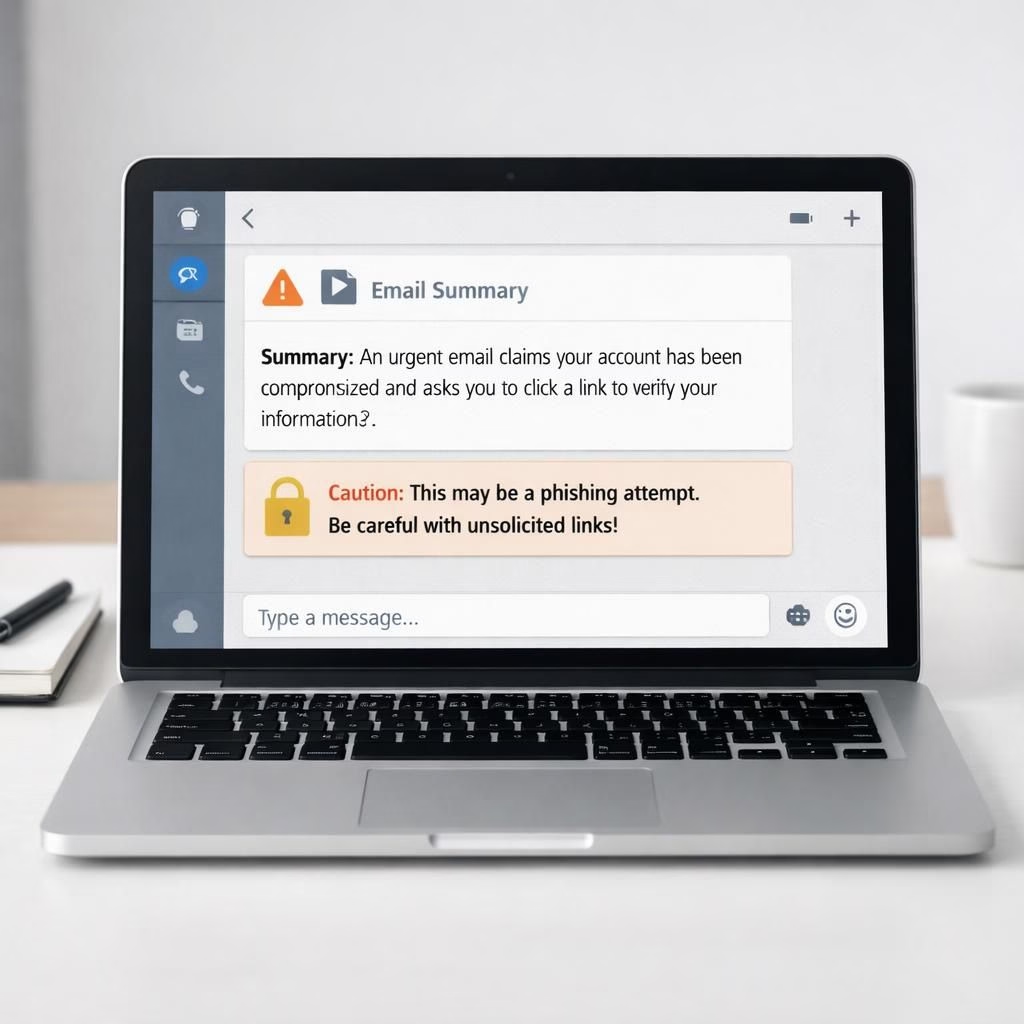
Copilot promises quick inbox summaries, but when it touches Confidential Emails, privacy questions arise. Copilot can summarize these messages, raising consent and data-handling concerns for 2026.
Copilot and Confidential Emails: A Real-World Glitch, A Cautionary Tale
Mashable and others report Copilot logging and summarizing content from several Confidential Emails without explicit permission. The Register flagged a bug that bypassed DLP on a ‘Confidential’ label, illustrating a policy gap. TechCrunch and Neowin noted that Microsoft uploads your emails to Copilot for summarization. This pattern isn’t malice; it reveals a data handling gap that AI systems must respect. Privacy guardrails must keep pace in 2026.
What Copilot’s Handling of Confidential Emails Teaches Us in 2026
Relying on Copilot for summaries? Use per‑message opt-out or prohibit summarizing items labeled Confidential Emails. The event shows Copilot’s usefulness grows with clear guardrails, not brittle ones. For users, ask where your data goes and how it’s processed. For builders, design privacy by default and easy toggles. Together, we can keep Copilot helpful without turning it into a privacy liability, especially when handling Confidential Emails.
Practical steps to reduce risk:
- Review default data sharing settings for Copilot.
- Label sensitive emails clearly and enforce non-summarization for Confidential Emails.
- Provide opt-out options for AI processing of internal communications.
- Regularly audit AI integrations for privacy risks.
Governance and Practical Safeguards
Beyond the basics, security teams are likely to push governance frameworks. Expect privacy-by-default settings and data minimization. On-device processing should be preferred where possible. Developers and users will receive practical privacy training. Incident response playbooks will include AI data‑exposure checks. This is not a disaster; it marks a turning point toward disciplined AI use in business.
Additional practical steps for 2026 include privacy impact assessments, vendor data-processing addenda, and strict data retention windows. Organizations will audit access permissions and monitor for unusual data flows. Transparency dashboards will show what data travels where. The aim is simple: keep productivity high and protect information. Industry perspectives vary, but the core idea remains: AI can assist without compromising privacy if governance keeps up.
Industry perspectives vary, but the core idea remains: AI tools should amplify human decision‑making, not override privacy boundaries. Vendors will publish clearer data-sharing policies and emphasize control for administrators. For organizations, this means evolving governance models that cover data labeling, access controls, and continuous monitoring. For individuals, it means staying informed about what data is used to train or summarize content and how to opt out.
In practice, success will blend speed and privacy. Teams will enjoy faster summaries when allowed, while privacy teams sleep a little easier knowing there are strict limits on what data gets sent to the AI. The takeaway is simple: with thoughtful setup, Copilot can become a trusted assistant that respects Confidential Emails and other sensitive data while keeping daily work moving forward.
Original reporting and gratitude: A big thank you to Mashable for kicking off the discussion and linking to real-world privacy concerns. You can read the original article here: Mashable.
If this sparked a thought or a story of your own, share it in the comments below. Your experiences help others navigate the balance between productivity and privacy.
FAQ
- What happened with Copilot and Confidential Emails?
- Initial reporting shows summaries could run on content labeled Confidential Emails without explicit permission. That highlights the need for stronger guardrails and consent controls.
- What can users do to protect their data?
- Review Copilot’s data-sharing settings and opt out of AI processing for sensitive messages whenever possible. Apply per‑message controls where available.
- What should organizations implement next?
- Adopt privacy‑by‑default configurations, enforce data minimization, and secure clear data‑processing agreements with vendors.
- Is on‑device processing a viable alternative?
- On-device processing can reduce data exposure, but it requires robust security and performance considerations.