

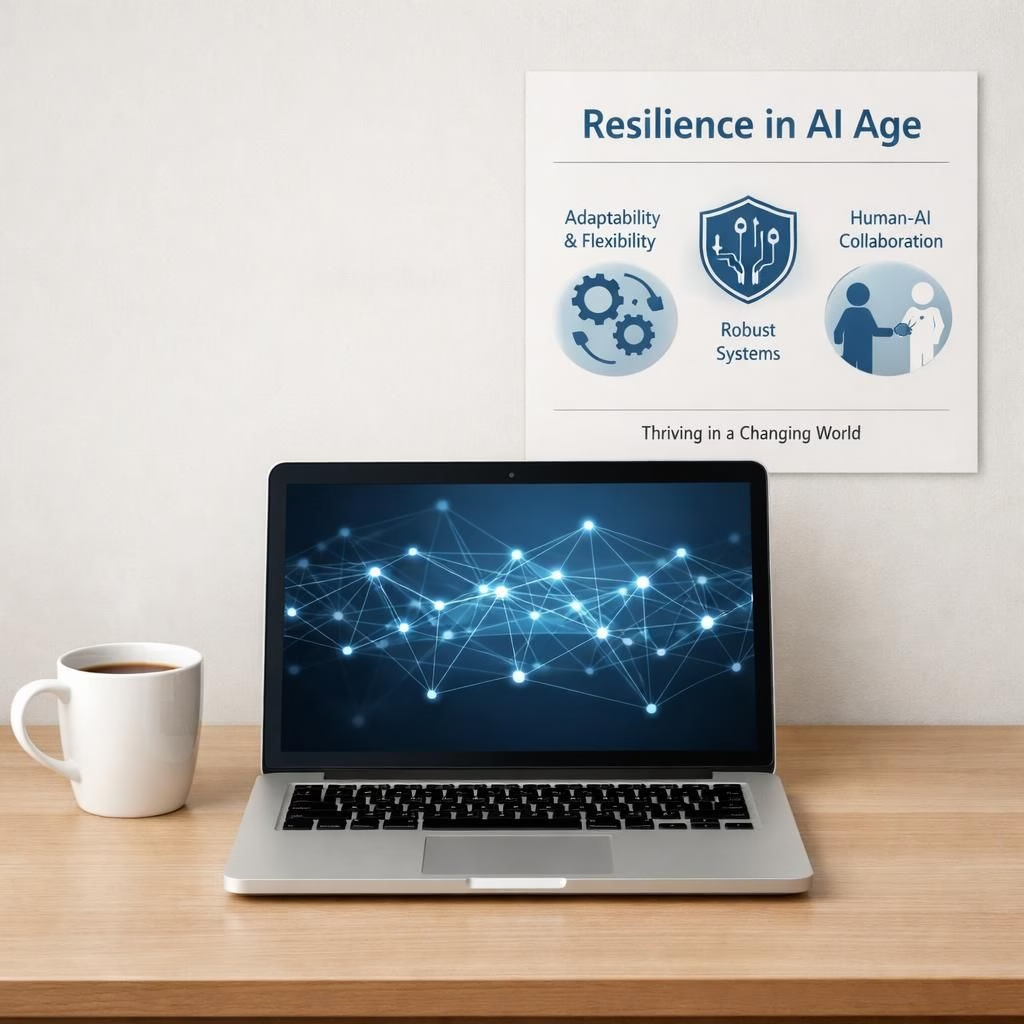
In 2026, the Artificial Intelligence revolution lands not as sci‑fi, but as a boardroom reality. The Imagining the Internet Center at Elon University gathered hundreds of expert voices to argue that resilience must move from the margins to the center of how we govern, deliver services, and protect rights. The report notes that AI will play a significantly larger role in shaping everyday life in the next decade, and it cautions that old resilience playbooks won’t cut it in an AI‑infused society. The tone is practical, not apocalyptic, and the mood is less doom and more do‑this‑now, with a smile and a blueprint.
Artificial Intelligence and Imagining the Internet Center: A 2026 Resilience Roadmap
Experts describe Artificial Intelligence as the invisible operating system of modern life—quietly coordinating opportunity, risk, and accountability while slipping into the texture of daily routines. The Imagining the Internet Center notes that resilience must be designed at a systems level. Individual grit can help, but it won’t counterbalance the scale and speed of AI‑driven change. This is a call for cross‑sector collaboration, shared norms, and practical guardrails that can survive leadership turnover and shifting tech trends.
The canvassing emphasizes that progress rarely looks like a straight line. When AI becomes the background layer of education, work, health, and governance, the risk isn’t a single spectacular failure—it’s a slow drift where people and institutions lose the ability to question or even notice what has changed. Short‑term wins can mask longer costs, especially if human judgment and accountability get outsourced to clever algorithms. The authors push for a deliberate shift from reaction to anticipation—an agenda that aligns governments, businesses, educators, civil society, and communities around resilient infrastructure rather than episodic fixes.
Several voices stress the need for a new language of responsibility. It isn’t enough to demand “better tech” or endless automation. We need cognitive triage that helps people reflect on choices, plus a cultural shift toward transparency and human oversight. The practical takeaway is crisp: build systems that support human judgment, not systems that erode trust or blur accountability. This is resilience as design, not just a mood or moodboard for the future.
All told, the report’s authors stress that resilience is collective. Individual action matters, but a robust AI age requires coordinated action across multiple layers of society. The result is a blueprint for action rather than a manifesto for doom. The team frames resilience as a living practice—an ongoing negotiation among policy, technology, and everyday life—where people remain central even as machines become more capable.
In addition to the governance focus, the report offers a menu of concrete targets. The following sections summarize the most prominent ideas, organized by sector and practical impact. This is not a mere wishlist; it is a concrete set of steps designed to shift institutions from fragile improvisation to durable resilience.
Imagining the Internet Center-led Institutions-First Strategy for AI
Governments are urged to accelerate public resilience investments now. This includes international norms, a framework for pre‑deployment safety audits, and a robust authentication infrastructure to watermark and track generated outputs. Tax policy could be used to disincentivize displacement while encouraging AI systems that improve accuracy and trust. In short: governance should shape the pace and direction of AI’s integration into society, not merely react to its surprises. For context, see global governance frameworks such as the OECD AI Principles and the EU’s AI Act. OECD AI Principles • EU AI Act.
For AI developers, the guidance is blunt yet practical: design for reflection, not just engagement. Build friction points that prompt human review, require AI outputs to cite human‑centred foundations, and invite independent safety audits before release. The aim is to avoid hype cycles and create systems that support thoughtful decision‑making rather than exploit cognitive shortcuts.
Business leaders are called to champion human augmentation and carve out spaces where humans stay central. This includes policies that address psychological and social impacts of AI on work and identity, and the deliberate creation of human‑only zones where automation is minimized or prohibited. The goal is to preserve purposeful work and meaningful human connection while still embracing AI where it adds value.
Educators face the task of building “existential literacy”—helping learners understand how technologies shape goals, values, and identities. They are urged to cultivate metacognition, discernment, and epistemic vigilance so students can navigate change with agency. The recommendation is to pair technical proficiency with emotional and social intelligence, ensuring people can thrive in an AI‑mediated world.
Civil society and local communities are encouraged to strengthen social capital and create participatory governance structures. Data trusts, citizen assemblies, and distributed AI governance can empower communities to shape how AI is deployed. Offline spaces that resist algorithmic mediation—analog communities, dumbphones, and simple, trusted environments—are framed as essential buffers against pervasive surveillance and overreach.
For individuals, the message is personal and practical: protect your agency, cultivate existential literacy, and practice stop‑and‑reflect routines when engaging with AI. Balance screen time with in‑person connections, grow your personal networks, and approach algorithmic systems with curiosity and healthy skepticism. The path to flourishing in the AI age is paved with deliberate choices and human connection.
In closing, many experts express cautious optimism. If resilience is built into institutions and everyday life, humans can not only survive but flourish as AI becomes more embedded in society. The tone remains pragmatic rather than apocalyptic: smarter governance, smarter systems, and smarter humans can co‑evolve toward better outcomes. The conversation is ongoing, but the blueprint is clear: act now, together, and with a healthy dose of humility about what we still don’t know.
What futures did the Imagining the Internet Center experts imagine? The report collects a spectrum of scenarios—some hopeful, some sobering—about shifts in relationships, work, privacy, and solitude in an AI‑driven world. The common thread is that human values, accountability, and collaboration will determine whether AI serves us or outpaces our ability to steer it. This isn’t about resisting change; it’s about guiding change with purpose and governance that keeps people at the center.
If you’re curious about the concrete steps and the full range of expert voices, the complete executive summaries and methodology are publicly available and worth a deeper dive. The essence remains practical: resilience is a system property, not a personality trait, and the most trustworthy AI future is one that humans actively shape through wise policy, responsible development, and engaged citizenship.
Share your thoughts in the comments below. How should we balance rapid AI progress with human agency in your community? What small, scalable steps would you implement first?
Special thanks to the original article published by Imagining the Internet Center for the foundational material. Original article available here: https://www.elon.edu/u/news/2026/04/01/building-human-resilience-for-the-age-of-ai/.
Practical steps by sector
- Governments: accelerate resilience funding, adopt pre‑deployment safety audits, and establish a watermarking/authentication system for AI outputs. Consider tax incentives that reward trustworthy AI and reduce displacement.
- AI developers: build in reflection points, require sources for outputs, and submit to independent safety reviews before launch.
- Businesses: prioritize human augmentation, protect human‑only spaces, and support policies addressing workforce well‑being and social identity in the AI era.
- Educators: teach existential literacy, metacognition, and discernment alongside technical skills. Emphasize agency and responsibility in AI‑mediated life.
- Civil society and communities: grow local data trusts, citizen assemblies, and distributed governance. Support offline, analog spaces to preserve privacy and autonomy.
- Individuals: practice stop‑and‑reflect routines, maintain in‑person networks, and stay curious about how AI shapes choices and values.
Frequently asked questions
- What is resilience in an AI-enabled future? It is the capacity of systems and people to anticipate, adapt, and guide AI changes while preserving human judgment and rights.
- Why a systems‑level approach? AI’s influence is broad and fast; resilience must span governance, services, and everyday life, not just individuals.
- How can communities participate? Through local data trusts, citizen assemblies, and participatory AI governance that reflects shared values.
Conclusion: A practical, collaborative path forward
Resilience in the AI era comes from coordinated action across governments, firms, schools, and neighborhoods. By tying governance to everyday life and keeping people at the center, we can reduce risk and improve outcomes as AI grows more capable.