

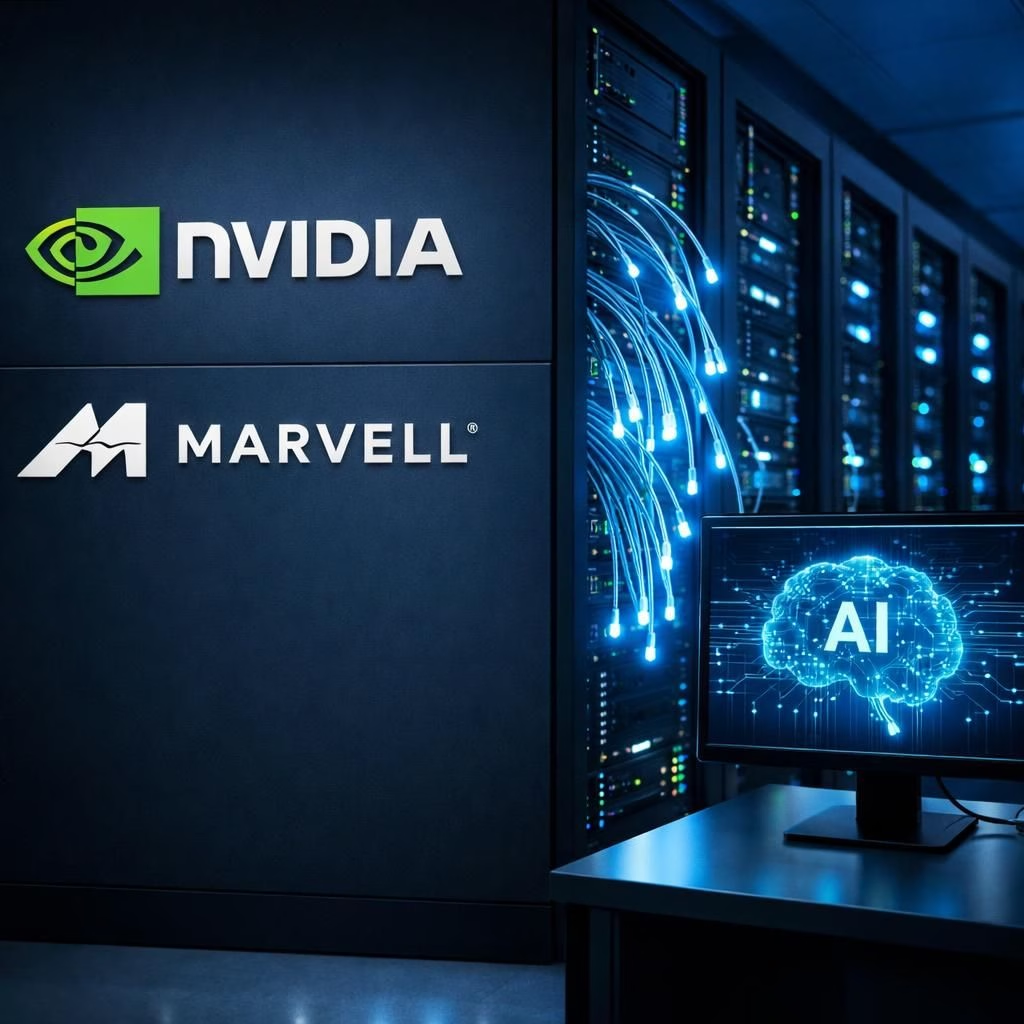
In a move that blends ambition with practicality, Nvidia announced a $2 billion investment in Marvell Technology. The deal signals a deliberate push to weave Marvell’s silicon innovations into Nvidia’s AI ecosystem, and to position Silicon Photonics as a backbone for AI workloads. The arrangement promises Marvell’s hardware to integrate with Nvidia’s AI stack, accelerating how clients deploy compute, storage, and networking tailored for AI workloads. And yes, this collaboration makes engineers smile: AI engines get closer to the data, while the data moves faster with lower latency. The emphasis on Silicon Photonics—the light-powered interconnects that move terabits per second—underscores a broader strategy to stitch together a robust AI-driven stack across chips, software, and networks.
The move sits squarely in Nvidia’s larger playbook: invest across a spectrum of tech firms to strengthen its central position in AI. The company has committed similar sums to Synopsys, CoreWeave, Coherent, Lumentum, and Nebius in a sustained effort to influence the full value chain—from silicon optics to accelerator software and data-center fabric. The idea is to create a compatible, end-to-end environment where customers can scale AI inference and content generation with fewer integration headaches. In practical terms, Nvidia is not merely buying partners; it is farming a coordinated ecosystem where partners’ products interlock, reducing friction for mutual customers and speeding time-to-value for AI deployments.
AI-Driven Growth: Nvidia-Marvell’s Silicon Photonics Play
From the vantage point of a technology observer, the Nvidia-Marvell deal reads as a calculated acceleration of infrastructure. Nvidia’s AI market leadership relies on a strong backbone—compute, memory, interconnect, and software—that can scale with demand. Marvell brings on-board strengths in signaling, storage, and processing that complement Nvidia’s GPUs and software stack. The synergy aims to optimize data paths for AI workloads, particularly in inference and model training, where latency and bandwidth matter as much as raw compute. The emphasis on Silicon Photonics is not merely a trendy footnote; it is a deliberate attempt to ease data movement across racks, clusters, and campuses. In practical terms, this reduces energy per bit sent and raises the ceiling on what AI systems can handle in real time.
The emphasis on Silicon Photonics is not merely a trendy footnote; it is a deliberate attempt to ease data movement across racks, clusters, and campuses. In practical terms, this reduces energy per bit sent and raises the ceiling on what AI systems can handle in real time.
Silicon Photonics + AI: A Bright Networking Path
The collaboration also tightens Nvidia’s grip on telecommunications networking. Silicon Photonics has long promised to shrink the distance between light signals and silicon chips. When paired with AI-optimized silicon, you get faster decision cycles, more responsive services, and the ability to support larger, multi-tenant AI deployments. For customers, this could translate into more affordable inference at scale, better support for real-time analytics, and fewer bottlenecks in data centers that serve AI-powered applications. The result is a virtuous loop: as AI models demand more throughput, the surrounding hardware and fiber networks become more capable, which in turn fuels even larger AI workloads. It’s a classic example of “build it once, scale it widely” for a sector thirsty for speed.
Beyond the tech specifics, the investment narrative reflects a broader industry arc: compute demand driven by AI inference and content generation is growing exponentially. Nvidia wants to secure the essential technologies that underpin this growth, not just in isolation but as part of a coordinated ecosystem. By aligning with Marvell, Synopsys, CoreWeave, Coherent, Lumentum, Nebius, and others, Nvidia is shaping a more resilient, interoperable AI supply chain. This approach lowers risk for customers who often grapple with compatibility challenges across disparate vendors. It also signals a market preference for integrated solutions that simplify procurement, deployment, and ongoing support for AI initiatives.
From a practical perspective, the deal could accelerate the rollout of specialized infrastructure. Imagine data centers that seamlessly blend high-speed networking, photonics-based interconnects, and AI accelerators in a way that requires fewer custom integrations. That simplification matters in enterprise, high-performance computing, and cloud contexts where time-to-value can determine competitiveness. The strategic emphasis on AI-ready silicon and photonics-enabled networking aligns with growing expectations for energy efficiency, cost-per-teraoperation, and scalable performance across diverse AI workloads. In 2026, when AI-driven services proliferate, this kind of cross-company collaboration helps ensure the underlying hardware and software keep pace with demand.
Market watchers may wonder how such partnerships influence pricing, availability, and competition. The optimistic takeaway is that a robust ecosystem tends to deliver more predictable supply, faster updates, and better optimization for AI tasks. For developers building on Nvidia’s platforms, the prospect of closer hardware-software alignment could translate into smoother AI model deployment, easier optimization, and access to a broader set of tools and accelerators. For investors, the move underscores Nvidia’s intention to remain at the center of a rapidly evolving AI economy, while giving partners a clearer path to growth and differentiation within a shared architecture.
As with any major strategic alliance, there are questions about execution, timelines, and return on investment. Yet the tone around Nvidia and Marvell’s collaboration is one of tempered optimism. The emphasis on Silicon Photonics and AI as core elements of the expansion keeps the conversation grounded in tangible capabilities—throughput, latency, energy efficiency, and scalable networking. The broader portfolio of commitments to Synopsys, CoreWeave, Coherent, Lumentum, Nebius, and related firms adds credibility to the model: no single bet, but a diversified, ecosystem-level strategy designed to weather AI’s rapid evolution through 2026 and beyond. Readers can expect a steady cadence of product integrations, performance benchmarks, and case studies as the year unfolds, each offering a glimpse into how AI-driven infrastructure will feel in real-world deployments.
In closing, the Nvidia-Marvell initiative is not merely a financial investment; it is a signal about how the AI era is shaping how hardware firms collaborate. The focus on AI and Silicon Photonics points to a future where data moves quickly, efficiently, and with intelligent orchestration across devices and networks. If successful, this blueprint could become a blueprint for others who aim to ride the AI wave without getting washed away by it. Even skeptics may appreciate the elegance of a well-structured, interoperable stack that promises faster time-to-value for AI projects and more resilient, scalable data-center architectures for enterprises and cloud providers alike.
Original article: Thank you for the original source material.
We’d love to hear your thoughts on this Nvidia-Marvell collaboration. Share your perspective in the comments and join the discussion about how Silicon Photonics might reshape data centers in 2026 and beyond.
What this means for data centers and buyers
- Expect more integrated, AI-ready hardware and software stacks that reduce interoperability gaps.
- Look for clearer product roadmaps that align silicon, software, and networking across vendors.
- Anticipate energy-efficient interconnects and higher throughput in multi-tenant deployments.
Frequently Asked Questions
-
What does Nvidia’s investment mean for Marvell?
It signals deeper integration of Marvell’s silicon capabilities into Nvidia’s AI stack, aiming to speed up deployment for mutual customers.
-
What is Silicon Photonics and why does it matter?
Silicon Photonics uses light to move data, reducing latency and energy use in data center interconnects. It complements AI-optimized silicon to enable faster, scalable workloads.
-
Will pricing or availability change for AI deployments?
That depends on broader market dynamics, but the strategy aims to improve supply predictability by building a coordinated ecosystem.
-
When can customers expect new integrated products?
The collaboration is ongoing, with product integrations and benchmarks expected over the next 12–24 months.
References
- NVIDIA press release
- Marvell Investor Relations
- NVIDIA Official Site
- Original article: Marketscreener