

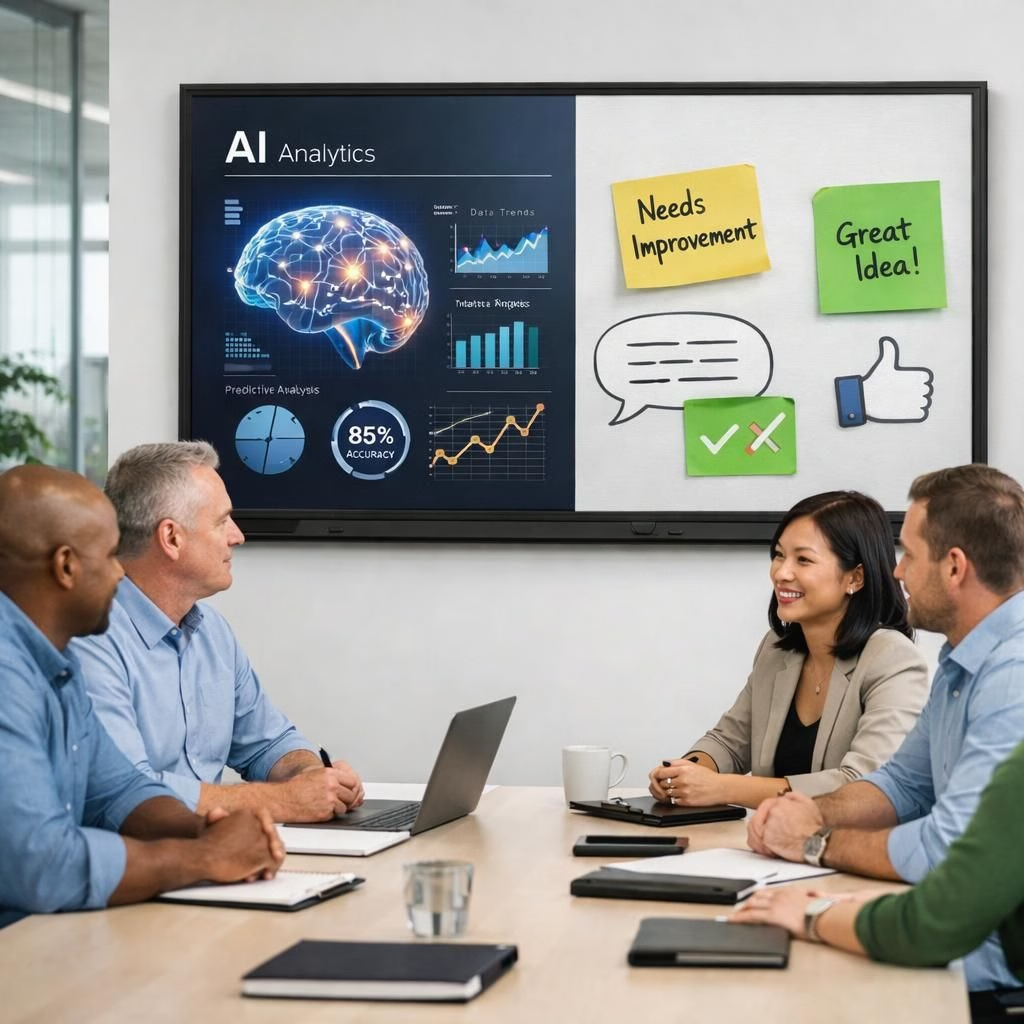
UserTesting, a leader in enterprise customer insights, announced the appointment of Neal Gottsacker as Chief Technology Officer. In this role, he will lead the global R&D organization and drive an era where AI-powered analytics meet human insight to transform enterprise decision-making. This shift emphasizes responsible AI and the enduring value of human accountability in customer insights.
Gottsacker arrives at a pivotal moment as organizations move beyond traditional research toward AI-accelerated, insight-driven decisions. He will scale the company’s AI strategy across the research lifecycle, ensuring the blend of AI capabilities and real, human feedback yields actionable customer insights at speed without sacrificing trust. The aim is to make AI a sturdy partner that enhances the depth of human understanding and the reliability of every customer insights in the pipeline.
At the heart of the transformation is a clear mandate: embed AI across core workflows while preserving transparency, explainability, and human-centered design. In practical terms, Gottsacker will oversee global R&D and push a next phase of innovation that combines AI with human nuance to help organizations understand customers better and make more confident decisions. This is not about replacing people; it is about empowering analysts, researchers, and product teams to exploit AI-powered signals with clear provenance and responsible oversight for customer insights.
Leadership at UserTesting now centers on accelerating innovation across the company’s AI strategy for customer insights. The plan emphasizes AI-assisted research, insight synthesis, and emerging agentic workflows, all built on a foundation of transparent, inspectable AI systems. The company promises to uphold human accountability as a core value even as AI accelerates the pace and scale of insight generation. In short, AI-powered capabilities should speed up decisions while maintaining the human touch that gives insights context and credibility.
AI-powered Leadership: Neal Gottsacker and the Next Chapter
Gottsacker brings a track record of leading technology organizations through rapid growth and transformation. He has built and scaled SaaS platforms, steered global engineering teams, and driven product innovation at key inflection points. Before joining UserTesting, he held senior technology leadership roles at Nintex, where he guided R&D through expansion, and at HP Software, where he oversaw a division focused on resilient, scalable software. He also started and ran a venture that fused technical depth with practical product vision, a background that should serve UserTesting well as it weaves AI into everyday customer insights work.
In his new role, Gottsacker will focus on advancing the company’s AI strategy across pillars such as AI-assisted research, customer insights, and emerging agentic workflows, all while maintaining a commitment to transparent, inspectable, and human-centered AI systems. The goal is to turn AI-powered capabilities into reliable business outcomes by making models auditable and outputs understandable for teams that must act on them every day.
From a strategic vantage, this appointment signals a broader industry trend: the rise of AI as a companion to human judgment rather than a replacement for it. Even as AI accelerates data collection, pattern recognition, and scenario testing, the human ability to interpret, tell persuasive stories with numbers, and hold decisions to account remains essential. Under Gottsacker’s leadership, UserTesting intends to demonstrate that speed and trust can coexist in AI-powered customer insights programs, a pairing that many enterprises crave in a world of noisy data and opaque dashboards.
Delivering customer insights the AI-powered Way
“UserTesting is uniquely positioned to define the future of customer insights in an AI-driven world,” Gottsacker comments, reframing radical efficiency as responsible efficiency. The emphasis is on blending the best of machine analysis with the depth of human feedback to deliver customer insights that teams can act on with confidence. The message is clear: AI-powered analysis should accelerate decisions without eroding accountability or clarity about how insights were produced.
The strategy includes continued investment in AI-driven insights and core workflows that help organizations understand customers and make more confident decisions. This will help ensure customer insights remain credible. Expect enhancements to AI-powered dashboards, more transparent explanation of models, and stronger human-in-the-loop mechanisms that keep practitioners in the loop and in control. The endgame is not clever dashboards alone; it is usable, trustworthy customer insights that support strategy, product design, and marketing decisions across the organization.
Practically speaking, the shift translates into shorter cycles for feedback, richer signals from interviews and usability sessions, and more robust synthesis that teams can rely on. It also means better governance: clear provenance for data sources, auditable model decisions, and the ability to explain why a particular customer insights matters. This is AI-powered work, but it is still human-centered work, aimed at helping teams understand customers with greater accuracy and empathy.
In terms of culture and governance, the focus is on transparency and accountability as the default. The AI-powered tools must be explainable to product teams, executives, and customers who rely on the insights. That means not only better algorithms but also stronger documentation, reproducible workflows, and an emphasis on ethical data handling. The outcome is a more credible, trusted customer insights function that can scale across the enterprise without losing the human context that gives insights their meaning.
For practitioners and leaders reading this, the takeaway is practical: expect closer alignment between AI capabilities and human judgment, more rigorous validation of insights, and a broader palette of tools to understand customers at every stage of the journey. The intent is to turn AI-powered advantages into concrete outcomes—faster learning loops, reduced risk in decision-making, and the ability to act at the speed of customer feedback while staying aligned with core business values.
Original article: Original article on PressReleaseCC. Thank you to PressReleaseCC for the original material.
We invite you to share your thoughts in the comments and contribute to a constructive discussion about AI-powered customer insights and the future of enterprise decision-making.
Practical steps for teams
- Map AI signals to key decision points in the customer journey.
- Establish data provenance and auditable model decisions for each insight.
- Create guardrails that keep human-in-the-loop for critical bets.
- Provide targeted training to help analysts interpret AI-generated outputs.
FAQ
- Q: How will Neal Gottsacker’s role affect AI-powered customer insights?
- A: He will scale the AI strategy across the research lifecycle, ensuring transparency and human oversight.
- Q: Will AI replace human researchers at UserTesting?
- A: The goal is to augment, not replace; AI accelerates insights while humans stay accountable.
- Q: How can teams ensure the trustworthiness of AI-driven insights?
- A: By maintaining provenance, auditable models, and explainable outputs with strong governance.