

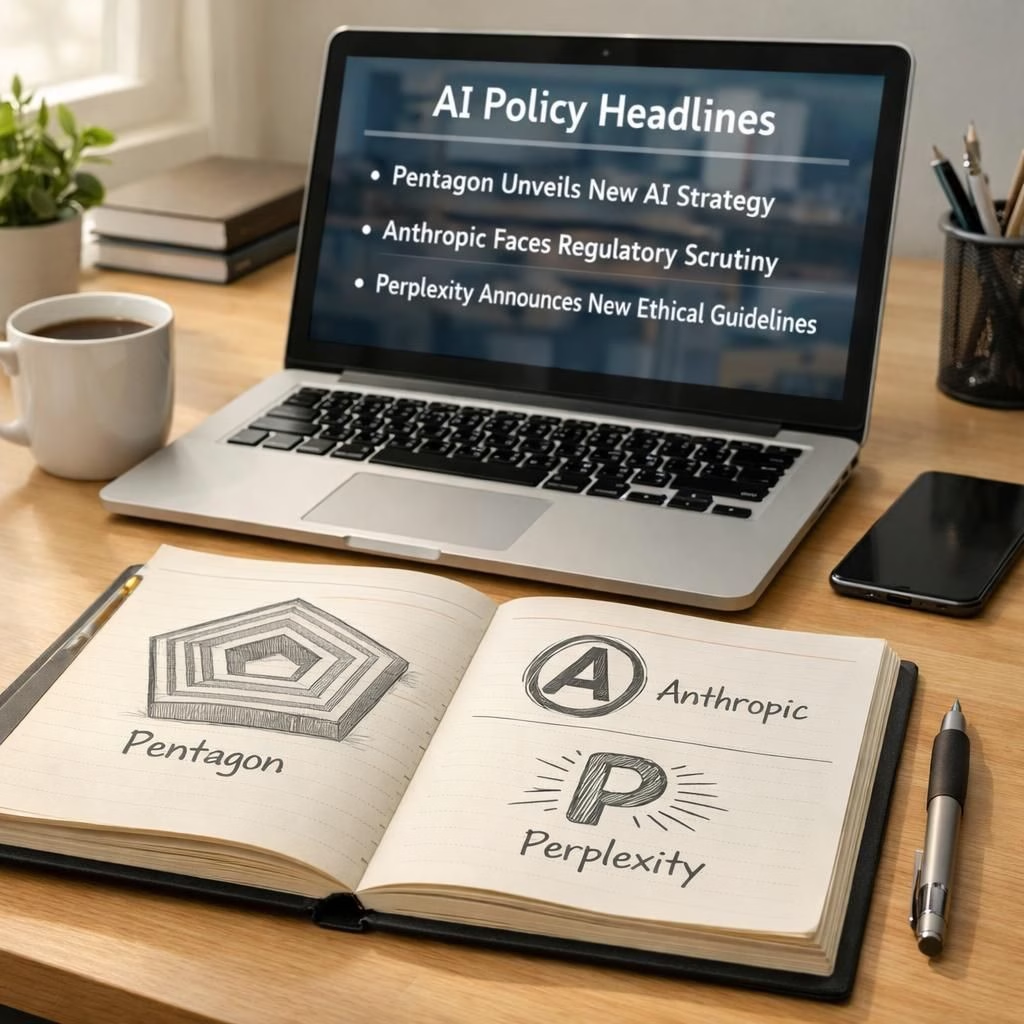
AI policy and US politics collide again as the Perplexity AI investment story unfolds in 2026. Venture capitalists like David Sacks push back against claims that Emil Michael’s stake creates a Pentagon link. He labels the piece a smear campaign and notes that Perplexity is not a direct Anthropic competitor and does not sell to the Pentagon. Regulators reportedly cleared Michael’s holdings, a detail that matters for perception even if it doesn’t prove a connection. The moment tests whether readers trust policy papers or press clips more.
AI policy in focus: Sacks’s take and the ethics layer
On the All-In Podcast, Sacks framed the timing as political. He urged listeners to separate rhetoric from facts and stressed that Perplexity isn’t a defense contractor or a direct rival to Anthropic. He noted that ethics regulators already cleared Michael’s holdings, a point he says weakens the idea of a hidden government link. The exchange highlights how US politics and AI policy blend ethics with commerce and geopolitics.
Critics in the ecosystem question governance and transparency. If a firm holds shares tied to defense-grade tech, how should regulators interpret conflicts of interest? The debate goes beyond money. It’s about trust, public duty, and whether risk belongs to policy design or marketing. The stakes feel cinematic, yet the practical consequences shape AI policy in weeks, not years.
Beyond personalities, the broader policy arc worries observers about fostering ethical development without throttling ambition. AI policy questions how to balance safety with innovation. Perplexity’s stance, while less defined on defense, invites questions about competition, funding, and pace of innovation. In 2026 the sentiment is less about one firm winning and more about a framework that can adapt as capabilities evolve, licensing shifts, and public trust fluctuates with every headline.
US politics and the tech policy clash
Anthropic’s stance against autonomous weapons or mass surveillance places it at odds with some defense circles. The company is backed by Amazon and Google, which adds weight to arguments that US politics and safety concerns should be kept separate from competitive advantage. The core question remains how to protect people while enabling innovation and national security. A court ruling pausing the Pentagon’s attempt to label Anthropic a supply chain risk signals ongoing judicial oversight in 2026, giving engineers room to focus on civilian work while lawmakers refine guardrails.
In the public sphere, Sacks’s leadership as co-chair of the President’s Council of Advisors on Science & Technology matters. He left a 130-day stint in the Trump orbit but remains influential in a policy space that blends science, tech, and oversight. The narrative shows that US politics and AI policy will stay tightly linked as long as AI touches war planning, the economy, and everyday life.
Beyond personalities, the broader policy arc worries observers: how to foster ethical development without throttling ambition. Anthropic’s safety-first posture prompts questions about acceptable risk. AI policy considerations must account for how governance shapes innovation and competitiveness. Perplexity’s position, while less defined on defense, invites questions about funding, licensing, and the pace of progress. The outlook in 2026 favors a flexible framework that can adapt as capabilities evolve and public trust changes with each headline.
The practical takeaway for readers is clear: AI policy must rest on verifiable facts, with transparent disclosures that satisfy regulators and ordinary users. Clear ethics guidelines, predictable safety standards, and accessible explainability are prerequisites for sustainable growth in a competitive landscape. The tech world benefits when regulation is thoughtful, not theatrical, and when government and industry work together rather than posture on opposite sides of a stage.
As the narrative evolves, Sacks’s 130‑day policy stint underscores how policy actors influence the conversation even after formal roles end. His pragmatism centers on separating political theater from technical reality, measuring outcomes, and communicating clearly about what AI can and cannot do in sensitive sectors. The takeaway for AI policy is to pursue stability and accountability while leaving room for audacious innovation that respects safety and national interests.
Readers, what do you think about the current state of AI policy and US politics in 2026? Share your thoughts in the comments below, and let’s keep the conversation constructive.
Original source and thanks: Special thanks to the authors of the original article for the material inspiration. You can read the original piece here: Original article.
References
- Original source: https://timesofindia.indiatimes.com/technology/tech-news/david-sacks-on-reports-linking-anthropic-ban-to-pentagon-cto-emil-michaels-stake-in-aravind-srinivas-perplexity-ai-says-there-is-no-/articleshow/129861837.cms