

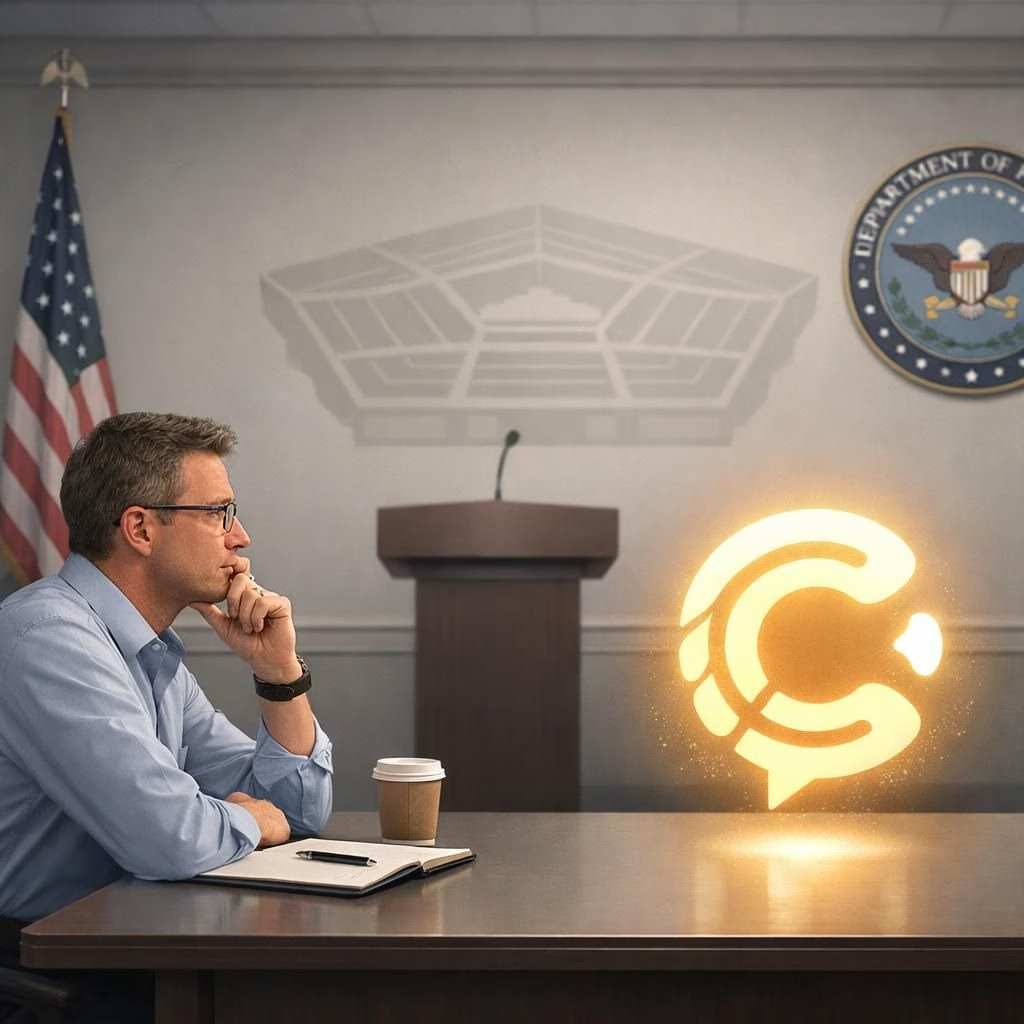
AI policy meets a stubborn debate about supply chain risk as Anthropic negotiates on Claude and the lines between private tech and national security blur. In 2026, the drama isn’t just about a single AI assistant; it’s about how decisions travel from boardroom to battlefield and back again, with far-reaching consequences for developers, users, and the public square. The Ninth Circuit’s upcoming April 30 deadline adds a clock to this policy puzzle, while the judge’s Orwellian framing underscored that supply chain risk isn’t rhetoric but a real concern for national security.
AI policy in action: Anthropic vs Pentagon
The government argues that designating Anthropic as a supply chain risk is a necessary shield to ensure secure operations. The DOJ filed an appeal after a federal judge halted some actions, describing them as potentially crippling. The Ninth Circuit is set to receive formal briefs by April 30, keeping pressure on how the government and private firms frame their obligations. Anthropic has stood on two lines: it won’t deploy Claude for autonomous weapons, and it won’t enable mass domestic surveillance.
Supply chain risk and AI policy governance
The heart of the dispute is not merely a contract, but a broader question: who controls building blocks of powerful AI? Anthropic emphasizes the need to separate core research from misuse, while the Pentagon worries about accessibility and reliability of partners it pays for. The Defense Secretary branded the supply chain authority as a tool that could shape every collaboration with private tech firms. The administration’s move to pause Claude use by federal agencies widened the fault lines between innovation and oversight. The court’s pause on broad punitive measures signaled a more measured approach while still recognizing risk management as essential. The appellee’s arguments contend that designating private firms as potential adversaries for disagreement is not a fair use of the language of national security. The case thus becomes a study in how AI policy interacts with real-world contracts and civilian oversight of military tech.
On the legal horizon: April 30 and beyond
The April 30 deadline means the legal uncertainty around Anthropic is unlikely to vanish soon. The Ninth Circuit will weigh the lower court’s reasoning against the government’s security concerns, and it will inevitably pick apart factual and legal threads. Whatever the outcome, the decision will shape how federal agencies choose vendors and how private AI firms calibrate their risk posture when negotiating with the state. The case also illustrates a broader tension in 2026: the desire to accelerate AI innovation while guarding against potential abuses. Public interest, corporate strategy, and national security all press into a single question: how do we govern the next generation of AI without suffocating it? This case will shape AI policy decisions for procurement and oversight.
What this means for AI policy and supply chain risk
For readers watching this from the outside, the key takeaway is that AI policy decisions echo far beyond courtrooms. If Anthropic can resist a sweeping declaration that treats Claude-like tech as a potential saboteur, it signals a slow, deliberate approach to AI policy, where governance grows through case-by-case scrutiny rather than broad branding. If the government prevails, we might see tighter procurement rules, more explicit safety standards, and a tougher line on how private firms participate in national security. Either way, supply chain risk will remain a hot topic, as the AI industry, policymakers, and the public weigh the trade-offs between speed, safety, privacy, and innovation. This is a 2026 story about how to balance ambition with accountability, a topic that will appear in many future headlines.
Please share your thoughts in the comments below. Your perspective helps illuminate how AI policy and supply chain risk should evolve in the years ahead.
Source: Original article: Original article (thank you to the authors for the material).
Practical takeaways for AI policy and procurement
- Developers and vendors should build explicit safety guardrails into Claude-like models and ensure contracts spell out oversight.
- Federal buyers may require clear risk assessments and ongoing monitoring for supply chain risk among contractors.
- Tech firms should align product roadmaps with evolving safety standards to preserve innovation without compromising security.
References
Further reading
References (original source): Times of India link above.