

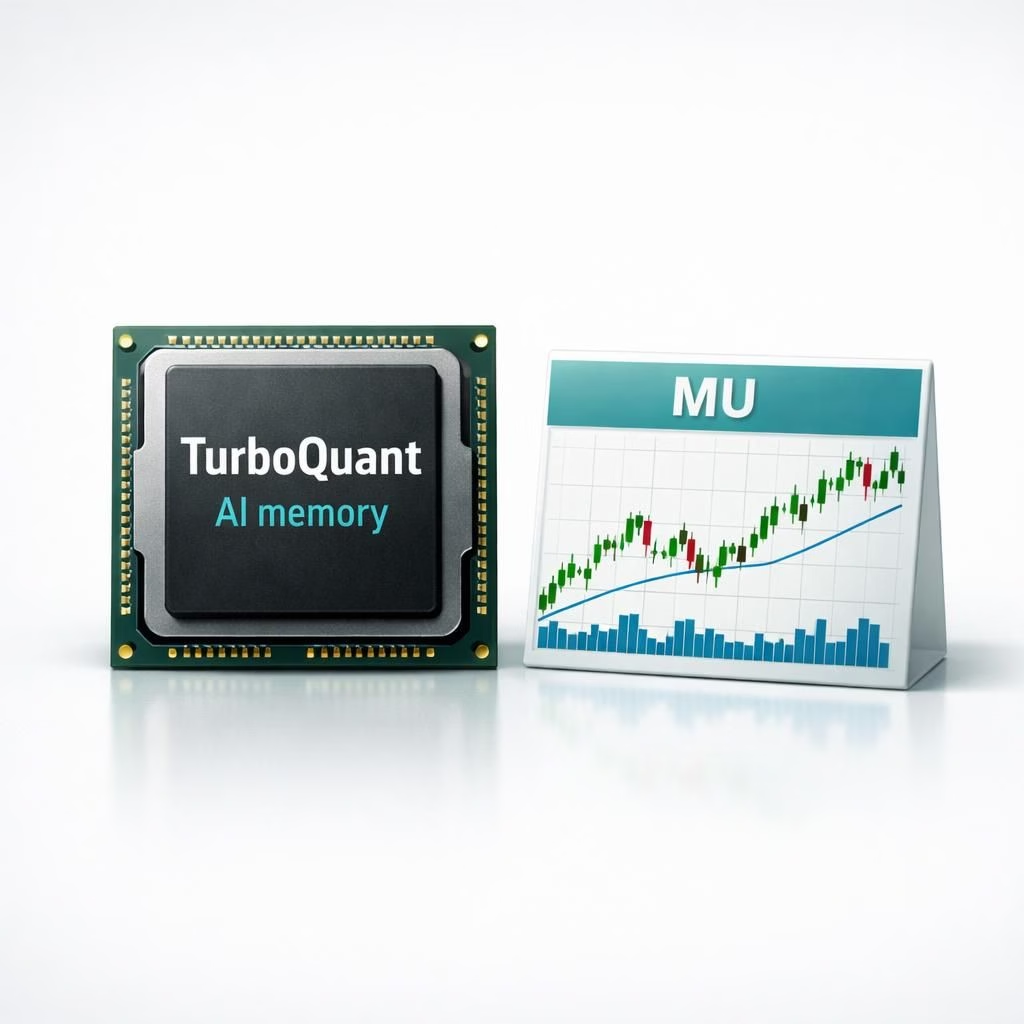
AI memory chatter has lit up the market like a neon sign at midnight, and Tag B finds itself a willing co-star. When Alphabet unveiled TurboQuant, a memory compression algorithm promising sixfold reductions, investors paused to wonder if the future belongs to leaner chips or leaner demand. The narrative sways between doom-and-gloom forecasts of demand destruction and the optimistic view that efficiency could unlock more AI workloads. Wells Fargo’s Andrew Rocha argues that TurboQuant is directly attacking the cost curve, while Bank of America Securities’ Vivek Arya counters that efficiency gains often boost total consumption, potentially yielding a 6x lift in accuracy and/or context length rather than merely shrinking memory.
AI memory implications for Micron MU
The stock narrative around Tag B continues to dance to the tape, with MU hovering in a world where technology and arithmetic collide. In practical terms, TurboQuant cuts memory requirements by six times, a headline that grabs attention and prompts a rethinking of demand models. The debate hinges on whether the improvement suppresses overall demand (demand destruction) or simply shifts the utilization curve higher as AI workloads scale. The Wells Fargo take emphasizes a direct hit to the cost curve, framing reduced memory spend as a potential drag on unit economics—yet that drag could paradoxically spur more usage if developers push for richer models at the same or lower cost. Arya, by contrast, leans into a growth hypothesis: efficiency may widen total consumption by enabling longer contexts and sharper accuracy, a 6x uplift in capability rather than a 6x reduction in memory. This duality keeps Tag B in the crosshairs of investors who enjoy a good spreadsheet-induced debate as much as a sharp rally or a thoughtful retreat.
Micron MU and the demand destruction debate in 2026
Meanwhile, MU faces a nuanced set of near-term dynamics. The stock sits near critical technical levels, with a market backdrop that includes an upcoming ex-dividend date and a quarterly payout of 15 cents. For investors tracking the stock, Tag B remains a focal point in MU’s risk-reward calculus as supply constraints collide with potential AI-driven demand growth.
On the supply side, Micron reiterates that memory remains a strategic asset. CEO Sanjay Mehrotra has repeatedly framed memory as a product with constrained capacity, noting that Micron can only meet roughly 50% to two-thirds of key customer requirements. That constraint shapes not only MU’s pricing power but also the long-run valuation story. If demand accelerates on the back of AI efficiency gains, MU’s ability to satisfy demand will become more than a footnote; it could influence earnings visibility for the next several quarters.
From a market-structure perspective, MU trades in a zone that hints at a cooling phase yet sits within an overarching uptrend. The price is about 15.4% below its 20-day simple moving average but 3.3% above its 100-day SMA, a relationship that often marks a constructive middle ground rather than a decisive breakout or breakdown. The RSI at 38.16 sits in neutral territory, suggesting the stock isn’t overbought or oversold in a dramatic way—though the MACD remains negative, signaling some lingering momentum headwinds. At publication, MU hovered around the low-to-mid $340s, a level that feels sticky given the tug-of-war between demand optimism and supply constraints. Technical traders will watch 404.50 as resistance and 332.50 as support, with the price action likely to respond to both macro AI cycles and micro company developments.
AI memory Micron MU: The broader mix of catalysts and potential payoffs
Beyond the headlines, the deeper question remains: will the AI memory story lift MU’s long-run earnings trajectory or merely adjust the pace at which profits materialize? The real-world test comes down to execution—whether Micron can convert efficiency gains from TurboQuant into higher cartridge usage, more offered memory capacity in AI accelerators, and sustained demand from cloud providers and enterprise customers. The supply constraints complicate this picture: a strategic asset, memory is not a commodity with infinite wiggle room. Mehrotra’s framing of memory as a strategic asset is not just a talking point; it’s a business reality that shapes MU’s pricing, production planning, and customer priority lists. In turn, MU’s ability to meet a larger slice of requests could translate into a more durable growth narrative, especially if TurboQuant-like innovations become a standard part of AI inference pipelines across industries.
From a sentiment perspective, the dialogue around demand destruction versus growth is less a binary choice and more a spectrum. If efficiency proves to unlock more AI usage—whether in natural language processing, computer vision, or large-scale recommender systems—we could see a reacceleration in MU demand that supports a higher earnings trajectory than the current price action alone would imply. Investors may be quietly penciling in scenarios where MU becomes the preferred memory supplier for next-gen AI stacks. In that frame, the sixfold memory reduction isn’t just a cost win; it’s a lever for more ambitious AI deployments across sectors.
In the meantime, the price and the setup reflect a cautious optimism. MU remains sensitive to broader AI sentiment, guidance from major cloud players, and any updates on TurboQuant’s uptake across OEMs and hyperscalers. The market has tastes for both drama and data, and the narrative around AI memory continues to deliver both in equal measure. The takeaway: stay tuned for how memory efficiency translates into real demand signals, how MU manages supply, and how the ex-dividend cadence interacts with the evolving hardware cycle. The next few weeks could reveal whether the stock’s price drift is the quiet before a real renaissance or simply a pause as the market digests the economics of memory in the TurboQuant era.
What are your thoughts on AI memory and Tag B? Do you expect demand to rise with efficiency gains, or will demand destruction prove too strong a headwind? Share your perspective in the comments and let’s compare notes on how 2026 will be shaped by TurboQuant and the memory cycle.
Original article: Thank you to the original source for the material and insights. Your reporting helped shape this rewrite.