

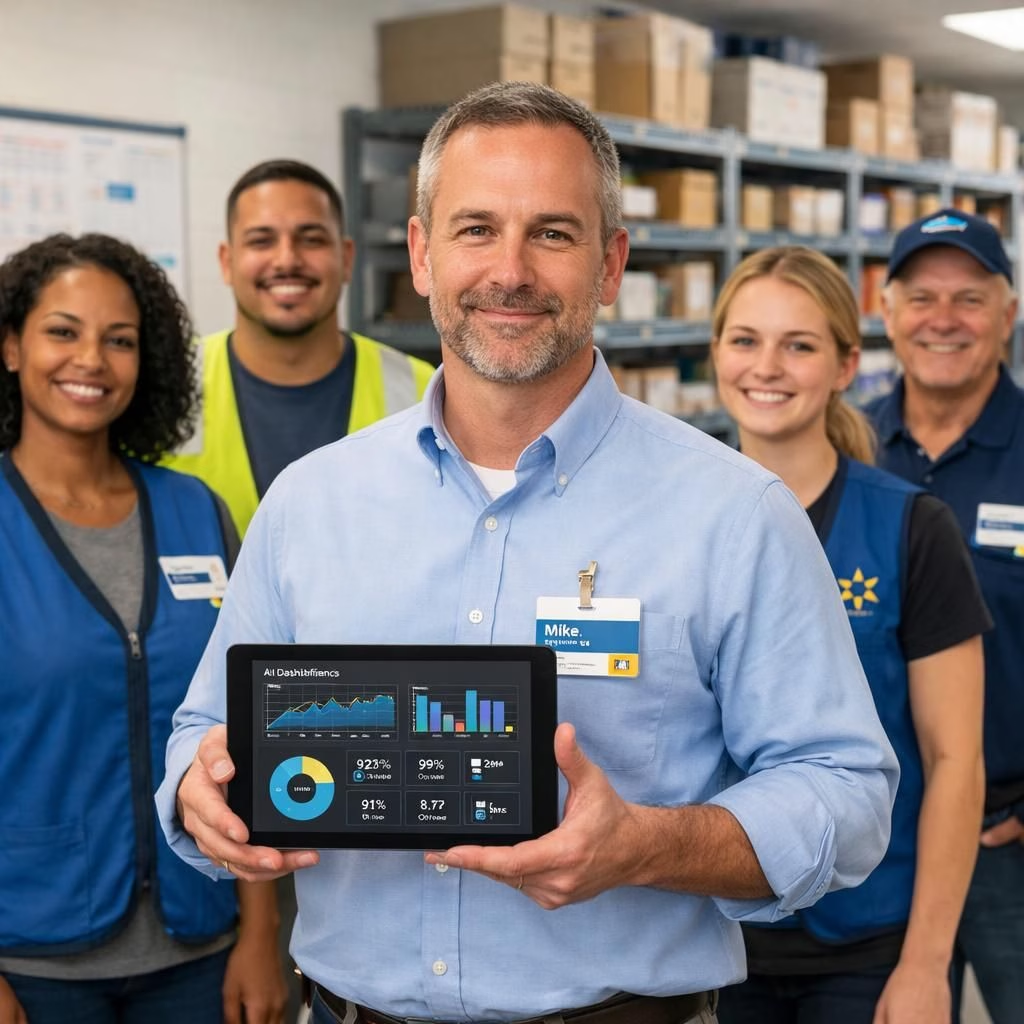
During Walmart’s annual Associates Week in Arkansas, leaders delivered a clear message: AI in the Workplace should amplify human work, not replace it, and Walmart AI will keep people at the center of every plan. The future, they said, blends technology with people, with Donna Morris declaring: “Technology will power our future. But our associates will lead it.” This balanced view anchors Walmart’s approach to both AI in the Workplace and Walmart AI as the two sides of the same coin.
AI in the Workplace: Humans First, Tools Second
Executives illustrated real-world uses that prove the promise. Walmart now certifies US employees in OpenAI tool use, turning training into an on-ramp rather than a side quest. The AI in the Workplace is designed to speed tasks and free people for problem solving, not to displace them. In one practical case, a freight-operations manager built a tool that helps truck drivers pick near-optimal loads toward the end of the week, reducing idle miles, saving money, and helping drivers get home sooner. The outcome is tangible: jobs stay secure while the bar for performance rises. The plan stays grounded in people, not buzzwords. For many, this is a clear demonstration of Walmart AI in action.
What this looks like in everyday work is clearer each quarter: associates learn, adapt, and lead with better data at their fingertips. The company frames these improvements as a partnership between human judgment and machine speed. When workers see AI reflecting their on-the-ground realities, confidence grows. The emphasis remains on empowerment rather than replacement, which is the practical flip many people have been waiting for in the broader AI conversation. This ongoing pattern reinforces the idea that AI in the Workplace is a tool for sharpened judgment, not a substitute for it.
Walmart AI: Tools That Help, Not Replace
Daniel Danker, EVP for AI acceleration, product and design, paints a future where AI helps predict demand so customers see items when heat waves hit. He describes a north star for Walmart AI: if a sudden heatwave arrives, items you need are available for delivery in 30 minutes or less. The company points to inventory improvements and self-checkout enhancements that make shopping smoother while preserving the human touch. Front-line staff learn to use AI to triage orders, handle returns, and personalize service in real time. The net effect is less boring busywork, more time for creative problem solving, and better logistics decisions. Walmart AI aims to keep shelves stocked, stores efficient, and workers confident in the tools at their disposal.
In practice, teams report faster discovery of issues, quicker pivots when demand shifts, and clearer guidance on how to allocate effort. The emphasis is on augmenting capability rather than replacing roles, which aligns with the broader aim of creating durable careers alongside evolving processes. This approach also helps maintain customer satisfaction, because trained associates can respond with speed and nuance that no AI alone could replicate. The overall message remains practical and hopeful: technology should empower people, not replace them, and Walmart AI continues to evolve alongside the workforce.
As the FT report notes, leadership ties AI adoption to outcomes that matter for people: fewer empty miles, improved inventory accuracy, and faster responses to shifting demand. The stance remains grounded: technology helps workers focus on value, while people bring judgment and care. The combined approach of Walmart AI and AI in the Workplace signals a future where machines and humans co-create better service. In 2026, that future feels within reach and worth cheering about.
Reality check in numbers comes from the field: training programs are expanding, precise metrics track efficiency gains, and pilots show AI enabling teams to tackle more complex problems without sacrificing safety or morale. The message from leadership is consistent: invest in capability, not fear. When workers see AI as a tool that respects their expertise, adoption accelerates and the benefits become shared rather than siloed.
Original article: Thank you to Financial Times for the reporting that inspired this post. Read the original FT article.
We invite readers to share their thoughts in the comments below and join the conversation about how AI in the Workplace and Walmart AI are shaping careers, customer experiences, and the broader landscape of work in 2026.
Putting AI to work: practical steps for teams
- Register for OpenAI tool certifications offered through Walmart’s program to gain hands-on experience.
- Encourage frontline staff to document every AI-assisted task and provide feedback to improve the system.
- Pair AI outputs with human oversight to maintain safety, ethics, and customer care.
FAQ
- Will AI replace jobs? No — leadership emphasizes augmentation and new opportunities through upskilling and retraining.
- How can I participate in AI training? Look for OpenAI tool-certification programs and talk to your manager about upskilling opportunities.
- What daily tasks are most affected? Routine triage, order handling, and customer service are targeted to be sped up by AI, freeing time for higher-value work.
External perspectives
References
Original source: Times of India