

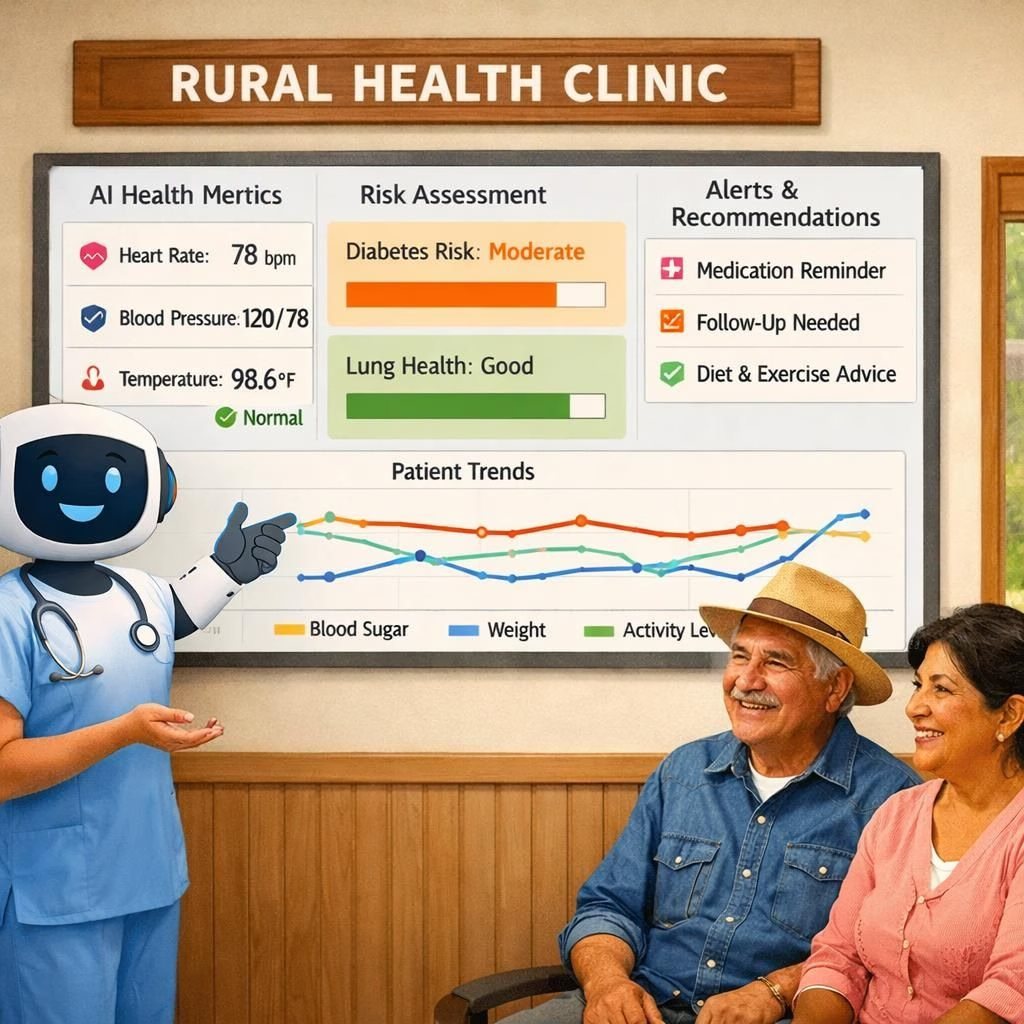
Over the coming years, AI in Public Health will move from a diagnostic aid to the backbone of public health. It will power real-time surveillance, early warning, and broad care delivery. For LMIC Health Systems, this AI becomes an embedded layer inside national programs, smoothing gaps and multiplying impact.
AI in Public Health and LMIC Health Systems: A Shared Vision
Two tracks define the path forward. First, AI-powered screening tools like qXR enable population-scale detection of tuberculosis and other lung conditions. They interpret chest X-rays autonomously, flag high-risk cases, and standardise reporting across thousands of screening sites. Second, an AI co-pilot for frontline health workers extends AI beyond imaging into primary care. It digitises symptom collection, helps ensure clinical protocol adherence, and offers real-time decision support. The result is time freed up for meaningful patient interaction, while data flows back into public health planning to strengthen the system as a whole. For LMIC Health Systems, these tools become part of routine care rather than isolated pilots.
In a healthy AI-enabled routine, high-volume, repetitive tasks such as image interpretation, triage, and symptom documentation are automated or assisted. When embedded into routine programs, these capabilities create continuous surveillance that flags risk earlier and provides policymakers with actionable intelligence at district and national levels. The aim is not a single clever tool, but a scalable, interoperable layer that can speak across devices, clinics, and government dashboards. AI in Public Health is the guiding principle here, with LMIC Health Systems benefiting from consistent data exchange and governance.
Practical Tracks for 2026: AI for Screening and AI for Frontline Care in LMIC Health Systems
The future lies in combining screening intelligence with embedded tools to create predictive, accountable systems. In rural primary health centres and national disease programmes alike, AI in Public Health can help run routine workflows more reliably and with less friction. For LMIC Health Systems, qXR-style screening standardises image interpretation and prioritises cases, improving early detection without increasing clinician fatigue.
For frontline care, the AI co-pilot supports digitised symptom collection, reinforces adherence to protocols, and provides decision support at the point of care. This payoff is not about replacing clinicians but about augmenting their capabilities—so they can focus on conversation, empathy, and precise care delivery. The combined approach enables scalable systems that serve entire populations responsibly, with transparent governance and continuous improvement loops.
To keep tone-and-truth balanced, this vision emphasises data quality, privacy, and accountability. As AI becomes a core condition of public health, we must build strong data pipelines, audit trails, and human-in-the-loop oversight that respects local contexts and respects patient autonomy.
Looking ahead, the aspiration is an AI-enabled health system that learns from millions of encounters, adapts to local epidemiology, and remains explainable to clinicians and policymakers alike. The result is a governance framework where AI supports decisions without invisibly steering lives. We see this as a partnership between technology, people, and policy—each reinforcing the others in a virtuous circle.
In practice, this means designing for interoperability, open standards, and continuous capacity-building. It also means maintaining plain-language explanations of AI outputs so that frontline workers and community leaders can trust the guidance and use it wisely. The long-term goal is an infrastructure where early detection, timely response, and routine care are integrated into daily workflows—making public health proactive rather than reactive.
We welcome discussion: what aspects of AI in Public Health and LMIC Health Systems do you find most promising or concerning? Share your thoughts in the comments to help shape pragmatic, ethical implementation.
Original article: Times of India Tech piece
Frequently Asked Questions
- Q: What is AI in Public Health?
A: It refers to applying AI to public health tasks such as disease surveillance, screening, and frontline support, with governance and data privacy. - Q: Why focus on LMIC Health Systems?
A: LMICs often face staff shortages and high disease burden; embedding AI in national programs helps extend care and strengthen data-driven planning. - Q: How do we ensure privacy and governance?
A: Establish data pipelines with audit trails, human-in-the-loop oversight, and community engagement, ensuring consent and transparency. - Q: Will AI replace clinicians?
A: No—it’s designed to augment capabilities, freeing time for patient interaction while supporting decision-making.
Conclusion and Next Steps
In summary, AI in Public Health and LMIC Health Systems can become a scalable, accountable backbone for health at scale. Realising this means interoperable systems, strong governance, and capacity building. For LMIC Health Systems, the path is to embed early detection and decision support into daily workflows—so care is proactive rather than reactive. For AI in Public Health, the focus is on human-centered design and transparent outcomes.