

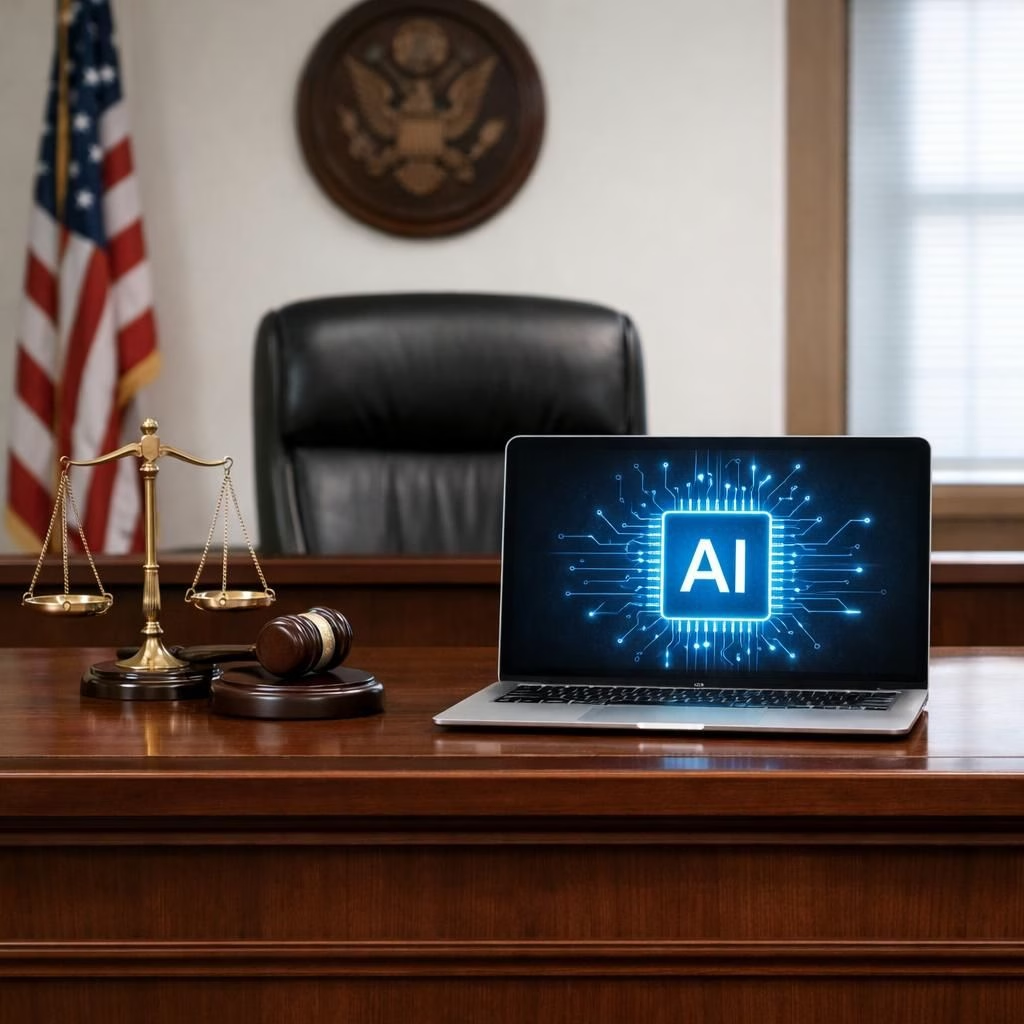
At the IAPP Global Summit 2026 in Washington, D.C., federal judges Boasberg and Burroughs offered a wry, practical take on how AI in Law reshapes the courtroom, and how Judicial Transparency is no longer a nice-to-have but a necessity. They argued that the pace of innovation, the volume of data, and the cleverness of software have outrun many old rules, and that the public deserves guardrails that are as robust as their coffee breaks. The conversation touched on Fourth Amendment concerns and pen registers, and it was clear that both sides want to avoid a future where technology runs ahead of constitutional text, even if the text was drafted long before smartphones and cloud storage existed.
AI in Law: Reality Check from the Bench
Boasberg emphasized that AI in Law should assist, not supplant, the human mind that weighs precedent, policy, and consequence. He cited a recent case where a brief mixed hallucinatory AI draft material into the filing, and the sanction—as a reminder that accuracy matters more than speed—was the payment of attorney fees. He was clear: people expect justice to be both fast and fair, but not fast in a way that sacrifices reliability. For Boasberg, AI in Law is a tool to aid, not replace, the evaluative judgment that makes rulings stick.
Judge Burroughs pushed back against hype, noting that constitutional protections for privacy still exist but need sharpening. The baseline of First and Fourth Amendment rights anchors the discussion, but Burroughs warned that discovery, metadata, and cross-border data flows complicate enforcement. She highlighted the tension between enabling law enforcement to do its job and preserving citizens’ expectations of privacy, urging courts to adapt without eroding safeguards. In her view, the center of gravity remains human judgment, even as data grows and networks multiply.
Judicial Transparency in Practice: Guardrails, Disclosures, and Sanctions
The two main tools used by judges and lawyers—LexisNexis and Westlaw—now come with AI features that promise efficiency and, ideally, fewer mistakes. Burroughs noted that in the versions actually used by judges, those AI capabilities have been effectively blacked out to protect sensitive matters and sealed proceedings. A handful of judges in the First Circuit have volunteered to pilot the AI features in both tools, slowly testing what can be automated without crossing lines that should stay in the human realm. This is where Judicial Transparency starts to matter: disclosures about what the AI did, how it checked citations, and whether it flagged potential hallucinations.
Burroughs also sees a practical role for AI in routine tasks. It can handle repetitive wording, standard boilerplate, and the clerical grind that eats away time from thoughtful analysis. The point, she says, is not to replace opinion writing but to support the fiduciaries who steward case flow. There may come a day when AI participates in administrative hearings—think Social Security or immigration appeals—within large government backlogs. The goal remains to free judges to focus on the big questions while keeping the process fair and auditable.
Where AI will be most useful, Burroughs notes, is in the repeatable, craft-like elements of chamber work. The moment you ask a model to craft a nuanced legal reasoning, you’re leaning into human judgment. The risk of overreliance is real, especially if a model mistakes boilerplate for insight or misreads a precedent. The result is a future where AI in Law accelerates the routine but never fully replaces the tacit art of deciding a case. In that sense, the tool should complement, not command, the courtroom.
Borrowing from Burroughs’ example, Boasberg speculated that if an AI model were trained on the same type of cases repeatedly, an appellee might opt for AI-rendered decisions for expediency’s sake. If an AI were 95% accurate, would people choose it over waiting for a human decision? Boasberg admitted that he would feel lucky at 95% accuracy but remained wary of the cost of error in high-stakes matters that affect real lives. Even so, the frontier would advance only with transparency, disclosure, and robust checks to ensure that speed does not outrun accountability.
In practice, the two judges agree that AI must be tethered to verifiable sources, with clear citation checks to avoid hallucinatory references. They stressed that lawyers should disclose AI use in filings and certify that their citations have been checked for accuracy. That culture of disclosure is, in their view, the backbone of trust in a technology-assisted system. For Judicial Transparency to guide practice, lawyers must disclose AI use in filings and certify that citations were checked for accuracy. The bottom line is simple: technology can help, but honesty about its role is non-negotiable.
The broader takeaway from the discussions is that AI in Law should enhance human judgment, not eclipse it. The legal system has always balanced efficiency with accountability, and this balance is at risk if models generate outputs that go unexamined. The pilots in LexisNexis and Westlaw offer a glimpse of a future where AI streamlines research and drafting, but the judge’s eye remains the ultimate arbitrator. The courts are learning to wield AI as a partner—one that can draft, flag, and organize—while insisting on human oversight for the most consequential decisions.
As the summit wrapped, Burroughs and Boasberg left no doubt about their shared caution and shared sense of possibility. They advocated for pragmatic guardrails, ongoing disclosure, and continuous learning by counsel and bench alike. They also reinforced the idea that AI is not a magical wand but a magnifying glass: it can reveal patterns, surface overlooked issues, and speed up routine tasks, provided the magnifying glass is held by careful, capable hands and labeled clearly for all to inspect. A strong thread through their remarks is the need for Judicial Transparency in every step of the process.
For readers watching this space, the message is clear: embrace the efficiency perks of AI in Law, but treat it as a co-pilot rather than a replacement for human judgment. The trajectory points toward more transparent processes, better-quality citations, and smarter workflows—while keeping the dignity of the courtroom intact. If you have thoughts on how AI should fit into the judiciary, share them in the comments below. And if you want to see where this dialogue is headed, it’s worth keeping an eye on ongoing pilots and policy discussions that shape how AI is used in courts everywhere.
Original article and additional coverage: IAPP Global Summit 2026 coverage — thank you to the original source material for the thoughtful material that inspired this rewrite.
FAQ: AI in Law and Judicial Transparency
- What is Judicial Transparency?
- The practice of making AI usage, data handling, and decision processes visible to the public and to stakeholders, with clear disclosures and checks.
- Will AI replace judges?
- No. AI is a tool to increase efficiency and support decision-making, not a replacement for human judgment and accountability.
- How should lawyers handle AI disclosures?
- They should disclose AI use in filings and certify that citations were checked for accuracy, supporting accountability and trust.
- What guarantees protect privacy when AI is used in litigation?
- Guardrails include strong adherence to the First and Fourth Amendments, careful handling of metadata, and rigorous citation checks.
External sources
- NIST AI Risk Management Framework
- ACLU on privacy and metadata
- Pen registers and the Fourth Amendment (Cornell LII)