

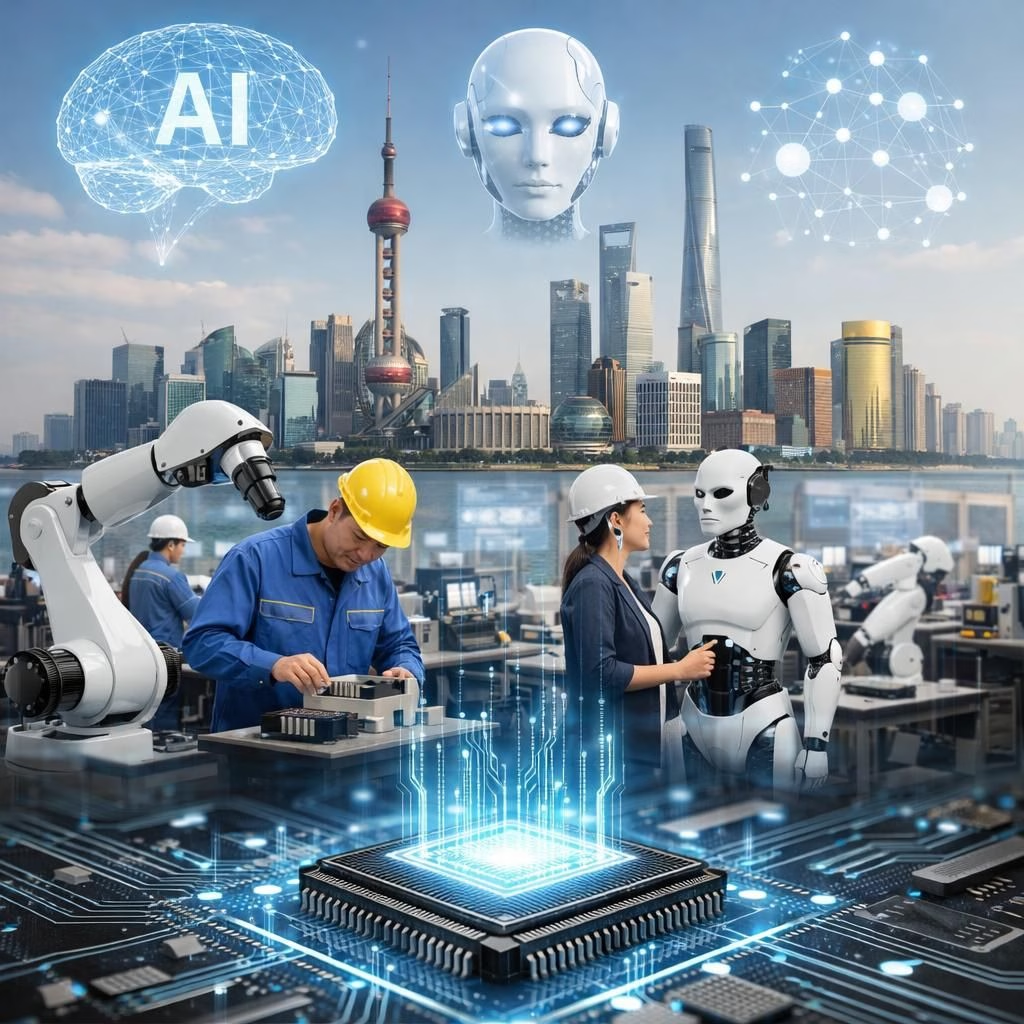
China enters 2026 with a bold bet: China will rely on AI to become the backbone of the economy, and the country will lead the tech race. The 15th Five-Year Plan maps out a future where AI touches 90% of industry, where open-source AI models fuel startups, and where robotics quarterback the factory floor. If successful, this blueprint could redefine how the world builds software, hardware, and the very idea of work in China.
AI and China in 2026: The Five-Year Plan Playbook
In plain terms, the plan doubles down on AI integration, declares a bold aim to automate much of labor, and bets big on a future where machines shoulder more of the heavy lifting. It targets 90 percent AI infusion into the economy by 2030, a goal that sounds heroic and heavily budgeted. The approach blends generous government incentives with open-source AI models to spark startups and speed deployments. This is a central pillar of China‘s push to widen tech leadership and build a domestic ecosystem for AI.
China moves toward practical deployment with intent. Open-source AI is pitched as a catalyst for entrepreneurship, inviting developers to download, tailor, and deploy models tailored to local needs. In Beijing, this approach is expected to foster a silicon-based creative economy that hopes to outpace Western gatekeeping while keeping a close eye on quality and safety. China also signals that a thriving software ecosystem and a domestically grown chip supply can gradually narrow the gap with peers.
Open-source AI strategy in China: global ripple effects
Analysts say the open-source angle could flatten the learning curve for new startups and push incumbents to compete without costly licenses. In China, this open-source angle is designed to accelerate adoption and nurture a broader software ecosystem. The hardware bottleneck remains a stubborn hurdle, reminding observers that self-sufficiency isn’t just software; it also requires robust supply chains, capable fabs, and reliable tooling. Still, China presses ahead, betting that a thriving software landscape paired with a domestic chip base can gradually shrink gaps.
On the hardware front, the country pours billions into AI chips, sensor networks, and edge computing. Beijing wants to accelerate local fabrication while securing materials, fabs, and tooling. Yet today’s high-end AI chips are still largely Western-made, a reminder that supply chain politics remain intertwined with silicon and code. In China, observers see progress, but also a persistent quality gap that could slow self-sufficiency ambitions.
China’s robotics push and AI-enabled factories
Beyond chips, the plan envisions a sweeping deployment of humanoid and industrial robots across factories, warehouses, and even some service sectors. The 2025 landscape shows tens of thousands of humanoid units on the world stage, with a big share coming from China firms. The aim is straightforward: ease labor shortages, fortify a robust manufacturing base, and keep the economy moving when demographics tilt older. Dark factories—robotic landscapes lit by LEDs and guided by machine learning—are no longer sci‑fi; they are living laboratories for testing new workflows and supply-chain resilience.
China has accelerated pilot programs, with auto plants and electronics lines testing AI-assisted operations. The broader world watches as robots learn to weld, assemble, and monitor quality with a reliability that often outpaces human crews. The International Federation of Robotics has reported sizable robot populations in Chinese plants, reinforcing the sense that automation is a national project, not a curiosity. The goal isn’t to replace people overnight but to re-skill and re-balance work around smarter machines and better data.
In addition to robotics, the plan spotlights brain-computer interfaces and cognitive systems as aspirational frontiers. While flying-car headlines grab attention, the real work targets embedding intelligence into workflows, city operations, and energy networks. The aim is to blend software openness with hardware ambition so that AI-powered tools become a practical backbone for traffic, logistics, and public services. It’s not magic; it’s a deliberate sprint to knit intelligence into daily life without turning work into a nightmare of outages.
Of course, this remains a high-stakes quest. The path to leadership in tech hinges on more than clever slogans; it requires reliable supply chains, skilled talent, and a workable regulatory framework. Analysts caution that despite progress, the gap in advanced semiconductor manufacturing persists. In plain terms: chips still matter, and the Western lead in design and fabrication remains substantial. Beijing signals resilience, layering incentives and domestic R&D funding into a plan designed to weather these constraints rather than pretend they don’t exist.
Still, the ambition is contagious. If China aligns policy, investment, and innovation, AI-enabled tools could become a practical backbone for everything from city traffic to industrial planning. The narrative isn’t about a single breakthrough moment but a sustained push to weave AI into national strategy, manufacturing, and digital services. The result could be an economic reorientation toward high-tech sectors, a new flavor of manufacturing, and a reshaped balance of power in the global tech arena.
As observers digest the blueprint, the stakes go beyond pride. The timing matters for supply chains, for global pricing of AI services, and for how other nations invest in their own ecosystems. If the plan succeeds, it could unlock a model for deploying AI with government-backed scaling, industry alignment, and a top-down ambition for self-sufficiency. If missteps occur, the plan could stall or widen gaps with other powers, turning talk of leadership into a strategic chess match on the world stage.
If you enjoy chasing big tech moves, share your thoughts below. How do you see China reshaping industries with AI and robotics, and what lessons apply globally? What are the real bottlenecks—chips, talent, or governance—and what should citizens expect from a government-backed AI push?
Original reporting credited to Reuters via Tingshu Wang, with thanks to the publication for the underlying material. For the source article, see Reuters: https://www.reuters.com/
What this means in practice
- Manufacturing and logistics: AI-enabled robots and intelligent sensors streamline production lines and inventory flows, potentially reducing downtime and energy use.
- Urban planning and services: City operations could lean on AI dashboards to optimize traffic, energy grids, and public safety.
- Small business and startups: Open-source AI models lower barriers to entry, helping new firms prototype products quickly.
- Workforce transformation: Reskilling programs aim to shift workers into data-driven roles and higher‑value tasks.
FAQ
- What does 90% AI infusion really mean for everyday work? It signals broad automation across sectors, from manufacturing to services, with AI augmenting many tasks rather than replacing all jobs overnight.
- Will this plan reduce reliance on foreign chips? The goal is self-sufficiency, but chip design and manufacturing remain global problems. Progress depends on rapid scaling of domestic fabs and talent pipelines.
- What role does open-source AI play for startups? Open-source models lower upfront costs, encourage experimentation, and create a collaborative software ecosystem that can accelerate product development.
- What are the risks for workers and the broader economy? Short-term disruption is possible as automation expands; long-term benefits hinge on retraining and safeguards to ensure a fair transition.
Conclusion
The 2030 vision outlines a sustained, state‑backed push to fuse AI, robotics, and open-source software into virtually every facet of industry and public life. If executed well, the approach could reshape how work is organized, how value is created, and how the global tech order shifts. The world will be watching China as it tests a comprehensive model for deploying AI at scale—one that blends ambition with risk management, and openness with protection of strategic interests.
External sources
Further reading from credible outlets on AI policy and China’s tech strategy: Reuters, Brookings Institution, Mercator Institute for China Studies.