

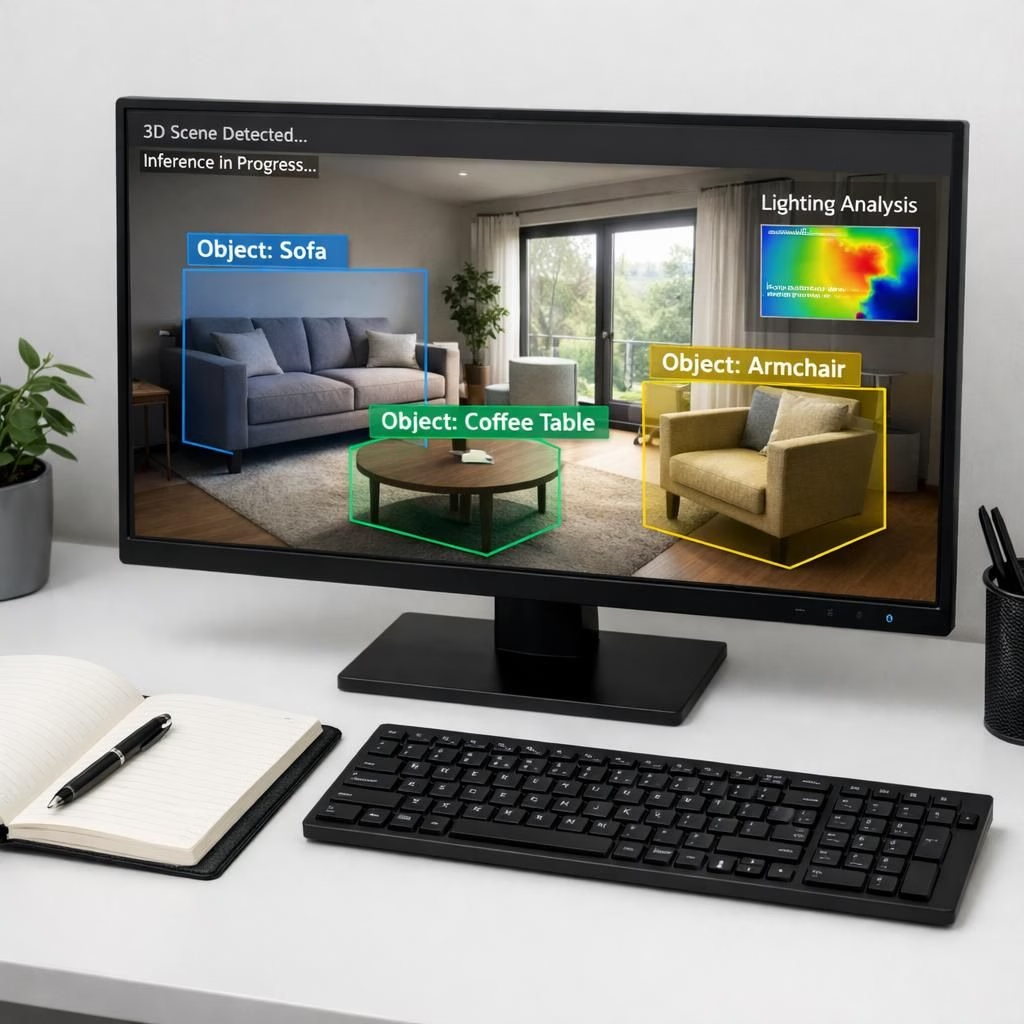
In 2026, Sony’s appetite for AI graphics and Cinemersive’s 3D reconstruction magic is more than a tech buzzword; it’s a quiet retooling of how visual fidelity scales from phone cameras to console GPUs. Cinemersive, a UK startup, has built a reputation around turning flat 2D photos into navigable 3D volumes. Their consumer VR app Parallax lets users capture images on a smartphone and stroll through the resulting scenes as if they were real rooms. The core is a dedicated AI pipeline that powers that transformation; Sony wants that pipeline inside its Visual Computing Group to turbocharge rendering, AI-driven tools, and the pipeline itself.
AI graphics and 3D reconstruction in Sony’s Cinemersive move
When a company like Sony buys a small, specialized team, you might expect a relocation notice and a bigger office. Instead, the company folds Cinemersive into the Visual Computing Group as an R&D asset. The goal is not to create a new game IP but to sharpen the underlying tech: more predictive upscaling, smarter rendering, and tooling that makes GPUs do more with less fuss. The acquisition also signals a generational shift in how Sony approaches graphics work: from hand-placed optimization to data-driven, AI-assisted pipelines that tighten the loop from capture to final frame.
In practice, Cinemersive’s strength in deriving depth and form from flat media slots nicely with Sony’s existing lines of work. PSSR, or PlayStation Spectral Super Resolution, is Sony’s homegrown upscaling brain, which renders games at a lower base resolution and reconstructs to 4K. The team could quietly influence how PSSR evolves on future consoles. And beyond upscaling, there’s potential cross-pollination with ray tracing and frame interpolation, areas Sony has kept a steady rhythm on with AMD’s Project Amethyst. The end game isn’t a single product launch; it’s a continuous improvement cycle that quietly raises the floor for visual fidelity across devices.
Two quick notes help frame the scope: this isn’t a game studio acquisition; Cinemersive won’t be turning into a global IP overnight. Instead, a lean team becomes part of a larger research engine. That matters because the value here isn’t a brand; it’s the capacity to test, validate, and deploy AI-powered graphics tools across Sony’s product families. The strategic fit rests in AI’s ability to handle heavy lifting where human designers can’t scale, such as predicting scene lighting or reconstructing a 3D room from just a handful of photos.
For players and developers, the message is encouraging: AI-driven graphics tooling is moving from niche experiments to practical, behind‑the‑curtain improvements that affect how games look and feel. The 2026 horizon points to more efficient pipelines, better upscaling, and smarter rendering techniques that keep frame rates steady while elevating detail. It’s not about flashy branding; it’s about making the next generation feel more alive, more responsive, and a touch more magical—all thanks to a focused team embedded in Sony’s research infrastructure.
Two quick clarifications: this is an R&D integration rather than a studio acquisition; Cinemersive’s core expertise—depth modeling and 3D workflows—will feed into Sony’s broader toolbox for 3D reconstruction workflows across platforms. The practical effect is a tighter loop from data capture to final render, with AI assisting every step along the way.
Source attribution: A big thank you to the original article detailing Sony’s acquisition of Cinemersive Labs. You can read it here: Times of India.
Have thoughts about how AI graphics and 3D reconstruction might change your gaming or creative work? Share them in the comments below.
Practical takeaways for developers and players
- Expect AI-assisted upscaling and depth-aware rendering to become more common across PlayStation and PC titles.
- Volumetric and depth cues may improve with less reliance on extra hardware, thanks to smarter pipelines.
- AI-driven tools could speed up asset creation, lighting decisions, and cross‑platform consistency.
FAQ
-
Q: Will Cinemersive become a game studio?
A: No. The team will operate as part of Sony’s Visual Computing Group, focusing on R&D and tooling rather than standalone game development. -
Q: What does this mean for future PlayStation visuals?
A: The move could improve upscaling, depth rendering, and real-time AI-driven tweaks, potentially lifting visual fidelity without heavy hardware costs. -
Q: How does this relate to AI in games overall?
A: It mirrors a broader trend: AI is increasingly used to automate and optimize parts of the rendering pipeline, freeing artists to focus on creative decisions. -
Q: What is 3D reconstruction, and why does it matter?
A: 3D reconstruction builds depth and spatial context from 2D data, enabling more convincing environments and more efficient data pipelines for graphics and VR workflows.
References
External readings:
- AI in graphics and image synthesis (IEEE Spectrum)
- AI-powered upscaling and rendering in games (NVIDIA)