

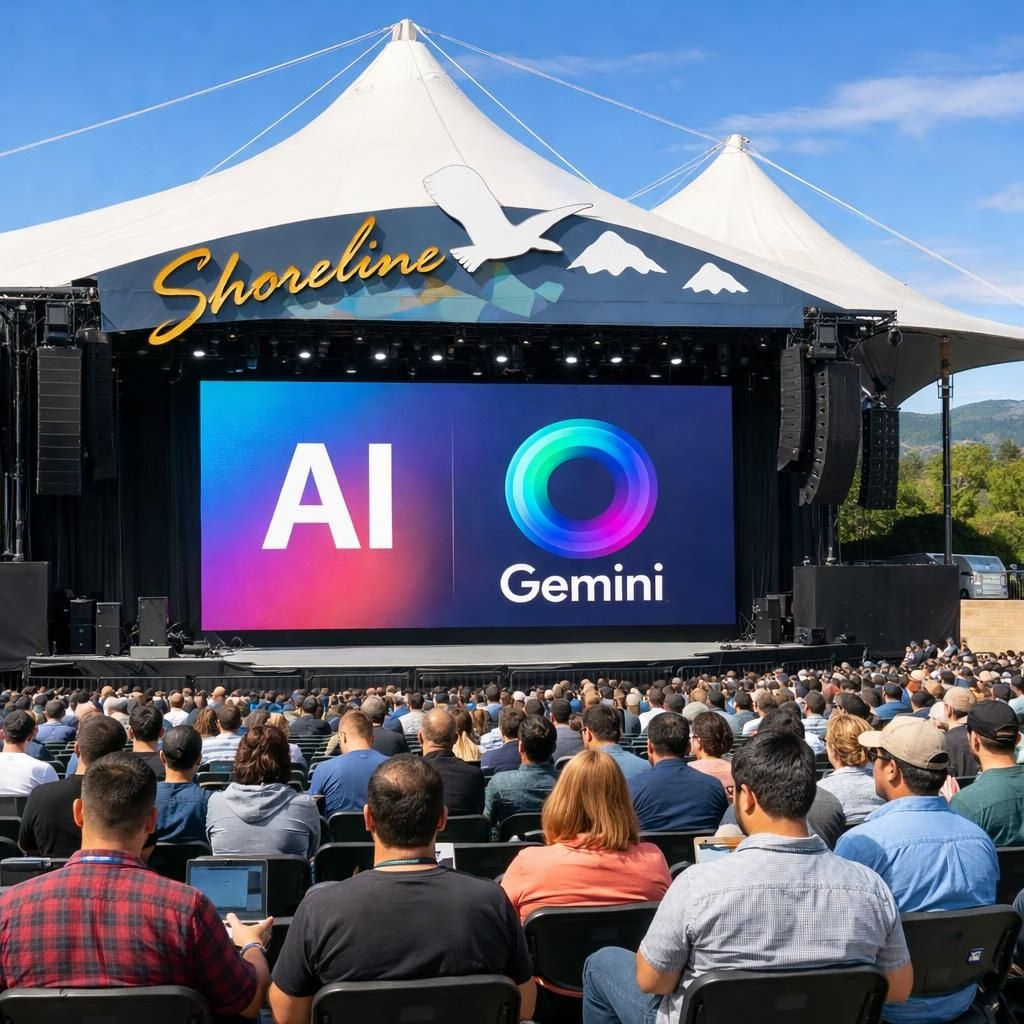
Google IO 2026 has officially confirmed its dates: May 19–20 at the Shoreline Amphitheatre in Mountain View, with a global livestream so developers, enthusiasts, and that awkward list-maker in the back row can all tune in. The vibe is unmistakably AI-first, and the chatter around a Gemini-powered teaser suggests the big reveal will be less “we added a cool widget” and more “we rewired the entire inference engine for real-world speed.” The conference is expected to roll out major software updates across Android, cloud services, and developer tools, all stitched together by a clear, Mars-blueprint-like AI roadmap for the year. While hardware hints may appear, the real star is software velocity: teams will be showing how Gemini-driven tools plug into day-to-day coding, data workflows, and consumer devices in a way that actually feels useful, not just clever on a slide.
Google’s official save-the-date page teases an interactive teaser experience powered by Gemini models, signaling that the Gemini ecosystem will be the connective tissue between ambitious demos and practical deployments. In plain terms: IO 2026 is the stage where momentum in AI-powered developer tools meets practical outcomes. If you’ve been wondering whether AI can move from novelty to necessity, this event will likely provide a roadmap, with Gemini anchors that try to keep the ship steady as models scale, governance conversations mature, and real-world use cases get real-world traction. The presence of Sundar Pichai in India for the India AI Impact Summit 2026, along with leaders like Demis Hassabis, reinforces a broader commitment to AI deployment with governance guardrails and careful, scalable rollout. Beyond the meeting, Pichai is expected to address broader themes at the India AI Impact Summit 2026, including the shift from experimentation to real-world implementation at scale. Meanwhile, Demis Hassabis, CEO of Google DeepMind, is also in India for the summit. Speaking at the event, Hassabis highlighted the current limitations of AI systems, noting that today’s models lack continual learning and long-term planning abilities.
AI-Focused Preview: Gemini’s Year Ahead
From the moment the IO banner goes up, AI is the lens through which the entire program threads. Expect keynote sessions to outline how Google plans to evolve the Gemini platform, with improvements in model reliability, safety, and efficiency. The Gemini-driven teaser isn’t just a promo; it’s a signal that the company intends to show tangible progress on the interface between developers and cutting-edge AI. That means fresh SDKs, updated APIs, and demo-ready pipelines that let builders experiment with generations, prompts, and on-device inference without needing a NASA-grade budget. In short, AI at IO 2026 isn’t a one-off stunt; it’s a pledge to turn smarter machines into better tools for creators, researchers, and enterprise teams alike, all while keeping the Gemini wave approachable and useful rather than esoteric.
The media chatter will inevitably escalate around how Gemini fits into a broader AI ecosystem—where language, vision, and planning models align to deliver more capable assistants, smarter analytics, and more reliable automation. Expect emphasis on governance and safety frameworks that don’t get in the way of productivity, plus demonstrations that illustrate how real-time feedback loops can improve model behavior without turning the lab into a liability. The Gemini ecosystem will likely be pitched as a stack—tools for developers, platforms for enterprise, and consumer-centric features that feel like a natural part of daily tech use—rather than a single flashy gadget. With AI in the spotlight, IO 2026 could become the moment when developers hear, clearly and plainly, how Gemini will help translate clever ideas into durable, scalable products.
In practical terms, the team will demonstrate safety checks, privacy-preserving on-device inference, and collaboration features that scale across teams. The emphasis will be on turning experiments into production-ready capabilities that end users can trust. The Gemini stack is framed as a platform that supports real-world deployment rather than a collection of isolated demos.
That said, the conversation won’t be all demos. The plan is to show how Gemini models evolve in governance-friendly ways, including live demos of safety checks, bias controls, and private-by-default inference. Attendees should expect talks that map how updates to Gemini scales from lab to production, with a focus on reproducibility and enterprise-grade reliability.
As the May dates approach, the IO program will balance strategy with hands-on capability. The Gemini stack should be presented as a backbone for cloud and on-device AI, designed to help developers ship safer features faster. The atmosphere will be constructive—idea sharing paired with real-world tooling that supports privacy, performance, and user value.
Closing the day with a nod to governance and responsible AI, IO 2026 intends to show that ambitious AI ambitions and practical software engineering can coexist. The emphasis on real-world deployment reflects a broader industry shift toward scalable, sustainable AI that serves people, not just pipelines of novelty. If the teaser hints prove correct, this conference will deliver a confident, optimistic vision: Gemini as a core ecosystem, AI as the everyday tool, and a roadmap that makes sense to developers and end users alike.
For readers who want a direct line back to the origins of this coverage, a heartfelt thank-you goes to the original reporting team behind the India AI Impact Summit and Google IO coverage. Original article attribution and thanks follow below.
Original article attribution: Special thanks to Divya Bhati and the India Today technology desk for the foundational reporting on Google IO 2026 and the India AI Impact Summit. Read the original material here: India Today Technology. Your thoughtful groundwork made this rewrite possible.
Share your thoughts and questions in the comments below to join the conversation about AI, Gemini, and IO 2026!
Gemini Ecosystem in Practice: AI Tools for Builders
Beyond the showmanship, IO 2026 is shaped by the practical needs of developers. Android upgrades are often a barometer of what Gemini-powered features can meaningfully add to mobile experiences, and this year you should expect more than glossy demos: deeper integration of Gemini-powered features into the Android toolchain, improved web and app development frameworks, and more advanced on-device tooling that respects privacy and battery life. For cloud developers and data scientists, expect expanded machine learning services, more robust APIs, and tooling that helps teams iterate faster—from model training to deployment and monitoring. The goal isn’t just bigger models; it’s smarter workflows, more transparent governance, and a smoother path from experiment to production. IO 2026 could be less about a single big reveal and more about the quiet, relentless improvement that makes daily work easier and code more delightful.
In the larger arc, the Gemini Gemini ecosystem is positioned as a backbone for the company’s AI infrastructure. Expect the narrative to address how updates to Gemini models support real-time collaboration, shared tooling, and reproducible experiments—reassuring developers that the AI stack they rely on won’t require a PhD to operate. The event will likely emphasize practical deployments that scale—where governance frameworks and policy guardrails aren’t bureaucratic overhead but enablers that let AI-powered features reach real users safely and responsibly. As the world moves from experimentation to real-world, scalable solutions, IO 2026 may remind us that Gemini is less a cutting-edge curiosity and more a reliable enabler for everyday software engineering.
Of course, we’ll also hear about the broader tech landscape: hardware whispers around AI accelerators, potential device-level enhancements, and a refined AI roadmap designed to outpace competitive pressures while staying grounded in user benefits. The atmosphere should be upbeat: when a company can couple ambitious Gemini goals with concrete developer tools and clear governance, the result is a healthier, more practical tech ecosystem. The synergy between Gemini and AI—two terms that will be hard to separate in the coverage—will be the throughline that helps builders imagine what’s possible in 2026 and beyond.
As IO 2026 unfolds, expect a balanced mix of strategic storytelling and hands-on capability showcases. The Gemini stack should be presented as a backbone for cloud-scale deployments and on-device experiences, designed to help developers ship safer features faster. The atmosphere will be constructive—idea sharing paired with real-world tooling that supports privacy, performance, and user value.
Closing the day with a nod to governance and responsible AI, IO 2026 intends to show that ambitious AI ambitions and practical software engineering can coexist. The emphasis on real-world deployment reflects a broader industry shift toward scalable, sustainable AI that serves people, not just pipelines of novelty. If the teaser hints prove correct, this conference will deliver a confident, optimistic vision: Gemini as a core ecosystem, AI as the everyday tool, and a roadmap that makes sense to developers and end users alike.
Frequently Asked Questions
- Q: When is IO 2026?
A: May 19–20, 2026 at the Shoreline Amphitheatre in Mountain View, with a global livestream available. - Q: Will there be a live stream?
A: Yes. Google typically provides a worldwide online broadcast and on-demand replays. - Q: What is Gemini?
A: Gemini is Google’s ecosystem of AI-powered tools and services designed to support developers, enterprises, and consumers with safer, scalable AI capabilities. - Q: How can developers prepare for IO 2026?
A: Keep an eye on Android and web framework updates, review Gemini-related SDKs and APIs, and plan pilots to test real-time collaboration and on-device inference.