

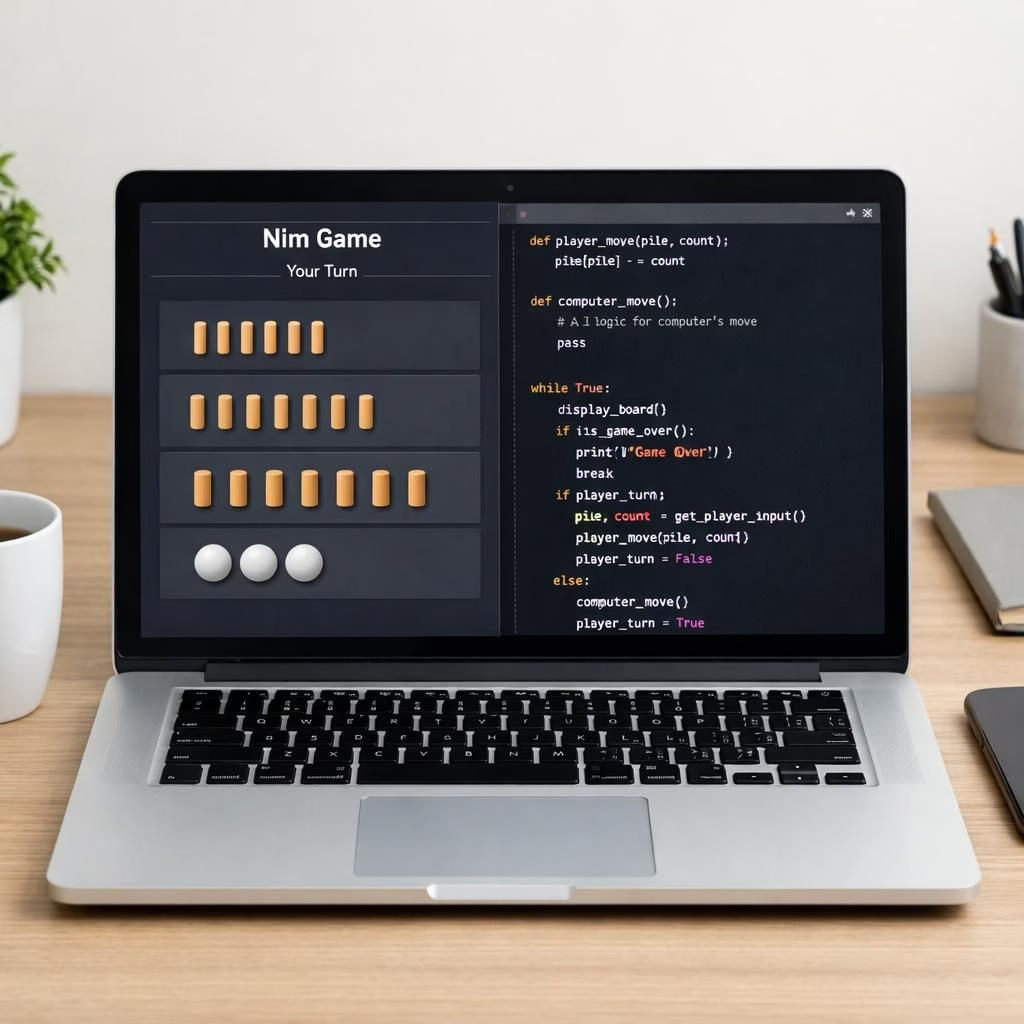
In 2026 the AI game-playing scene is buzzing as Nim boards meet AlphaZero-style self-play. Researchers poke at where these systems stumble. They ask what Nim teaches about strategy, learning speed, and the quirks of search. The punchline is simple. AI game-playing is clever but Nim still exposes gaps that even modern RL can’t close.
If you read between the lines, you’ll see a common thread. Small, well-defined tasks reveal big cracks in general intelligence. Especially when agents push into self-play and look for shortcuts rather than understanding the rule-set.
AI game-playing: What Nim reveals in 2026
Nim is tiny but brutal for testing game-playing. It reduces big ideas to clean rules and a few piles. When an Nim-driven agent tackles Nim, it learns fast but sometimes ignores obvious paths. The results show AI game-playing can improvise clever moves yet miss basic patterns. This is not a failure of intelligence, but a reminder that self-play can drift into overfitting to prior games. In practice, engineers must inspect the search process, not just the final move. Nim acts as a weather vane. It signals when the compass of a learning agent spins in too many directions. Researchers test many Nim variants to see if a strategy generalizes across piles and moves. The lesson for AI game-playing is simple: elegance in a dozen moves does not guarantee robustness in a dozen games. Nim offers a sandbox where researchers uncover how shortcuts creep into learning.
Nim patterns help explain AI game-playing limits
Beyond Nim, the same patterns show up in other simple games. The AI game-playing toolkit often relies on self-play as a primary teacher. This works well for broad strategy search but can miss edge cases that humans would spot quickly. Nim teaches caution. A clever variant can render a trained agent ineffective. It expects a familiar shape of the board. In practical terms, teams add diverse testbeds. They also use targeted adversaries and randomization to keep the agent honest. The Nim lens helps engineers tune exploration rates, constraints, and win conditions. When the agent encounters an unexpected rule, it should pause. It should reassess rather than push a familiar pattern. The result is safer Nim-driven AI game-playing with fewer surprising blind spots. For researchers and developers, Nim is a gentle mentor. It reminds us to favor explainability over sheer performance on a single benchmark. The broader goal is robust, reliable Nim-driven AI game-playing that can handle both Nim-like puzzles and real-world tasks.
Looking ahead, the field will continue to balance speed with scrutiny. The nim-like tests will keep exposing blind spots even as models grow bigger. If you enjoy tinkering, try a Nim variant and watch how an agent responds. You may notice the same small cues that trip up a system. The same small wins teach it to adapt. Share your thoughts in the comments with any Nim-inspired insights or AI game-playing experiences. And as always, we acknowledge the ongoing work of researchers across institutions who help us understand these quirks.
Original material and inspiration: Figuring out why AIs get flummoxed by some games — thank you to Ars Technica for the original piece.
Practical Nim tests for AI game-playing robustness
- Start with a Nim variant with one pile, then add piles to test how the agent scales its strategy.
- Vary pile sizes and starting positions to check whether the agent relies on memorized patterns or adapts to new rules.
- Introduce random adversaries and alternate win conditions to keep the agent honest and curious. Nim keeps the test honest by revealing blind spots.
FAQ: AI game-playing and Nim
- What makes Nim a useful sandbox for AI? It is small, deterministic, and unforgiving. It exposes gaps in search, generalization, and pattern recognition without huge complexity.
- Why does self-play sometimes backfire? It can overfit to prior games and miss edge cases humans would spot. That’s why diverse tests and adversaries matter. Nim helps you see those gaps clearly.
- How should teams use Nim in practice? Use Nim as a stepping stone alongside broader benchmarks. Pair self-play with explainability checks and targeted stress tests. Nim can guide where to probe next.
- What does this mean for real-world AI tasks? The lessons translate to any fast-paced decision task where rules are fixed but novelty exists. Prioritize robustness over peak score on a single task, and test with Nim-style variety.
For readers who want to dive deeper, the Ars Technica piece linked above provides the core context that inspired these reflections. The broader discussion includes findings from researchers at multiple institutions who study how simple games reveal the contours of general intelligence.
Conclusion
In short, AI game-playing keeps getting smarter, yet Nim reminds us that small rules can uncover big gaps. A healthy development cycle blends speed with careful scrutiny, varied testbeds, and a commitment to explainability. If you experiment with Nim variants, you’ll likely spot the same cues that trip up a system and the same prompts that guide it toward better generalization. Share your notes and Nim-inspired lessons in the comments, and stay tuned to ongoing AI research from diverse labs around the world. The point is not to abandon self-play, but to temper it with evaluation that stays honest under change.
References
- Figuring out why AIs get flummoxed by some games — Ars Technica
- AI’s game-playing still has flaws: AlphaZero-style self-play tested on Nim — Tech Xplore
- Queen Mary University of London — Research on AI game-playing limitations