

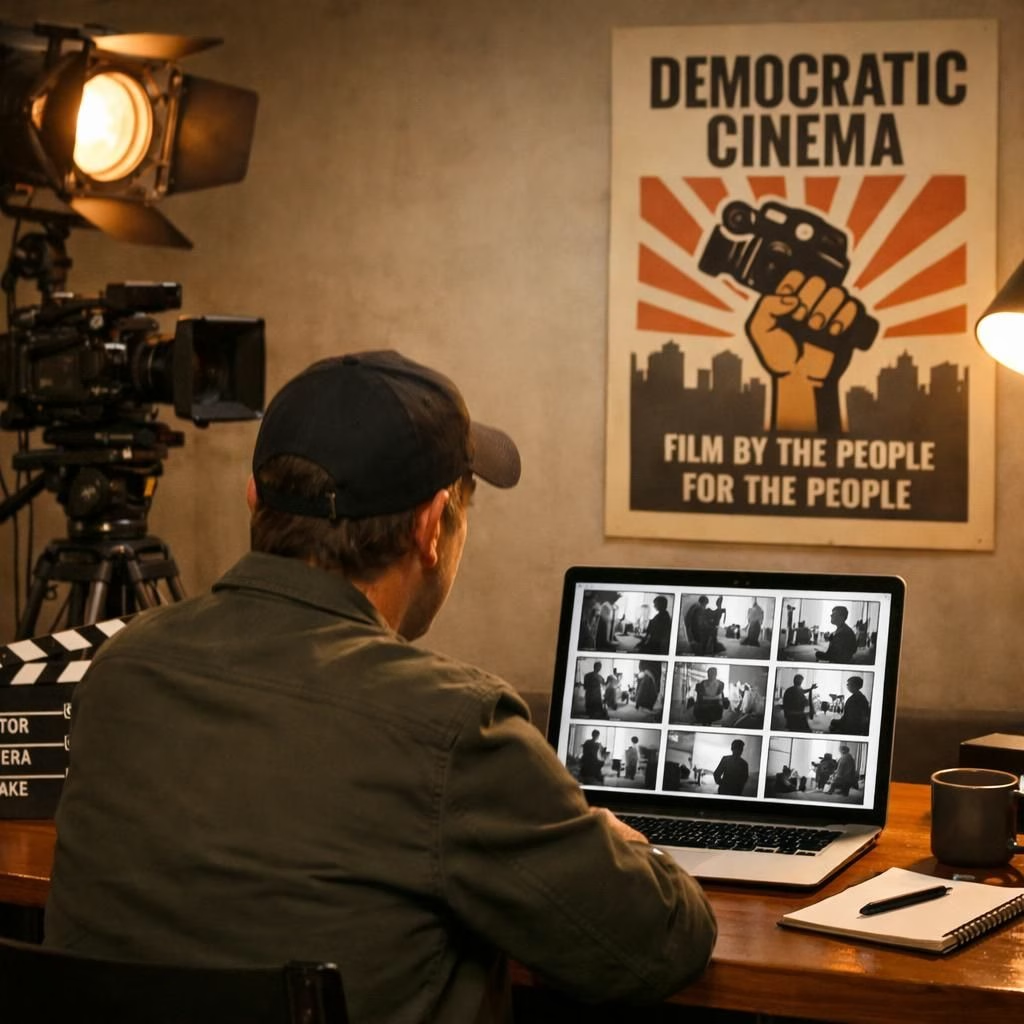
AI and filmmaking are shaping a quietly, surprisingly sunny shift in 2026. At the India AI Impact Summit 2026 at Bharat Mandapam, filmmaker Shekhar Kapur argued that AI will dramatically cut the cost of producing films, unlocking voices never funded before. He has already begun weaving AI tools into his own workflow, a pragmatic confession that many directors can relate to. The core truth is simple: cheaper tech lowers barriers, and that means more creativity in the pipeline. This is the kind of democratization story that makes industry insiders grin and reach for popcorn. AI can narrow the gap between budget and ambition, and that matters for audiences who crave new perspectives in filmmaking.
AI in Filmmaking: Democratizing Access in 2026
When the cost of entry falls, a wider chorus of voices enters the room. Kapur described AI as a ‘democratic’ technology that can reach streams of knowledge once locked behind elite institutions. In practice, this means new directors and writers can design, test, and iterate stories with AI-assisted tools. filmmaking teams can prototype scenes, study budgets, and map audience reactions with surprisingly little risk. The humor here is that the audience will enjoy more variety, not less polish, because AI is doing the heavy lifting on data and automation while humans steer the ship with taste and courage. AI is the accelerator, not the replacement, and that nuance matters to both teams and fans.
AI can add as much as a trillion dollars annually to India’s GDP by reshaping the wider economy and empowering talent from the bottom of the pyramid. Kapur framed the potential as a pipeline from the village to the silver screen — a bold claim, but a compelling one in 2026. The message is not to abandon craft, but to equip craft with better tools. AI enables the learning curve to be gentler and more inclusive, which means more stories from diverse communities will arrive on our screens.
AI Empowers Filmmaking Without Replacing Human Intuition
Yet Kapur cautioned that human intuition remains central. AI can do many tasks, but it cannot be intuitive in the way a seasoned director or actor can be. We still need a human touch to interpret emotion, culture, and context. The role of AI is to augment imagination, not to generate the final spine of a film. In practice, that means storytellers will use AI to brainstorm, organize shoots, and test narrative arcs while trusting the gut that guides tone and timing.
Think of AI as a co-pilot: it crunches numbers, suggests edits, and surfaces options we might not see. filmmaking remains a human craft, even as algorithms guide the process. The summit’s three pillars — People, Planet and Progress — underscore a broader ambition: use technology to serve people, protect the planet, and push progress forward. In this vision, AI helps us tell better stories that respect audiences and ecosystems alike. For broader context, you can explore How AI is changing filmmaking, which examines practical shifts in production and storytelling.
Beyond the high-level chatter, the event highlighted that the Global South can lead in practical AI adoption. The five-day summit organized around Sutras: People, Planet and Progress created a framework that blends policy, startup grit, and field experiments. The outcome is less hype and more usable tools for production houses of all sizes. AI and its kin can turn crowdfunding into real sets, and sample budgets into living roadmaps, if we keep the human element front and center.
In the end, the takeaway is hopeful: filmmaking can be more inclusive, creative, and efficient without stealing the magic of a good story. This isn’t a sci‑fi prophecy; it’s a plan with teeth for 2026, and perhaps beyond. Filmmaking will continue to rely on brave storytellers, sharp editors, and decisive directors who trust both data and instinct to craft experiences that resonate with diverse audiences.
As we close, a reminder that the summit was a milestone for a global south perspective. The Prime Minister Narendra Modi inaugurated the India AI Impact Expo 2026 at Bharat Mandapam, signaling intent to align AI solutions with domestic priorities and global challenges. The conversation is ongoing, and the road ahead blends policy, toolkits, and on‑set improvisation.
If this stirs ideas, share your thoughts in the comments below. Your voice helps steer the next wave of public discourse on AI in filmmaking.
Linkback attribution: Thanks to the original article for material and inspiration.
Practical steps to start using AI in your next filmmaking project
- Assess your goals: define what you want AI to accelerate—scripts, budgeting, shot planning, or postproduction.
- Choose the right tools: start with AI-assisted scripting, storyboard generation, and budgeting templates tailored to filmmaking workflows.
- Prototype early: run small pilots to test ideas and measure impact before committing to full-scale production.
- Preserve human touch: appoint a creative lead to guide tone, cultural context, and performance nuances.
FAQ: AI and filmmaking in 2026
- Is AI replacing filmmakers? No. The consensus is that AI augments human creativity, handling repetitive tasks and data-heavy work while storytellers steer emotional and cultural direction.
- What parts of production can AI help with? Script development, budgeting, shot planning, visual effects previews, and audience testing are common areas where AI adds speed and insight.
- Will AI drive down costs for independent filmmaking projects? It can reduce certain fixed costs and enable smaller teams to prototype more quickly, broadening access to new voices.
- What about ethics and authenticity? The aim is to use AI to empower creators without eroding authentic storytelling or exploiting cultural contexts; human oversight remains essential.
Conclusion: A hopeful direction
The headline takeaway is practical: AI can make filmmaking more inclusive, creative, and efficient without removing the magic of a good story. The approach is not fantasy but a concrete plan for 2026 and beyond, rooted in brave storytellers who blend data with instinct.
References
- LiveMint article that inspired this piece: Original source