

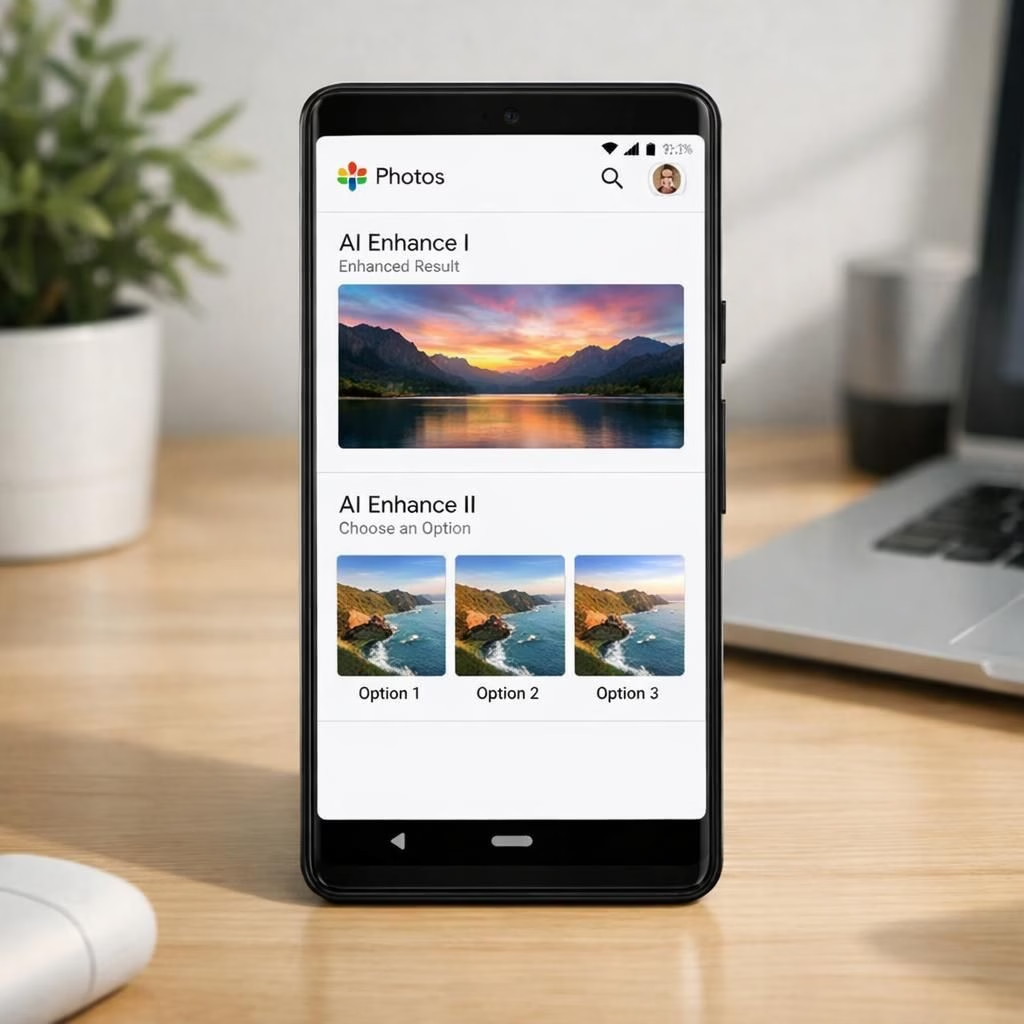
Pixel owners, meet a friendlier AI Edit. In 2026, AI Enhance inside Tag B is getting a small but telling tweak. The Pixel-exclusive tool that automatically adjusts composition, lighting, and color is being split into two variants. The take: AI Enhance I will generate a single, best edit, while AI Enhance II will offer multiple output options. The change aims to reduce choice fatigue and ease server load, all without sacrificing the magic of automated retouching. This is based on APK teardown findings for Google Photos version 7.69.0 and is currently limited to a test group, with no official confirmation yet.
AI Enhance I vs II on Google Photos: Pixel UX in 2026
In plain terms, Tag B is testing two flavors of AI Enhance on Pixel devices. AI Enhance I is the solitary star; AI Enhance II acts like a small orchestra of edits. Previously, the tool could generate three versions; now the math changes to one tool with an optional second track. The aim is to reduce decision fatigue and lighten server load. Observers note that the change arises from the APK teardown of version 7.69.0.890655694. This is currently limited to a small test group, with no official confirmation yet. The split reflects Google’s ongoing curiosity about how people interact with automated edits on Pixel hardware, not a dramatic overhaul of the underlying engine.
What AI Enhance I means for speed and accuracy
The smaller, single-path option gives a quick, definitive edit as a default. For fast sharing or archiving, that can feel especially helpful. The trade-off is that there’s less built-in room for exploring alternatives on the spot, which suits users who value speed over variety. Importantly, the two variants still share the same core controls and order of edits, keeping the experience familiar for Pixel fans.
Google Photos and AI Enhance: a calmer, more focused auto-edit experience
The rationale behind the split is plain psychology. Too many outputs can stall even decisive editors, so fewer choices can speed up decisions and improve perceived results. For fans of Tag B who rely on automated tone tweaks and quick fixes, this approach feels like a thoughtful refinement rather than a radical change. The two variants keep the core edits consistent—composition, lighting, color—so the look remains recognizable while the interaction becomes more streamlined. Pixel-exclusive features like this illustrate Google’s strategy: tailor high-impact tools to the device’s strengths and keep the rest quietly backstage.
From a user-experience perspective, AI Enhance I is a welcome simplification. It offers a single, definitive edit as a default path, which can be perfect for social sharing or quick archival. AI Enhance II preserves the safety net of multiple outcomes, allowing a bit of experimentation if you’re in the mood for mood lighting or a different color balance. The tension between singular precision and optional variety mirrors broader design debates in mobile apps: simplify for speed, offer choice for customization. The fact that both variants apply edits in a similar way helps maintain consistency across the user’s photo library, reducing surprise when you tap the Save button.
Technically speaking, the APK teardown of Google Photos version 7.69.0.890655694 reveals the two variants share most of their editing logic. The edits are applied in the same order and with the same controls, differing mainly in output count. The single-path AI Enhance I still renders a high-quality edit, while AI Enhance II presents several thumbnails or options, depending on the current UI flow. That means the user interface remains familiar, which lowers the learning curve for Pixel users who already trust Tag B to take care of routine adjustments. In practice, the look of the edits remains consistent, even as the presentation adapts to one or multiple outputs.
From a systems perspective, the goal is to balance demand on Google’s servers with the value users place on fast results. The design seems to assume that fewer outputs will reduce network chatter and processing time per edit, thereby improving the experience on mobile devices and variable connections. Early observations, however, suggest that producing a single image does not dramatically cut processing time compared with generating three versions. This means the real advantage lies in perceived speed and cognitive load, not raw wall-clock time. In other words, the change might feel faster or smoother, even if the milliseconds saved aren’t dramatic, which is often enough to influence user satisfaction over many edits.
For Pixel enthusiasts, this Pixel-exclusive experiment fits into a broader pattern: Google tests incremental changes in a controlled way, learns from how users respond, and then adjusts. The two-variant approach provides a natural experiment to measure whether people prefer the certainty of one output or the possibility of multiple options. It also gives Google data about how demand for options correlates with the speed of sharing a finished image. In practice, some editors will love the one-shot AI Enhance I; others will savor the variety offered by AI Enhance II. Either way, the core magic of automated retouching remains intact, sharing a common DNA with the firmware-level optimizations that Pixel devices have long enjoyed.
Another angle worth noting is the testing scope. The feature is in early stages, and Google has not officially confirmed any rollout plans. The testing group is intentionally small, which is typical for AI feature experiments that balance product stability with real-world usage data. This is not a global launch; it’s a careful probe into what Tag B users actually want when a camera-ready brain Thinks for them. The absence of a formal announcement means we should not assume a broad deployment is imminent, even as the signs on the APK point toward a careful and measured evolution of Google Photos’ AI editing capabilities.
For writers and researchers, this update is a fascinating case study in how user control, automation, and hardware-specific optimization intersect in mobile photography. It highlights how a single feature—AI Enhance—can be reframed not as a bigger toolbox but as a smarter, more navigable set of choices. The human factor, not just the machine, remains central: fewer choices can lead to faster decisions and, often, more confident edits. Yet the option for diversity persists, preserving a safety net for those who want to explore alternative moods or color stories without leaving the app.
If you’re curious about the practical implications, consider trying Pixel updates with caution when they roll out to your device. The UX tradeoffs will become clearer as more users encounter the two variants in real life. Will AI Enhance I’s simplicity win hearts, or will AI Enhance II’s versatility win more converts? Time—and your feedback—will tell.
In conclusion, this Pixel-exclusive experiment showcases Google Photos’ willingness to adapt editing workflows to user preferences and device capabilities. The split between AI Enhance I and AI Enhance II is a thoughtful nudge toward faster decisions for some and richer exploration for others. Whether you care most about speed, variety, or both, the evolution of AI-powered editing is likely to continue shaping how we approach everyday photography on Pixel devices in 2026.
We invite you to share your thoughts in the comments. Your experiences with Tag B on Google Photos can help others decide how to approach automated editing on Pixel devices.
Special thanks to Android Authority for the original reporting on Google Photos’ Pixel-exclusive AI Enhance updates. Read the original article here: Android Authority original article.
Image credit and prompt attribution: See the image prompt below for a realistic, simple depiction of how this feature looks in the app.
Original article basis and attribution: Thanks to Android Authority for the initial reporting that spurred this discussion on AI Enhance and Google Photos. We appreciate the thorough teardown that sparked broader conversation about Pixel-exclusive edits and the two-variant approach.